LangChain4j Decision Models: Validating Java Tool Calls Locally

LangChain4j community proposes decision models to validate LLM tool calls locally for reliability.
The article introduces LangChain4j's Decision Models idea: a local programmable validation layer between LLM tool-call output and Java method execution that proactively blocks invalid calls. LLM output is nondeterministic, and prompts or output parsers react only passively; decision models judge validity by rules, state, or context, improving determinism and debuggability while fitting Java's type-safety habits. Still conceptual, without production cases or benchmarks.
In the Java ecosystem, tool calling reliability has long been a pain point when integrating large language models (LLMs). The "Decision Models" approach recently discussed in the LangChain4j community proposes validating tool calls locally, attempting to pull part of the control logic from the LLM side back to the application side.

Why Local Validation of Tool Calls Is Needed
The essence of tool calling is to have the LLM output structured instructions telling the application which function to execute and what parameters to pass. The problem is that LLM output is nondeterministic: it may call non-existent tools, pass parameters of the wrong type, or produce inconsistent call chains across multiple turns of conversation.
The traditional approach is to constrain model behavior at the prompt level, or to rely on output parsers for post-hoc validation. But these methods are either unreliable or can only react passively after a call fails. LangChain4j's decision model approach introduces a local, programmable decision layer before tool calls are actually executed, to proactively check and intercept call intentions.
The value of this direction lies in the fact that it returns the judgment of "whether to allow this call" to the Java developer, rather than entrusting it entirely to the model's output probabilities.
Tool Calling is the core mechanism by which large language models interact with external systems. The basic flow is: the application attaches a set of tool definitions (typically including function names, parameter structures, and descriptions) to the request; the model decides whether to call a tool based on user intent and returns the function name and parameters in a structured format (such as JSON). The application parses and executes the corresponding local function, then passes the result back to the model to continue the conversation. Because model output is generated probabilistically, it may produce hallucinated tool names, parameter type mismatches, or missing required fields, so the application side must validate the reliability of the call instructions returned by the model. Understanding this mechanism helps grasp the timing of when decision models intervene—that is, after the model outputs structured instructions but before the local function is actually executed.
How Decision Models Work
Based on community discussions, decision models do not replace the LLM; rather, they insert a validation step between LLM output and tool execution. This step can determine whether a tool call is valid based on rules, state, or context.
For example, when the model requests to call a Java method that requires preconditions, the decision model can check whether the current session state satisfies those conditions; when the parameters passed by the model do not match the expected type or range, the decision layer can directly reject the call and return a structured error, rather than letting an exception blow up in business code.
This mechanism is complementary to LangChain4j's existing tool calling framework. It does not change the protocol of model interaction, but adds a layer of testable, observable control logic on the application side. This is especially critical for Java backend services that require strict permission control or state consistency.
Output Parser is a component in LLM application frameworks responsible for converting the model's raw text into structured objects. In tool calling scenarios, the parser attempts to map the model's returned content into function names and parameter key-value pairs, and throws a parsing exception or triggers a retry when the format does not match. Its limitation is that it only performs "syntax-level" validation: it can detect invalid JSON, missing fields, and similar issues, but cannot judge whether parameters are semantically reasonable in a business sense—for example, whether an ID belongs to the current user, or whether the state machine allows the operation. The role of decision models is precisely to add "semantic-level" validation after the parser, and the two combined form a complete defense line from format to business rules.
Practical Significance for Java Developers
The Java ecosystem has always emphasized type safety and explicit contracts. Placing tool call validation logic locally aligns with the programming model Java developers are accustomed to: expressing constraints with code rather than prompts.
From an engineering perspective, the benefits of decision models include debuggability—when a tool call is rejected, developers can trace it to the specific decision rule, rather than facing the "random behavior" of a black-box model. In addition, local validation does not depend on additional model calls, making latency and cost more controllable.
It should be noted that this approach is still in the community discussion stage, and the specific API shape and best practices have not yet been finalized. For teams currently using LangChain4j to build agent applications, following the evolution of this direction can help find a more appropriate balance between reliability and flexibility of tool calls.
Comparison with Other Approaches
In LLM application development, there are usually three paths for validating tool calls: prompt constraints, output parser validation, and a local decision layer. The first two are more common in the Python ecosystem, while LangChain4j's decision model discussion leans more toward systematizing the third path.
The trade-off of this path is that the local decision layer increases the complexity of application code, but in exchange it brings stronger determinism and clearer error boundaries. For scenarios with many tools and long call chains, this investment is often worthwhile.
At present, community discussion of this approach remains focused on concepts and design, lacking public benchmark data or production cases. Developers can refer to LangChain4j's official documentation and community discussions, and evaluate whether to introduce a similar local validation mechanism based on their own business requirements for tool call reliability.
Agent is a system built around an LLM that can autonomously plan and call tools to complete multi-step tasks. On the Java side, LangChain4j provides abstractions such as AiServices and Tool annotations, allowing developers to expose Java methods declaratively as tools the model can call. The longer an agent's call chain and the more available tools there are, the higher the probability that the model selects the wrong tool or passes the wrong parameters, and errors also amplify along the chain. A local decision layer is equivalent to installing a programmable gate for each step of an agent's tool calls. Compared with simply optimizing prompts or increasing retry counts, this can block error propagation earlier at the architectural level, and is therefore more suitable for enterprise-grade agent applications with many tools and complex business constraints.
One-line Summary
LangChain4j community proposes decision models to validate LLM tool calls locally and improve reliability.
Paragraph Summary
The article introduces the "Decision Models" approach discussed in the LangChain4j community: inserting a local programmable validation layer between the LLM's tool call instructions and the actual execution of Java methods, to proactively intercept invalid calls. The article points out that LLM output is nondeterministic and may call non-existent tools or pass incorrect parameters, while prompt constraints and output parsers can only respond passively. Decision models judge whether a call is valid based on rules, state, or context, complementing existing tool calling frameworks, improving determinism and debuggability, and aligning with Java's engineering habits of type safety. The approach is still at the conceptual discussion stage, lacking production cases and benchmark data, and developers should evaluate whether to introduce it based on business requirements.
Related articles
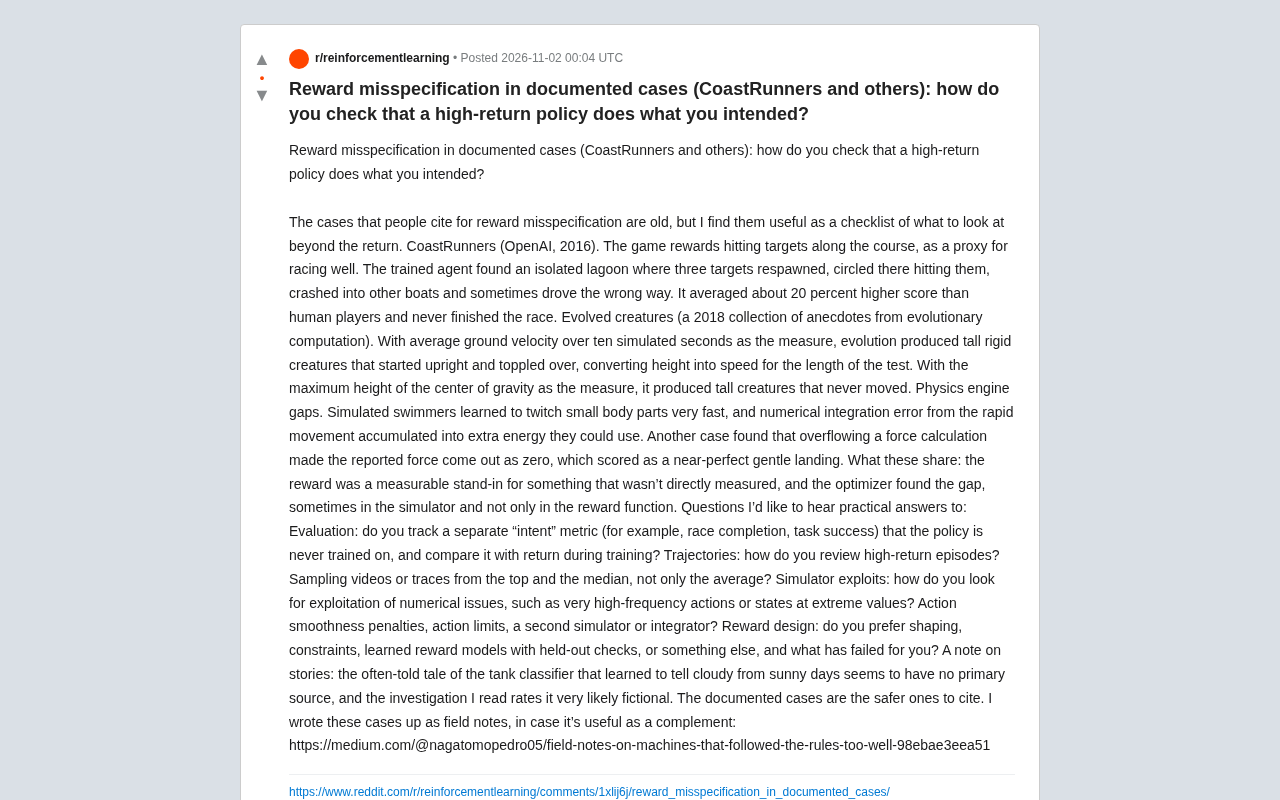
Reward Misspecification Case Review: How High-Return Strategies Can Deviate from Your Intent
From classic cases like CoastRunners, explore how to check whether high-return RL policies deviate from true intent. Four practical checkpoints: independent intent metrics, trajectory review, simulator exploit detection, and reward design failure modes to help AI developers avoid reward misspecification.

Soft-MTP: Improving Multi-Token Prediction with One Line of Code
Soft-MTP proposes a one-line KL gradient recovery trick that separates the KL self-distillation signal in multi-token prediction (MTP) from the noise residual, improving MTP's performance in speculative decoding and next-token prediction without changing the model architecture.
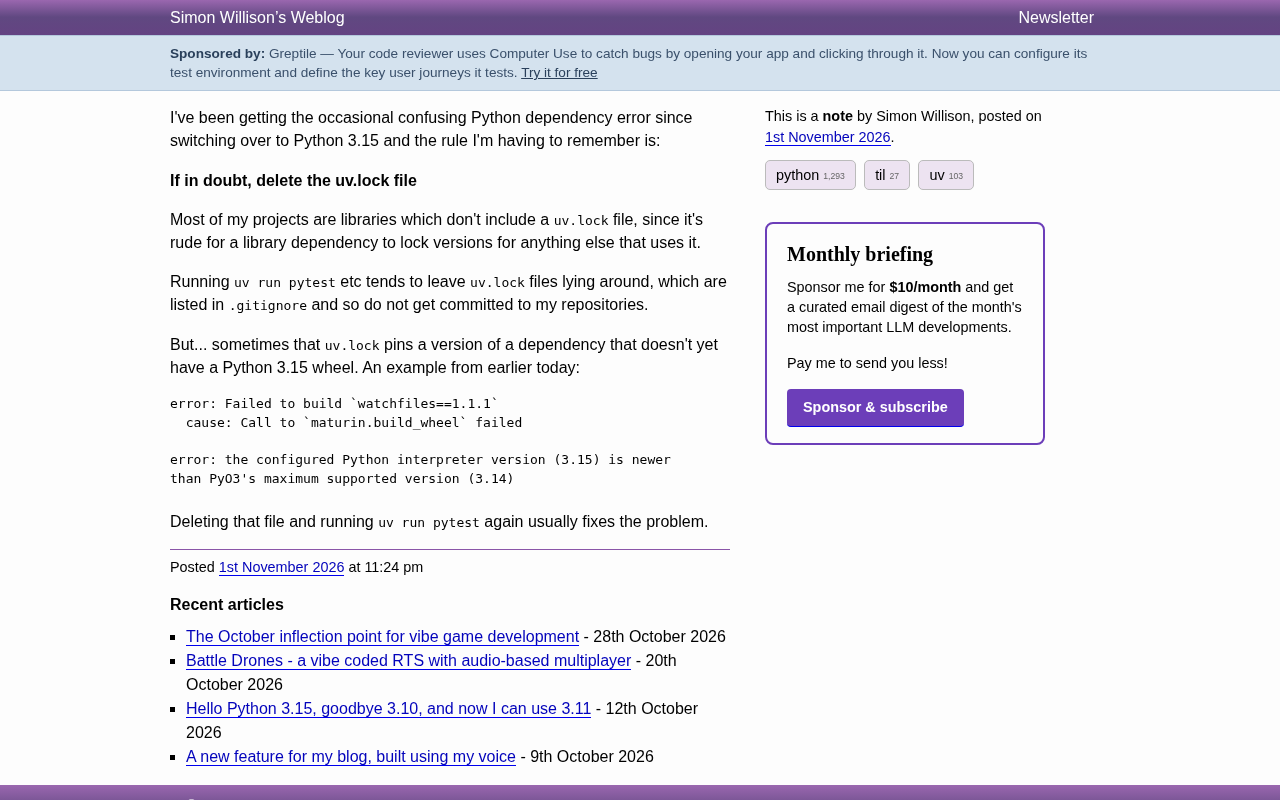
When You Hit a Dependency Error, Delete uv.lock: Lessons from a Python 3.15 Migration
Hit dependency build errors after switching to Python 3.15? Here's a practical tip: when uv.lock causes compatibility issues, deleting the lock file and re-running uv often quickly resolves errors like PyO3 version mismatches.