Langfuse Practical Guide: Core Capabilities and Boundaries of an AI Agent Observability Platform

A practical breakdown of Langfuse's four core capabilities and boundaries as an AI agent observability platform.
This article systematically analyzes Langfuse, an open-source LLMOps platform, covering its core capabilities: agent call-chain tracing, prompt version management with hot-rollback, token cost monitoring, and evaluation feedback collection. It clarifies what Langfuse can and cannot do, helping developers understand how to build production-grade AI observability solutions using this specialized platform.
As large model applications transition from demos to enterprise-grade production, an unavoidable question becomes increasingly prominent: after your AI agent goes live, what exactly is it doing? Which tools did it call? How many tokens did it consume? Are its answers accurate? Are users satisfied? The answers to these questions represent the core proposition that "observability" aims to solve. Based on a practical tutorial by instructor Xiaobin from Mashi Education's large model course on Bilibili, this article systematically breaks down the positioning, capability boundaries, and practical value of the open-source large model engineering platform Langfuse.
What Exactly Is Langfuse: Positioning as an Open-Source LLMOps Platform
According to its official definition, Langfuse is an open-source LLMOps platform for large models. But from this sentence alone, it's hard to understand its true value. A more accurate description is: it's an open-source AI Engineer platform designed for large model, RAG, and agent applications.
To understand Langfuse's positioning, you first need to understand the concept of LLMOps. LLMOps (Large Language Model Operations) is the evolution of MLOps in the era of large language models. Traditional MLOps focuses on the full lifecycle management of model training, deployment, and monitoring, while LLMOps provides specialized engineering support for the unique characteristics of large model applications—such as prompt engineering, context window management, token cost control, and hallucination detection. As models like GPT-4 and Claude are widely integrated into enterprise applications, the LLMOps toolchain is rapidly maturing, forming a complete ecosystem that includes observability (Langfuse, LangSmith), gateway proxies (LiteLLM), evaluation frameworks (RAGAS, DeepEval), and more.
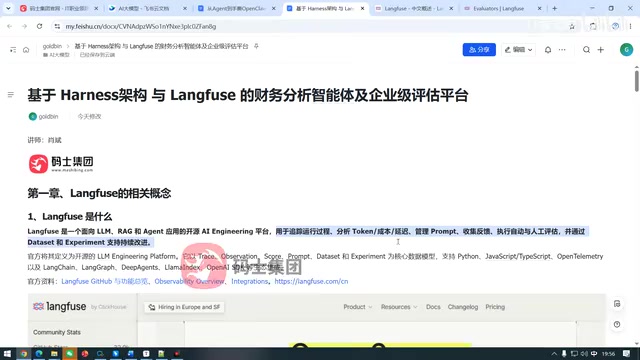
Its core functions can be summarized as: tracing runtime processes, analyzing token costs and latency, managing prompts, collecting feedback, performing automated and manual evaluation annotations, and enabling continuous improvement through Datasets and Experiments.
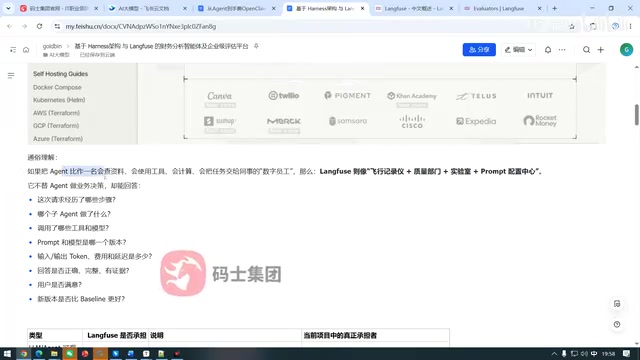
There's a key distinction that needs to be clarified here: Langfuse is a "platform," not a "development framework." We typically don't use Langfuse to develop AI applications. Instead, we install its self-hosted service directly, then integrate this service with our own large models, RAG projects, and agent projects to enable log tracing, evaluation, and a series of other operations.
In terms of the technology stack, Langfuse's top-level language support includes Python and TypeScript/JavaScript, and it achieves seamless integration with mainstream agent development frameworks such as LangChain, LangGraph, DeepAgent, LlamaIndex, and OpenAI Agent SDK. Current mainstream agent development frameworks each have their own focus: LangChain provides modular chain-call abstractions, LangGraph supports stateful multi-step workflow orchestration, LlamaIndex specializes in data indexing and retrieval, and OpenAI Agent SDK offers native tool-calling and multi-agent collaboration capabilities. Langfuse integrates with these frameworks through Callback mechanisms or Decorator patterns, automatically capturing the input/output, duration, and token statistics of each LLM call without invading business logic. This non-intrusive design philosophy allows developers to introduce observability at any stage of a project without refactoring existing code.
An Intuitive Analogy: Understanding Langfuse's Role
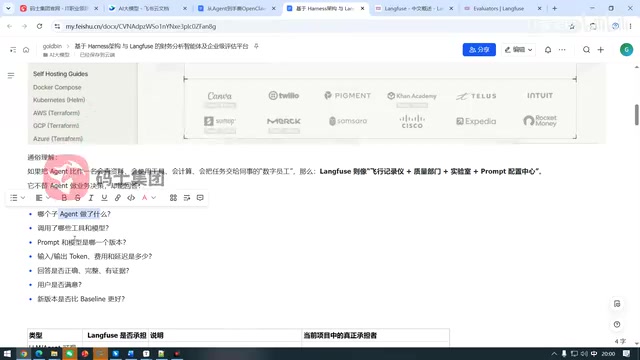
The instructor used a very vivid metaphor to illustrate Langfuse's role. If you think of an Agent as a "digital AI employee" that can look up information, use tools, and perform calculations, then Langfuse is essentially this employee's:
- Flight recorder: Comprehensively tracking every action of the AI digital employee
- Quality department: Evaluating the quality of generated answers
- Laboratory: After modifying prompts or switching models, running tests in the lab first to see the results
- Prompt configuration center: Centrally managing and version-controlling prompts
This analogy precisely encapsulates the positioning of Langfuse's four core capabilities.
Why Observability Is So Critical in AI Systems
Observability originates from control theory. In traditional software engineering, it's typically composed of three pillars: Logs, Metrics, and Traces. However, in large model applications, observability faces entirely new challenges: model outputs are non-deterministic—the same input may produce different outputs; agent decision paths are dynamic, and call chains cannot be determined at compile time; token consumption is directly tied to cost, and pricing differs enormously across models. Therefore, LLM observability must not only record "what happened" but also answer "why it responded this way" and "whether this response is good enough." This is precisely what distinguishes Langfuse from traditional APM (Application Performance Monitoring) tools.
Why Prompts Need a "Configuration Center" for Version Management
Many developers wonder: isn't it perfectly fine to write prompts directly in project code? Why manage them separately in Langfuse?
This is precisely the most easily overlooked pain point in enterprise-level development. The instructor raised a sharp question: Will your prompts be modified during runtime? After modification, could the results actually get worse? The answer is—absolutely possible. No one can guarantee that modifying a prompt will necessarily improve results.
So the question becomes: if results deteriorate, can you quickly roll back? Can you switch versions without restarting the RAG project or agent project?
If prompts are hard-coded in the codebase, this is nearly impossible to achieve. Langfuse's Prompt management feature solves exactly this problem—it provides version management and hot-rollback capabilities for prompts, making prompt iteration controllable and traceable.
From an engineering practice perspective, in enterprise AI applications, prompts occupy a position similar to a hybrid of configuration files and business logic in traditional software. A seemingly minor wording change—such as changing "please answer briefly" to "please analyze in detail"—can cause dramatic changes in output quality, token consumption, and response latency. Traditional code version control (like Git) can record prompt changes, but cannot associate a specific prompt version with its actual effects (accuracy, user satisfaction). Langfuse's prompt management connects version control with effect tracking, enabling A/B testing-level prompt iteration management. The support for hot-rollback means prompt versions can be switched without redeploying the service. This is why the value of a prompt configuration center is often severely underestimated in real enterprise scenarios.
What Key Questions About Agent Runtime Can Langfuse Answer
The essence of observability is making originally "black-box" AI applications transparent and queryable. After integrating Langfuse, you can clearly answer the following questions:
- What steps did this request go through?
- Which sub-agent did what? What tools and models were called?
- How long did each tool and model take to execute?
- Which version of prompts and models were used?
- What are the input/output token statistics, cost statistics, and latency?
- Was the answer correct? Is there comprehensive accuracy data?
- Is the user satisfied (through user annotations)?
- Is the new version better than the current stable version?
Using RAG systems as an example, the observability requirements are particularly prominent. RAG (Retrieval-Augmented Generation) reduces model hallucinations by retrieving relevant documents before generation. But debugging RAG systems is extremely difficult: the retrieval stage might recall irrelevant document chunks, re-ranking might change the priority of key information, and the generation stage might ignore the retrieved context. Without observability tools, when facing an incorrect answer, developers cannot determine whether the problem lies in the retrieval stage, context assembly stage, or generation stage. Langfuse's trace tracking capability allows developers to decompose each step of the RAG pipeline layer by layer, pinpointing quality bottlenecks.
Regarding token and cost monitoring, this point deserves special elaboration. Large model API billing typically charges separately for input and output tokens, and unit prices between different models can differ by a hundredfold (e.g., GPT-4o vs. GPT-4o-mini). In complex agent applications, a single user request might trigger multiple rounds of model calls—including intent recognition, tool selection, parameter extraction, result summarization—with cumulative token consumption far exceeding a single conversation. If the agent also involves long-context retrieval or multi-turn conversation memory, token costs can grow exponentially. Langfuse's cost statistics feature helps teams identify token consumption hotspots, providing data support for model selection, context trimming, and caching strategies.
The last point is particularly important. Langfuse's "laboratory" capability allows developers to test effects in an experimental environment after modifying prompts or switching models. If the new version performs better than the currently running stable version, then the replacement is made. This data-driven iterative approach avoids the blindness of "changing prompts on a whim."
Defining Langfuse's Capability Boundaries: What It Can and Cannot Do
Understanding a tool requires knowing both what it can do and what it cannot do. The instructor specifically used a table to clarify Langfuse's boundaries.
What Langfuse Can Do
- Provide observability for large models, RAG, and agents—recording complete call chains of models, tools, retrieval, and sub-agents
- Evaluation and feedback collection
- Prompt management (including version control and hot-rollback)
- Metrics analysis (token consumption, cost statistics, latency monitoring, etc.)
What Langfuse Cannot Do
- Does not provide a development framework for agents themselves
- Does not provide large models themselves
- Does not provide vector knowledge bases (you need to build your own vector database)
- Is not responsible for server operations, monitoring, and health checks after agents or RAG go live
Simply put, Langfuse focuses on four things: "observation, evaluation, prompt management, and metrics analysis." It doesn't replace agent frameworks for business decisions, nor does it take on the operational responsibilities of underlying infrastructure. This clear positioning is precisely its advantage as a specialized observability tool.
It's worth mentioning that Langfuse's tracing capability is not limited to self-developed agents. The instructor pointed out that tools like Claude Code and Codex are themselves agents and can equally be connected to Langfuse for log tracing, token analysis, and cost/latency analysis. This greatly expands its application scenarios.
Summary: Langfuse's Core Value in Agent Engineering
As large model applications gradually enter enterprise production environments, "being able to develop" is no longer the only threshold. "Being able to observe, evaluate, and continuously optimize" is becoming the dividing line between toy projects and engineered products.
As an open-source LLMOps platform, Langfuse fills a critical gap in agent trace tracking and evaluation monitoring. Its seamless integration with mainstream development frameworks, prompt version management with hot-rollback, and laboratory-driven iteration approach are all indispensable components of enterprise AI application observability solutions. For developers building production-grade agents, mastering LLMOps tools like Langfuse is shifting from a "nice-to-have" to a "must-have."
Related articles

Alguard: Building a Dual-Layer Trust Defense for AI Agent Shopping
Alguard, an Amazon Developer Hackathon project, designs a dual-layer trust architecture for Alexa+ agent shopping. Through physical isolation between an MCP server and a human approval channel, it replaces prompt defenses with structural constraints to block unauthorized purchases caused by prompt injection.

Food Poisoning: Causes, Symptoms, Treatment, and Prevention Explained
Food poisoning is caused by bacteria, viruses, parasites, or toxins contaminating food, with common symptoms including vomiting, diarrhea, and dehydration. This article explains the causes, symptoms, treatment, and prevention of food poisoning to help you safeguard food safety.

Meta Uses LLMs to Make Facebook Feed Customizable
Meta launches LLM-powered algorithm personalization for Facebook and Reels, letting users manage interests via menu and customize feed with a text box.