LangGraph in Production: Five Years of Hard-Won Agent Architecture Experience

Five years of Agent architecture lessons: why LangGraph's real value is making implicit flow explicit and maintainable.
A developer who has been building AI assistants since ChatGPT's public beta shared five years of Agent architecture experience on Reddit and open-sourced a production-grade reference project. His early "intent classifier + conditional tree" architecture became a maintenance nightmare as the system grew. After realizing he needed a state machine but abandoning a self-built solution, he found the answer in LangGraph. His core insight: LangGraph's value isn't its feature list — it's turning hidden logic into an explicit, team-maintainable flowchart. The project supports both real LLMs and scripted models, and is paired with a blog series addressing a near-total gap in production-level Agent content.
From Hand-Rolled State Machines to LangGraph
A developer who has been building real-time AI assistants since ChatGPT's public beta recently shared five years of experience refining Agent architecture on Reddit, along with an open-source production-grade reference project — agent-graph-engineering. His story will resonate deeply with anyone building complex conversational systems on top of LLMs.
This developer originally served the financial advisory space, which eventually evolved into a full platform. His early architecture was a classic "intent classifier + conditional tree": a classifier routed user input into a decision tree made entirely of if-else branches. Every new use case meant grafting on another branch. The problems were predictable — this tree existed only in the code and in his own head, and the flowcharts he maintained "were out of date within a week."
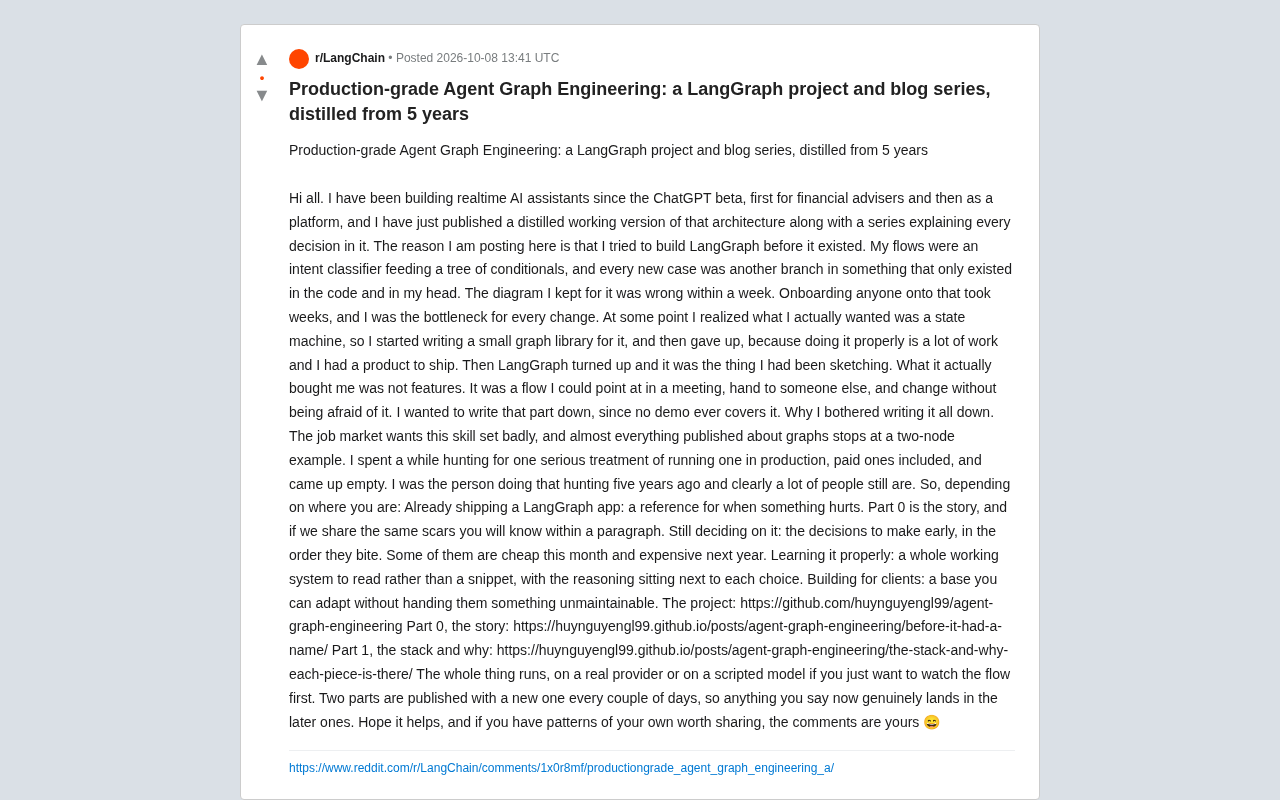
Even more damaging was the collaboration cost. Onboarding any new team member took weeks, and he became the sole bottleneck for every change. After repeatedly hitting the same walls, he realized what he actually needed was a state machine. He started building a small graph library — then gave up, because "doing it right would take a lot of work, and I had a product to ship." When LangGraph came along, it was exactly the thing he had wanted to build but never did.
A state machine is a computational model that represents system behavior as "states + transition rules." In conversational systems, each node represents a dialogue phase (e.g., "clarifying intent," "invoking a tool," "awaiting confirmation"), and edges represent the conditions that trigger transitions. Compared to if-else conditional trees, the key advantage of a state machine is that all possible states and transitions must be declared explicitly — there are no logic branches hiding inside deeply nested code. LangGraph implements this idea using a directed graph: each node is an executable piece of logic, and edges define data flow and conditional jumps. The entire workflow can both be executed by code and rendered directly as a flowchart by visualization tools, eliminating the perpetual mismatch between "the flow in the code" and "the flow in the docs."
LangGraph's Real Value Isn't Features
The most thought-provoking line in this post is: what LangGraph gave him was "not features, but a process I can point to in meetings, hand off to someone else, and change without being afraid."
That's a sharp observation. Many people evaluating Agent frameworks default to comparing feature checklists — node types, tool calling, memory management — but what actually determines success in production is often observability and maintainability. When an Agent workflow transforms from implicit logic buried in code into an explicit graph that the entire team can understand, collaboration efficiency and confidence to iterate change dramatically.
In other words, the significance of a graph structure isn't about "what it can do" — it's about "who can understand it, and who can safely change it." A conditional tree that exists only in its author's head is organizational technical debt, even if it's functionally complete. Making implicit state explicit is the critical leap from toy demo to production system.
Why Write This Series
The author is candid about the two motivations behind documenting these experiences.
The first is market demand. He observed that the job market is "hungry" for Agent graph engineering skills, yet almost every public tutorial "stops at a two-node example and goes no further." He spent a long time searching for material that seriously addressed "how to run this in production" — he went through paid content too — and came up empty.
The second is empathy. Five years ago, the person desperately searching for this kind of material was him. He knows there are still a large number of developers stuck at that same stage today. So he offers tiered recommendations based on where readers are:
- Already running LangGraph in production: Use it as a reference manual when you hit pain points. Part 0 is the story — "if we have the same scars, you'll recognize it in a paragraph."
- Still on the fence about adopting LangGraph: Decisions are listed in the order problems tend to surface. Some decisions are cheap this month and expensive next year.
- Serious about learning: A complete, runnable system to read through — not scattered fragments — with the reasoning behind each choice documented alongside it.
- Delivering for clients: A base framework that can be adapted without leaving clients with code they can't maintain.
A Reference Project That Actually Runs
One practical design choice in this project: the entire system can run against real LLM providers, or with a "scripted model" — if you just want to trace the flow without burning API credits. This is friendly for both learners and evaluators.
The companion blog series has two parts published so far:
- Part 0 — Before it had a name: The story of how he struggled before LangGraph existed.
- Part 1 — The stack and why each piece is there: A breakdown of the tech stack, explaining why each component exists.
The author says he'll publish a new post every few days, and specifically invites readers to share their own pain points and patterns in the comments — because "what you say now will genuinely shape the next few posts." This approach of writing while collecting feedback gives the series a collaborative, community-built quality.
A scripted model is a simulation technique used for testing and debugging: fixed, pre-written responses replace real LLM API calls. Its core value is decoupling "verifying the correctness of process logic" from "the non-determinism of model outputs" — developers can confirm that state transitions, tool call sequences, and error-handling paths behave as expected, without waiting on network requests or paying token costs each time. In a complex multi-node Agent system, a single complete run-through might involve a dozen model calls; scripted models can reduce debugging costs by one to two orders of magnitude. This practice has a direct counterpart in traditional software engineering — the Mock Object, where a controllable fake implementation replaces a real external dependency to enable deterministic testing.
Lessons for Practitioners
Setting aside the specific project, the lessons distilled from this post are worth keeping in mind for every Agent developer:
Don't try to brute-force complex conversation flows with conditional trees. When the number of branches grows to the point where you need to maintain a flowchart that's "always already out of date," it's time to consider an explicit graph or state machine structure. When evaluating frameworks, look at long-term maintainability and team collaboration costs — not just the feature list. Most importantly, many architectural decisions have a strong time dimension: making the right call early might cost you almost nothing, while correcting it later can be extremely expensive.
For teams moving from demo to production, hard-won insights written from experience — with the "scars" to prove it — will often help you avoid the real pitfalls far better than official documentation ever could.
Related articles

Why Does the Tesla Roadster Need to Fly? A Deep Dive into Musk's Wild Demo
Tesla's Roadster launch showed wall-climbing, upside-down driving, and flying stunts—but The Vergecast notes the demo car may lack a battery, the Rocket version is invite-only and not street-legal, and the website terms don't guarantee delivery. After nine years of delays, why does this car still need to exist?

AI Is Not a Replacement: Human-AI Collaboration Through the Lens of Factory Root Cause Analysis
Starting from factory root cause analysis, this article explains how AI accelerates evidence chain construction rather than replacing human experts, exploring the pragmatic implementation logic and business value of 'AI supporting people rather than replacing them.'

AI Agent Decision Auditing: Building an Evidence Chain in Regulated Workflows
Starting from a Reddit discussion, this article analyzes three core issues in AI agent decision auditing within regulated workflows: what fields audit records should contain, how to handle feedback latency for erroneous decisions, and how to continuously calibrate LLM judge consistency with human judgment.