LangGraph + MCP + Medical RAG: A Practical Introduction to Enterprise-Grade Multi-Agent Systems

A thinking-first course on building enterprise multi-agent systems with LangGraph, MCP, and medical RAG.
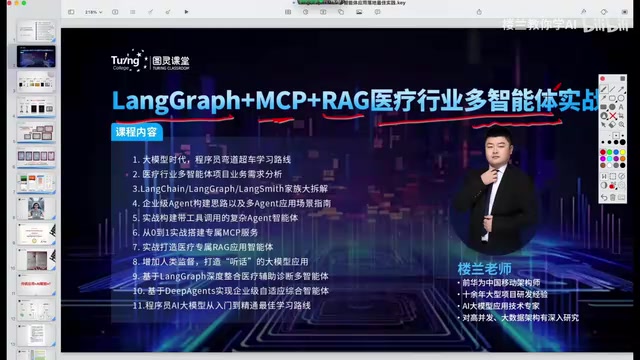
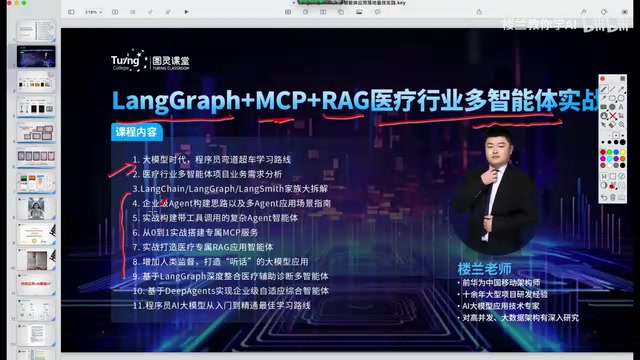
This article introduces instructor Loulan's Agent development course from Turing College, which argues that most tutorials fail learners by either overwhelming them with jargon or encouraging mindless code copying. Using a real healthcare multi-agent project built on LangChain, LangGraph, and MCP, the course teaches enterprise Agent development from requirements analysis to deployment — with an emphasis on building the right mental framework rather than chasing shortcuts.
Why Most Agent Tutorials Leave You Nowhere
Since large language models exploded in popularity, "Agent" has become one of the most overused buzzwords in tech. Whether or not someone has a technical background, conversations about deploying LLMs almost inevitably point in the same direction: build Agents. But in this hands-on course, instructor Loulan from Turing College pulls no punches — he argues that the vast majority of Agent tutorials on the market have two fatal flaws that leave learners unable to build anything on their own.
The first pitfall is putting the cart before the horse. Many tutorials open by piling on jargon — tool calling, task planning, memory mechanisms, ReAct framework — before learners have even formed a mental model of the whole picture. Beginners get lost in terminology before they've grasped the fundamentals, and many simply give up. The second pitfall is the obsession with shortcuts. The internet is flooded with "Learn Agents in 10 Minutes" and "Build an Agent in One Code Snippet" clickbait. Running through someone else's code only reproduces a finished product. Without understanding the underlying principles, without knowing how to debug or adapt to real business needs, this approach leaves you just as lost as when you started.
The right path into Agents is: understand the logic first, then work on real projects. Start by internalizing the core principles through intuitive examples, build a complete knowledge framework, and clarify your thinking — then gradually take on real-world development. Only this way can you walk the full journey from requirements analysis and solution design all the way to deployment.
The ReAct framework (Reasoning + Acting) is one of the most foundational paradigms in Agent design today, proposed by a Google Research team in 2022. The core idea is to have a large model alternate between "reasoning" and "acting" while executing a task: the model first thinks through the current state and its next intention, then calls an external tool to gather information, then reasons again based on the result — looping until the task is complete. This "think before you act, keep thinking as you act" pattern gives Agents the ability to handle complex, multi-step tasks, and it's a key theoretical foundation underlying frameworks like LangGraph. Understanding how ReAct works is a prerequisite for truly reading Agent code — not just running it.
Understanding Enterprise Multi-Agent Systems Through a Real Project
The best way to understand what Agents are capable of isn't to list concepts — it's to dissect a real project. This course centers on a multi-agent system for the healthcare industry — one that the instructor's team is actually delivering as a real client project.
On the technical side, the project uses a full modern toolchain: the LangChain and LangGraph ecosystem, plus protocols like MCP (Model Context Protocol). Multiple agents collaborate to handle task orchestration in a medical context. The teaching approach starts with industry analysis and project background — first explaining why this project is being built and what it should achieve — before introducing the technical implementation and finally moving into hands-on coding.
It's worth emphasizing: this is a course about thinking, not about copying code. The instructor is clear that all code will be shared, but the code itself isn't the point. The real goal is to help learners develop a mental framework for building enterprise Agents — to broaden their perspective so they know what dimensions to consider and what shape the final system should take.
LangChain is currently the most widely used framework for building LLM-powered applications. It provides standardized interfaces for working with LLMs, vector databases, and tool calling, dramatically reducing the complexity of building AI applications. LangGraph is a framework built on top of LangChain by the same team, designed specifically for multi-agent orchestration. Its core idea is to model an agent's workflow as a directed graph — nodes represent individual agents or processing steps, and edges represent transition conditions — enabling complex looping inference, conditional branching, and multi-agent collaboration.
MCP (Model Context Protocol) is an open protocol released by Anthropic in late 2024, designed to standardize how large models interact with external tools and data sources. Think of it like a USB standard for hardware — MCP aims to provide AI applications with a universal "plugin interface" so that tools, databases, and APIs from different vendors can all connect to models using the same protocol, eliminating the need to write custom adapter code for every project. In multi-agent scenarios, MCP helps standardize how context is passed between agents and between agents and external systems.
In the AI Era, the Value of Writing Code Is Declining
The instructor makes a provocative but honest observation: writing code is becoming less and less of a differentiator. This isn't a dismissal of technical skill — it's a clear-eyed read on how collaboration is changing in the AI era.

Today, with AI deeply involved in development, what humans actually need to do is control requirements, form mature and stable ideas, and communicate them clearly to AI. You can't just say "build me a multi-agent system for healthcare" and call it done — if you can't even articulate what you want, AI has nothing to work with. A human's value lies in knowing which dimensions to approach an enterprise-grade Agent from and what the final system should look like.
The instructor draws on his own career to back this up. He started in QA in 2008, spent over a decade in development, pivoted to big data research around 2015–2016, and began working on large models in 2023. He recalls the pain of setting up Java projects in the early days: you had to manually download Spring, Struts, and other JAR files from each vendor's website, drop them into the right directories, and wire up all the dependencies by hand. Now there's Maven, scaffolding tools — a few clicks and it's done. From a pure tooling perspective, we're in a golden era where the barrier to entry has never been lower.
The Gap Between Developers Is Usually About Perspective, Not Skill
The instructor offers a key insight about developer growth: many people lack confidence in their work not because their technical skills are weak, but because their perspective hasn't been opened up. Because they've seen so little, even after learning many frameworks, they don't know what those frameworks are capable of producing — they have no feel for the possibilities.

He emphasizes that career growth isn't purely a function of what you personally can do — it depends on what the industry can do and where you stand within it. At this stage of large model development, the baseline gap between people has narrowed. Whoever can better harness LLMs will cut down on the time spent going down dead ends and advance faster in their career.
To stand out from the crowd, technical skill alone isn't enough. You also need differentiating factors: solid hands-on project experience, soft skills, and industry certifications (the instructor himself is among the first cohort of Alibaba Cloud LLM ACP-certified experts). These elements combined are what make a real impression in job interviews.
On project experience, the instructor's advice is blunt: you have to build it yourself. Don't listen to the bloggers who say "memorize the standard interview questions and go apply" — there's a world of difference between someone who has actually built a project and someone who hasn't, and it shows immediately in how you talk and think during an interview. Even just walking through a full tutorial from scratch once will fundamentally change your understanding of your own strengths and weaknesses, and deepen your grasp of the technology involved.
Final Thoughts
The value proposition of this course is clear: a few hours isn't enough to cover every detail of a complete project, but it is enough to thoroughly explain the core thinking behind enterprise-grade multi-agent systems — and paired with supplemental materials, it gives learners everything they need to complete the full journey from zero to one on their own. In the age of large models, "how to think about technology and how to control requirements" is becoming more important than "how to write code." For developers looking to seriously enter the Agent space, a project-driven, thinking-first learning path offers far more long-term value than any shortcut tutorial that just walks you through copying code.
Related articles

Chain of Thought Isn't Just for AI: How Humans Can Use CoT to Improve Thinking Quality
Chain of Thought isn't just a prompt trick for large models. Starting from a Hacker News discussion, this article analyzes why CoT works for human thinking too, breaks down actionable ways to transfer it, and highlights the key differences between human CoT and machine CoT.
Cloudflare Teams Up with OpenAI: Closi…
Cloudflare Teams Up with OpenAI: Closing the Loop from Vulnerability Discovery to Defense with AI
Cloudflare uses OpenAI Daybreak to investigate security vulnerabilities and generate reviewable remediation plans, while developers use Codex to boost coding efficiency and quality.

Orca Multi-Agent Orchestration in Practice: A Guide to Parallel Collaboration with Claude and Codex
Orca is Stable AI's free open-source agent workbench supporting 34 agents like Claude Code and Codex in parallel. Learn its Git worktree isolation, multi-model orchestration, and mobile management.