LangGraph Production Template in Practice: A Complete Guide to Budget Control and Canary Routing

A production-grade LangGraph template with budget control, canary routing, and 800+ tests for shipping AI Agents safely.
langgraph-agent-stack is an MIT-licensed open-source template that bridges the gap between LangGraph demos and production deployments. It features per-run dollar budget circuit-breaking (returning HTTP 402 on overrun), canary traffic routing with sticky sessions, a Mock LLM mode for cost-free CI testing, and 800+ test cases across Python 3.12–3.14 — plus Docker, Helm, Prometheus, and Cosign-signed images with SBOMs.
From Notebook to Production: Bridging LangGraph's Deployment Gap
Most developers encounter LangGraph through examples that end with "here's a Graph running in a Notebook." LangGraph is a framework within the LangChain ecosystem for building stateful, multi-step Agents. Built on a directed acyclic graph (DAG) model, it lets developers orchestrate LLM calls, tool use, and conditional branching into reusable workflow nodes. Unlike simple chained calls, LangGraph supports loops, branching, and persistent state — making it well-suited for complex Agents that require multi-round reasoning. However, the framework itself focuses on logic orchestration and doesn't address the engineering infrastructure that production requires: cost control, traffic management, security scanning, and so on. That gap is precisely the root cause of the chasm between demo and production.
These demos are helpful for understanding concepts, but there's a significant gap between them and actually deploying an AI Agent to production — all the boring-but-critical engineering details: cost control, traffic routing, observability, test coverage, and security scanning.
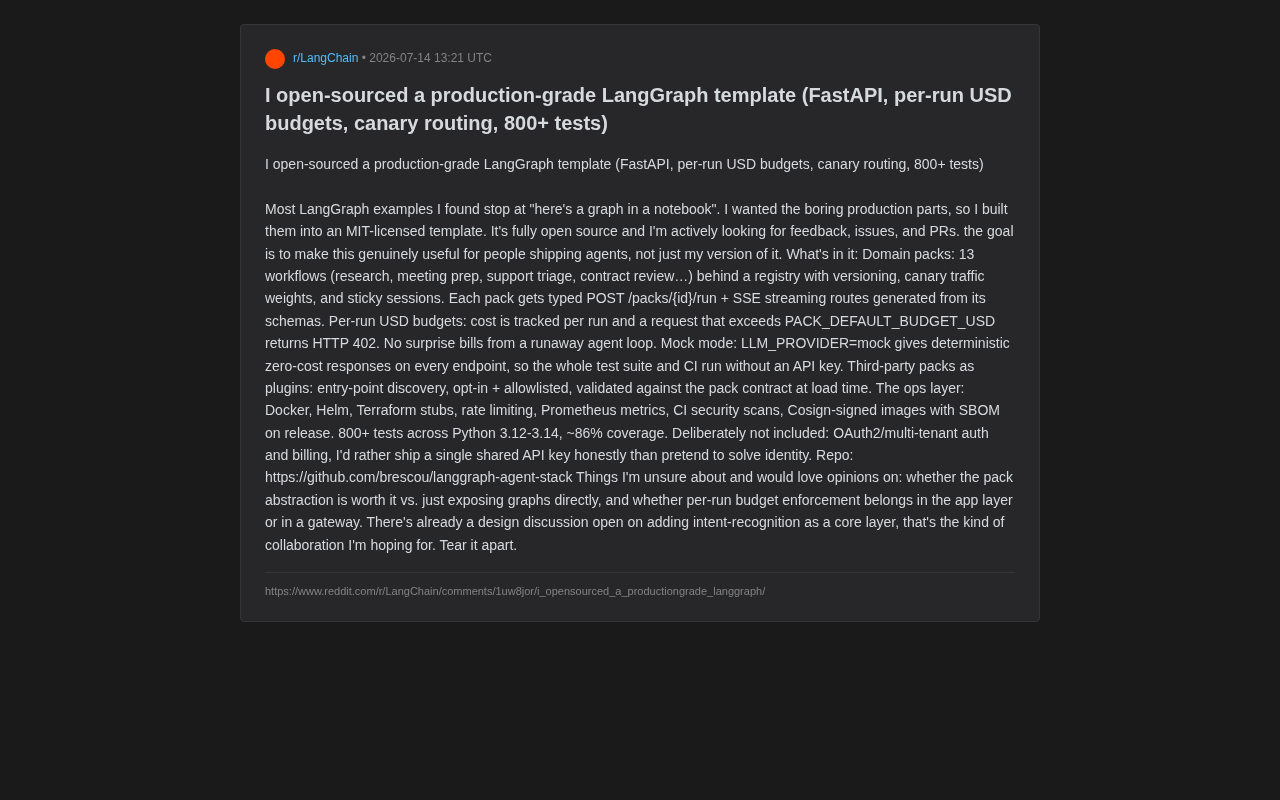
Recently, a developer open-sourced a MIT-licensed LangGraph production template on Reddit — langgraph-agent-stack — that systematically tackles these problems. The author is explicit that the goal isn't to showcase "my version" of things, but to refine it into a genuinely useful tool for teams that need to ship Agents, through community feedback, Issues, and PRs.
The project's positioning is telling: it's not another "how to build an Agent" tutorial, but rather a reference for how to safely and controllably bring an Agent to production.
Core Features: Modularizing Production Requirements
Domain Packs and Canary Routing
The template includes 13 built-in workflows covering common scenarios like research, meeting preparation, customer service ticket triage, and contract review. These workflows are packaged as "domain packs" and dispatched through a versioned registry.
The most noteworthy aspect of this abstraction is its ability to manage production traffic:
- Versioning: Each pack can have multiple versions running concurrently
- Canary traffic weights: A small percentage of traffic can be directed to a new version to validate its behavior before gradually increasing the rollout
- Sticky sessions: Ensures that consecutive requests from the same user hit the same version, preventing a fragmented experience
Canary traffic weights come from the Canary Deployment strategy — named after the historical practice of miners using canaries to detect toxic gases. In software engineering, this pattern routes a small percentage of real traffic (typically 1%–5%) to a new version, validating stability by observing error rates, latency, and other metrics before gradually expanding the rollout to 100%. Sticky sessions ensure that the same user is always routed to the same version during the canary period, preventing context loss or experience inconsistency due to version switching. Together, these two mechanisms form the core foundation of modern zero-downtime releases and are natively supported by mainstream infrastructure like Kubernetes Ingress, Nginx, and Istio.
Each domain pack automatically generates a typed POST /packs/{id}/run endpoint and SSE streaming response routes based on its schema. This "schema-driven route generation" design reduces the burden of writing boilerplate code and makes interface contracts clearer.
Per-Run Dollar Budget Control
This is one of the most practical designs in the entire project. The most anxiety-inducing risk with Agents is runaway loop calls causing API bills to skyrocket.
The template tracks costs on a per-run basis. Once a request's consumption exceeds the threshold set by PACK_DEFAULT_BUDGET_USD, the API immediately returns HTTP 402 (Payment Required). HTTP 402 is a status code reserved in RFC 7231 but rarely used historically — originally designed for future digital payment scenarios. In the AI Agent context, using it for budget-exceeded responses is an exceptionally semantically expressive engineering choice: it clearly distinguishes between "the request itself is malformed (400)" and "the request was rejected for economic reasons (402)." This "budget circuit breaker" design borrows from the Circuit Breaker pattern in microservices architecture, preventing a single runaway Agent call chain from triggering a cascade of cost explosions. Given that LLM APIs bill by token, Agent loop calls can very easily trigger unexpectedly large bills, making cost circuit-breaking a necessary safety net for production-grade Agents.
Developers can set a clear dollar ceiling for each Agent run, fundamentally guarding against unexpected costs from "runaway Agents." Treating cost as a first-class citizen and expressing it through standard HTTP status codes is an extremely pragmatic approach for production environments.
Mock Mode: Full Testing Without API Keys
By setting LLM_PROVIDER=mock, all endpoints return deterministic, zero-cost responses. This provides two immediate benefits:
- CI/CD requires no real API keys: The entire test suite can run in the pipeline without incurring any API costs
- Response determinism: Test results are stable and predictable, eliminating the interference that LLM randomness introduces into test workflows
LLM randomness (controlled by the Temperature parameter) is one of the core challenges in AI application testing. Even with Temperature set to 0, different model versions and server-side load balancing strategies can cause minor output variations, making idempotency hard to guarantee with real API-based tests. Mock mode decouples the LLM from test dependencies by returning preset deterministic responses, bringing Agent workflow testing back to the controllable state of traditional software testing — similar to the common practice of mocking databases or HTTP dependencies in backend development. In CI/CD pipelines, this also eliminates additional instability factors like network jitter, rate limits, and key management, significantly improving pipeline reliability and speed.
For team collaboration and continuous integration, this design substantially lowers the barrier to entry and reduces costs.
Pluggable Third-Party Packs
Third-party domain packs are integrated as plugins using an entry-point mechanism for automatic discovery. Python's Entry-Point mechanism (implemented via importlib.metadata) allows installed packages to register extension points with a host application without modifying the host's code — the standard approach for implementing plugin architectures in the Python ecosystem, widely used in pytest plugins, Flask extensions, and more. However, automatic discovery itself introduces supply chain security risks: malicious packages could hijack the system by registering an entry-point with the same name. Therefore, the template requires explicit opt-in and allowlist approval, and validates against the pack contract at load time. This three-layer design of "disabled by default, allowlist admission, and contract validation" aligns with recent best practices in Software Supply Chain Security — establishing an explicit trust boundary while enabling open extensibility, striking a reasonable balance between extensibility and security.
Complete Operations Layer and Testing Coverage
What truly demonstrates "production-grade" quality is the operational infrastructure bundled with this template:
- Deployment: Docker, Helm, and Terraform stubs all included
- Stability: Built-in rate limiting
- Observability: Prometheus metrics exposure
- Security: CI-stage security scanning, and images signed with Cosign with an attached SBOM (Software Bill of Materials) at release time
SBOM (Software Bill of Materials) is a structured manifest recording software components, dependencies, and their versions — analogous to an ingredient list in the food industry. After the 2021 U.S. Executive Order (EO 14028) made SBOMs a security requirement for federal software procurement, they rapidly became standard practice in enterprise software delivery. Cosign is the core tool of the Sigstore project; by writing image signature information to a transparency log (Rekor), it enables verifiable provenance tracing for container images. Together, they mean that images built with this template allow consumers to verify: "This image was indeed built by this project, and the exact versions of all its dependency components at build time are auditable." This is critical for passing security audits within enterprises and is a key threshold for moving from open-source tools to trusted enterprise deployments.
The test coverage is equally solid: 800+ test cases covering three Python versions from 3.12 to 3.14, with approximately 86% code coverage. This level of testing and multi-version coverage is uncommon in open-source Agent projects and reflects the author's commitment to engineering quality.
Intentional Trade-offs: Not Pretending to Solve Authentication
Commendably, the author has a clear-eyed understanding of the project's boundaries. He deliberately omitted OAuth2/multi-tenant authentication and billing features, with a candid rationale: rather than pretending to solve the complex problem of identity, it's better to honestly provide a shared API key scheme.
OAuth 2.0/OIDC (OpenID Connect) multi-tenant authentication involves a large number of highly correctness-sensitive details: tenant isolation, token lifecycle management, scope design, refresh token rotation, and more. Historically, security vulnerabilities from homegrown half-baked authentication solutions — such as improper token validation and unauthorized cross-tenant data access — are among the most common high-severity issues in SaaS products. Clearly scoping authentication out of the project and delegating it to specialized Identity Providers like Keycloak, Auth0, or Clerk aligns with the modern architectural principle of "outsourcing security-critical components to specialists." This "honest omission" demonstrates more engineering maturity than "carelessly including it" — it acknowledges the true boundaries of complexity and allows users to make architectural decisions based on clear assumptions. This approach of not over-promising actually enhances the project's credibility.
Two Design Trade-offs Worth Deeper Discussion
The author also candidly raises two design questions that are still being weighed, hoping the community will explore them together:
First, is the domain pack abstraction layer worth it? Compared to directly exposing the Graph, the pack abstraction brings versioning, canary routing, and route generation — but also introduces additional complexity. This is a classic "abstraction cost vs. benefit" trade-off.
Second, where should per-run budget enforcement live? Placing it in the application layer (the current implementation) provides finer-grained control and closer proximity to business logic; pushing it down to the gateway layer makes it more unified and transparent to the application. Both approaches have trade-offs and ultimately depend on the team's architectural preferences.
Additionally, the repository has opened a design discussion around making "intent recognition" a core layer. Intent recognition plays the role of routing brain in multi-Agent systems: it classifies users' natural language inputs into specific workflows or domain packs, deciding "which Agent should handle this request." The motivation for elevating it to a core layer (rather than scattering it across individual business packs) is that a unified intent layer can share training data across packs, achieve hot/cold path separation (high-confidence intents route quickly, low-confidence ones enter clarification dialogs), and serve as a natural entry point for access control and audit logging. This design draws from the Dialogue Manager architectural concept in traditional NLP systems, adapting it to LLM-based multi-Agent orchestration — an important direction in the architectural evolution of current Agent frameworks. The author expressed that this is exactly the kind of collaboration he's hoping for.
Closing Thoughts: A Reference Paradigm for Production-Grade Agent Engineering
The value of this project lies not in offering some novel Agent capability, but in systematically answering the question of how to operate an Agent as a serious production service. Budget circuit-breaking, canary routing, mock testing, image signing, and multi-version test coverage — these are precisely the elements most easily overlooked when moving from demo to production, yet they're the ones most likely to determine a project's success or failure.
For teams currently deploying or planning to deploy LangGraph Agents to production, this template's engineering philosophy is worth studying even if you don't adopt it directly. The author's open, pragmatic, and non-hyperbolic attitude also provides a noteworthy example for the open-source community of how to run a "responsible infrastructure project."
Related articles

Felix Rieseberg Personal Homepage
Felix Rieseberg's personal homepage sparks attention on Hacker News. This article covers the Slack engineer's technical background, the rise and fall of nativefier, and the value of a developer homepage as a tech calling card.

@ai-sdk/vue 3.0.306 Patch Release Syncs with [email protected] Update
@ai-sdk/vue 3.0.306 released, synced with [email protected]. A routine patch release for the Vercel AI SDK ecosystem with no public API changes; the Vue adapter layer stays version-aligned with the core package.

Gemini 4 Argon API Launches: The Era of Million-Token Output Begins
Google launches Gemini 4 Argon with sparse MoE architecture, up to 1M output tokens, and a 68.90% Vals Index score, available across API, AI Studio, and the Gemini app.