LangGraph Retry Safety in Practice: Idempotency, Approval Gates, and Compensation Handlers

Three key engineering patterns for production LangGraph: idempotent state machines, approval gates, and compensation handlers.
Based on a LangGraph hands-on course on enterprise claims triage, this article notes that demo-grade workflows only cover the happy path, while real production challenges are partial node failures, duplicate side effects on retry, and high-risk decisions requiring human intervention. It breaks down three engineering patterns: idempotent state machines that maintain stable idempotency keys and execution traces for each side-effecting node so retries can skip completed actions; approval gates implemented as explicit state machine nodes, making approvals observable, auditable, and retryable; and compensation handlers inspired by the Saga pattern that undo completed steps in reverse order—closer to real business than full rollback. It also covers using small encoders like ModernBERT/SetFit for CPU routing under 15ms, split conformal prediction to decide when to escalate to a human or LLM, and evaluation with Wilson intervals and clustered standard errors for more robust conclusions.
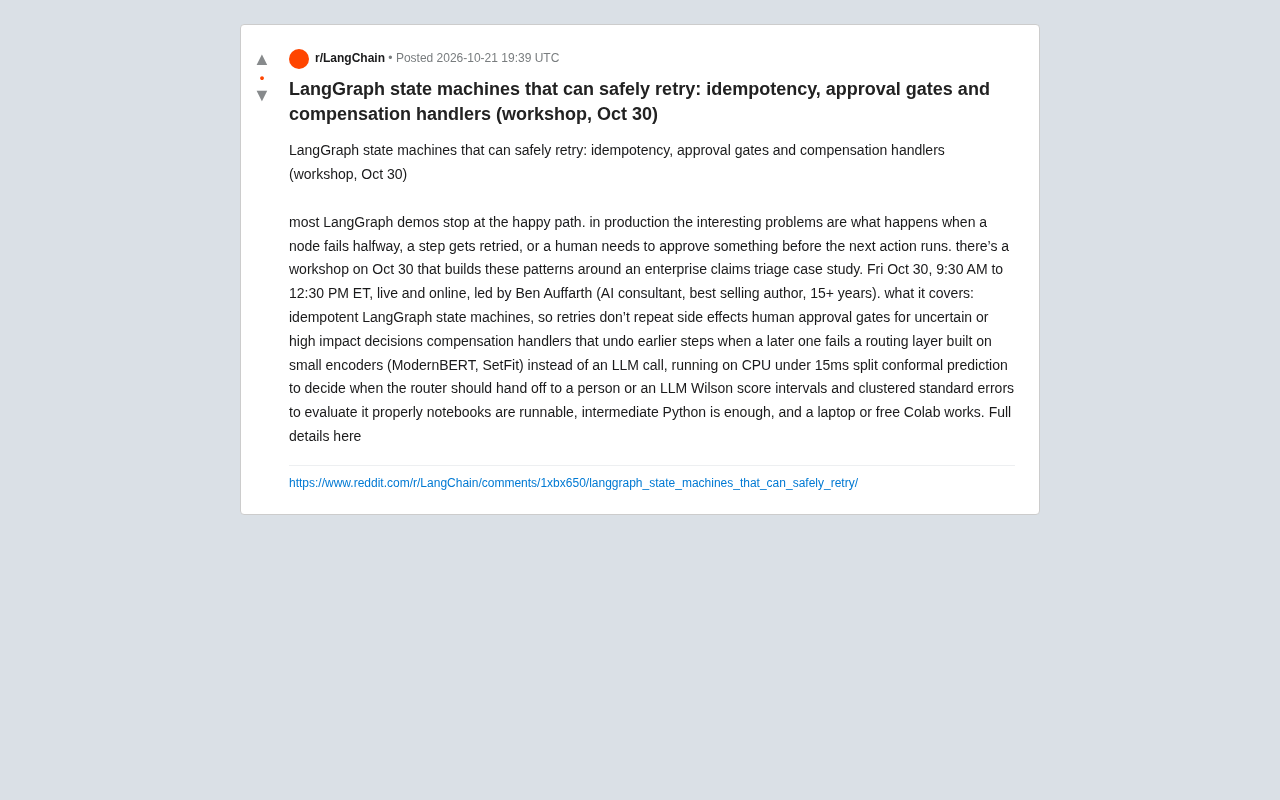
Most LangGraph demos stop at the happy path and call it a day. What really causes headaches in production is when a node fails halfway through, the same step gets retried, or a high-impact decision must get a human sign-off before proceeding. According to a workshop shared on Reddit, a hands-on course built around an enterprise claims triage case specifically breaks down the engineering patterns for these three problems: idempotent state machines, human approval gates, and compensation handlers.
Why demo-grade LangGraph falls apart in production
LangGraph models agent workflows as state machines, passing state between nodes and routing conditionally. This abstraction works great in the prototype phase. The problem is that demos usually assume every node either succeeds or crashes the whole flow, whereas production systems more commonly deal with "partial success": an external API call deducts payment but returns no receipt, a database write succeeds but the message send fails, or a retry executes the same side effect all over again.
The workshop organizers boil these problems down to three must-answer questions: Will side effects be duplicated on retry? Who makes the call on uncertain decisions? And when a later step fails, how do you undo actions that already happened? Without solving these three, a LangGraph workflow stays stuck in demo land.
Idempotent state machines: no more duplicate side effects on retry
The first core module of the course is idempotency design. The idea isn't new, but putting it into practice within a state machine framework requires concrete conventions: every node that produces external side effects must carry a stable idempotency key, and on retry you use that same key to check whether "this step has already been executed" rather than blindly running it again.
For LangGraph, this means some state isn't just business data—it also has to record execution traces: which nodes have committed, what the idempotency keys are, what the external systems returned. That way, when a node gets rescheduled due to a timeout, the state machine can skip the completed side effects and only fill in the missing parts. The course uses claims triage as its case study; claims scenarios naturally involve multi-step external calls, making them ideal for exposing these kinds of problems.
Approval gates: handing uncertain decisions to humans
The second module is human approval gates. Not every decision is suitable for the model to execute directly, especially high-impact, low-confidence branches. The course's design makes the approval gate an explicit node in the state machine: when the flow reaches this point it must suspend and wait for human confirmation before continuing, rather than sneaking in an if-check in the code.
The benefit of making it explicit is that the approval step itself is observable, auditable, and retryable. Once approved, the flow continues; if rejected, it takes another branch. For compliance-sensitive processes like claims, the approval record itself is a business asset, not just an incidental line in the logs.
Compensation handlers: undoing earlier actions when later steps fail
The third module is compensation handlers. The Saga pattern from distributed transactions gets brought into LangGraph here: when a later node fails and the overall flow can't complete, the system needs to execute compensating actions in reverse order to undo steps that already took effect—for example, releasing reserved credit limits or canceling notifications that were already sent.
Compensation logic is written as independent handlers, decoupled from the forward flow, with each forward node paired with a corresponding compensating action. When the state machine enters the failure branch, it triggers compensations in sequence based on the record of completed nodes. This is closer to real business than "roll everything back on error," because many external side effects simply can't be rolled back—they can only be offset.
The Saga pattern was first proposed by Garcia-Molina and Salem in 1987 to solve the problem that long-running transactions in distributed systems can't rely on a single database transaction to guarantee atomicity. Its core idea is to split a long transaction into several local transactions, each paired with a semantic reverse operation (compensating action). If a later local transaction fails, the compensating actions of the already-successful transactions are executed in reverse order, logically offsetting the side effects that were produced. Unlike two-phase commit (2PC), Saga doesn't require resource locking, making it better suited to cross-service scenarios involving external APIs; the trade-off is that it only guarantees eventual consistency, and the compensating actions themselves must also be idempotent—otherwise retrying a compensation introduces new side effects. To implement Saga in a state machine framework like LangGraph, the key is maintaining an ordered list of "completed forward nodes" and ensuring each compensation handler can determine from its idempotency key whether it has already been executed.
Replacing LLMs with small encoders for routing
The course also includes a noteworthy engineering decision: the routing layer doesn't use LLM calls but instead relies on small encoders (ModernBERT, SetFit) running on CPU with latency under 15 milliseconds. For classification tasks like triage, small models are accurate enough, and their cost and latency are far lower than calling a large model on every routing decision.
LLMs are reserved for steps that genuinely require reasoning. To decide when a request should go to a human versus an LLM, the course introduces split conformal prediction, attaching statistically grounded confidence guarantees to routing decisions rather than setting thresholds by gut feel.
Split conformal prediction is a distribution-free uncertainty quantification method. The approach is to first split labeled data into a training set and a calibration set, fit the model on the training set, then use the calibration set to compute a quantile threshold such that, at confidence level 1−α, the true label falls within the prediction set with probability at least 1−α. For classification tasks, it outputs a set of candidate labels rather than a single label: a small set means the model is confident, while a large set or one containing multiple labels means uncertainty. This maps directly to the "when to escalate to a human" rule described in the article—when the conformal prediction set size exceeds 1 or contains high-risk labels, the request is handed to an approval gate or an LLM. The method's advantage is that it provides finite-sample coverage guarantees without relying on model distribution assumptions, and it doesn't require multiple sampling at inference time, so computational overhead is minimal—making it well suited to pairing with a 15ms-class CPU routing layer.
Evaluation methods: Wilson intervals and clustered standard errors
The final part of the workshop covers evaluation. Point estimates of classifier accuracy are very unstable when sample sizes are small, so the course recommends using Wilson score intervals to provide confidence intervals for proportion metrics. At the same time, because multiple records from the same case are correlated, evaluation should use clustered standard errors to avoid treating correlated samples as independent and overstating significance.
In business triage scenarios, this evaluation combination is more convincing than plain accuracy/F1 because it answers "what's the performance range of this router, and are the conclusions robust?"
The Wilson score interval is a way of constructing confidence intervals for binomial proportions. Compared with the common normal approximation (Wald interval), it doesn't go out of bounds when sample sizes are small or proportions are near 0/1, and its coverage is more robust, making it the preferred choice for proportion metrics like classifier accuracy. Clustered standard errors, meanwhile, handle situations where samples aren't independent: when the same case corresponds to multiple records, those records share case-level noise, and computing variance as if they were independent samples underestimates the standard error and inflates significance. The correct approach is to first aggregate residuals or scores at the cluster level, then adjust the variance estimate based on the number of clusters. Combining the two, as the article does, essentially elevates evaluation from "single-point accuracy" to "robust conclusions with confidence intervals"—especially necessary in business triage scenarios where samples are limited and naturally clustered.
Who should attend
According to the course information, the notebook is runnable, intermediate Python skills are sufficient, and you can follow along on a laptop or free Colab. The instructor, Ben Auffarth, is an AI consultant and bestselling author with over 15 years of experience. The course runs Friday, October 30, from 9:30 to 12:30 US Eastern Time, as a live online session.
For teams pushing LangGraph from prototype to production, these three patterns—idempotency, approval gates, and compensation—form the minimal complete set for retry safety. Miss any one of them, and the workflow will show its cracks when real failures hit.
Related articles

Gemini 4 Argon Hands-On: AI Builds Board Games, Constructs Temples, and Trains Robots Autonomously
Gemini 4 Argon hands-on roundup: AI autonomously builds a desk racetrack and temple in Blender, writes a ray tracing engine, trains a humanoid robot to sink 7 shots, plus API pricing and developer access.

The Magic Octagonal Coin: Why Only 9% of People Can Predict Its Flip?
Only 9% of people can correctly predict the Magic Octagon coin flip. This article explains its spatial rotation mechanism, common cognitive pitfalls, and a new hypothesis based on Relevance Theory, exploring the limits of human spatial reasoning.

Sam Altman: AI Is Entering the Era of Scientific Discovery — Math Breakthroughs Will Replicate in Biology and Energy
Sam Altman says AI is entering the era of scientific discovery — math breakthroughs will replicate in biology, materials science, and energy to help develop new drugs and energy sources.