LangGraph vs CrewAI: Which Framework Handles Multi-Agent Handoffs More Reliably?

LangGraph vs CrewAI: the core trade-off between explicit state control and high-level role abstraction in complex multi-agent systems.
This article examines a Reddit developer's hands-on comparison of LangGraph and CrewAI, asking which is more reliable when multi-agent handoff logic gets complex. LangGraph excels with explicit state, checkpoints, and routing — ideal for fine-grained control with retry and validation. CrewAI's role-task abstraction speeds up simple workflows but may hit limits with large context or complex recovery logic. The article distills six core capability dimensions for production multi-agent systems and notes that many teams ultimately move toward combining frameworks or building a custom handoff layer.
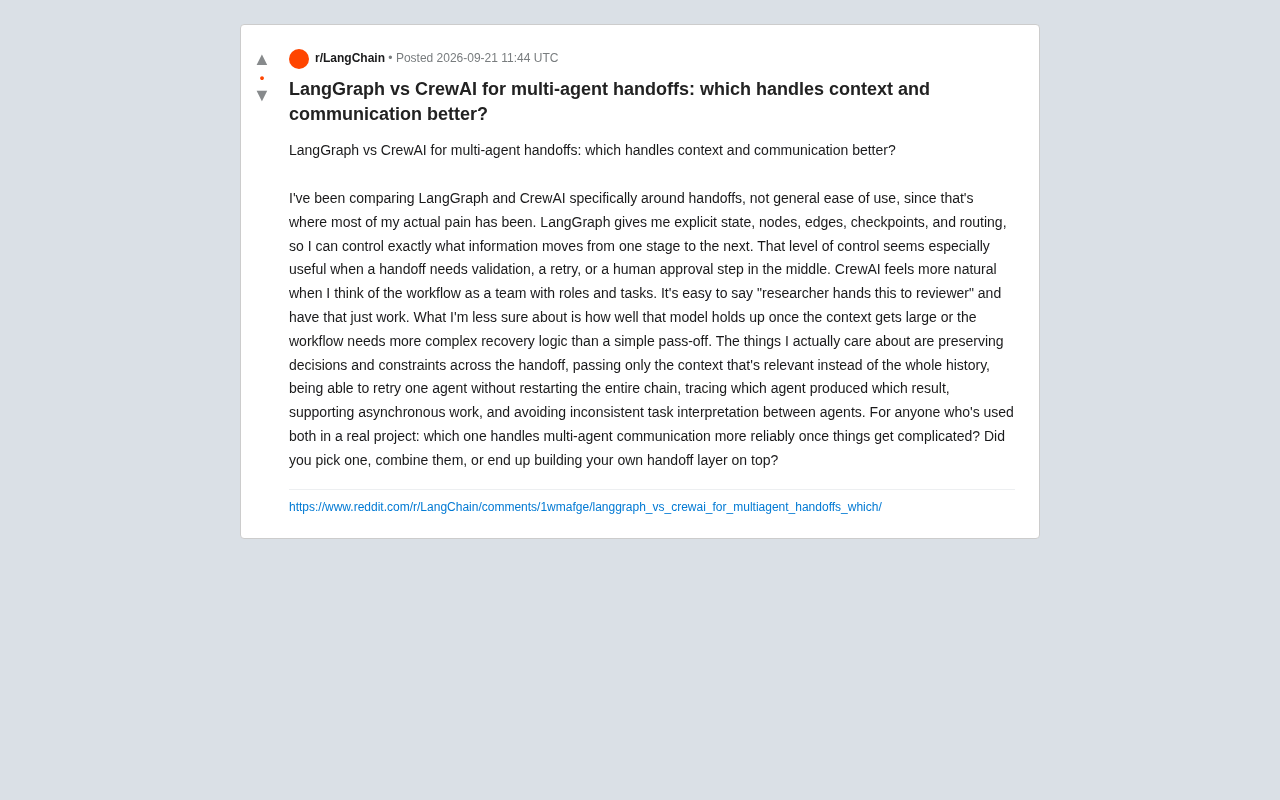
When building multi-agent systems, what truly frustrates developers isn't usually the framework's learning curve — it's the handoff between agents: how do the decisions, constraints, and context from one agent get passed to the next accurately and completely? A developer on Reddit recently sparked an in-depth comparison between LangGraph and CrewAI, with one central question: when workflows get complex, which framework handles context and communication more reliably?
Two Fundamentally Different Design Philosophies
LangGraph and CrewAI represent two distinct approaches to multi-agent orchestration. Understanding their differences is essential before making a choice.
LangGraph: Explicit State and Graph Structure
LangGraph provides explicit state, nodes, edges, checkpoints, and routing mechanisms. This means developers can precisely control which information flows from one stage to the next.
The original poster emphasized that this level of control is especially valuable when handoffs require inserting validation, retry, or human approval steps. In other words, when your workflow isn't a simple linear pipeline but needs a "checkpoint" in the middle, the explicit control that graph structure offers becomes a clear advantage.
LangGraph is built on a Directed Graph paradigm, with its core concepts rooted in compiler theory and state machine design. State is a shared data structure that flows through the entire graph — typically defined as a TypedDict or Pydantic model — and each node reads from and writes to it. Checkpoints automatically save snapshots after each node executes using a persistence backend (e.g., SQLite, PostgreSQL), which is the underlying mechanism for "single-node retry" — when something fails, you can resume from any checkpoint without rerunning the entire pipeline. Edges come in two flavors: regular and conditional. Conditional edges allow the next node to be determined dynamically at runtime based on current state, which is key for branching logic and human-in-the-loop interrupts. This design makes LangGraph fundamentally closer to a recoverable state machine engine than a simple LLM call chain.
CrewAI: Role and Task Abstractions
CrewAI aligns more closely with the intuition of "team collaboration." When you think of your workflow as a team with clear role assignments, it feels very natural — you simply declare "the researcher hands this off to the reviewer," and the system makes it work.
This roles-and-tasks-centric abstraction reduces cognitive overhead and lets workflow logic read almost like natural language. But the author's concern is valid: when context grows large, or when recovery logic is more complex than a simple pass-through, can this model hold up?
CrewAI's abstraction layer uses an "Agent-Task-Crew" three-tier model: Agent defines a role's identity, goals, and available tools; Task describes the specific work to be done and its expected output; Crew orchestrates the execution order of Agents and Tasks, supporting both Sequential and Hierarchical process modes. In Hierarchical mode, CrewAI automatically creates a "Manager Agent" to coordinate other agents, eliminating the need to manually define routing logic. The cost of this high-level abstraction is that context passing between tasks defaults to the framework's internal string concatenation mechanism — developers have limited visibility into "what information is being passed and how," which makes debugging complex handoff issues difficult due to insufficient observability.
Six Dimensions That Actually Matter in Complex Scenarios
Setting aside the surface-level question of "which is easier to get started with," the original poster listed what he actually cares about in real projects — a practical rubric for evaluating any multi-agent framework:
- Preserving decisions and constraints across handoffs: Decisions and constraints made by earlier agents must not get lost in transit.
- Passing only relevant context: Rather than dumping the entire history into the next agent, avoiding context bloat.
- Single-node retry capability: The ability to rerun just one agent without restarting the entire pipeline.
- Traceability: Clearly knowing which output was produced by which agent.
- Support for async work: Allowing agents to run in parallel or non-blocking fashion.
- Preventing inconsistent task interpretation: Stopping different agents from developing divergent understandings of the same task.
These six points cover nearly every common pitfall in production-grade multi-agent systems. Notably, most of them point to the granularity of state management — which is precisely where LangGraph's explicit design shines, and where CrewAI's high-level abstraction may fall short.
The Trade-off: Control vs. Development Efficiency
From a design perspective, the trade-off logic between the two is fairly clear:
LangGraph trades higher explicitness for greater controllability. When you need retry, validation, human intervention, or precise routing, the "screwdriver-level" control it offers is almost a necessity. The cost is that you have to assemble more pieces yourself, which means a higher upfront cognitive investment.
CrewAI trades higher abstraction for development speed. The role-task model makes simple collaboration scenarios work out of the box, but once handoff logic goes beyond "A passes to B" — when you need complex recovery, async orchestration, or fine-grained context filtering — you may hit the ceiling of the abstraction layer.
For requirements like "pass only relevant context" and "retry a single agent" mentioned in the original post, LangGraph's checkpoint and state mechanisms are a much more natural fit. CrewAI typically requires additional workarounds in these scenarios.
A Third Path: Building Your Own Handoff Layer
The question the original post ends with is highly representative: among those who've used both, did they pick one, combine both, or build a custom handoff layer on top?
The question itself reveals an industry reality — no off-the-shelf framework perfectly satisfies all production requirements. Many teams end up following this path: using LangGraph as the underlying state machine and orchestration engine for controllability and traceability, then wrapping it with more business-semantically meaningful role abstractions to recover the natural expressiveness of CrewAI. Others simply build a lightweight handoff layer and borrow only parts of each framework.
It's worth noting that this is an open-ended discussion thread from Reddit. The author presented a detailed comparison framework and evaluation criteria but has not reached a definitive conclusion. Actual framework selection should be validated against each team's specific use case.
"Building a custom handoff layer" in engineering practice typically means defining a Message Contract that is framework-agnostic — explicitly specifying the fields that must be included in every agent handoff, such as decisions made, constraints, remaining token budget, tracing IDs, and so on. These approaches sometimes draw from the Event Sourcing pattern, treating each handoff as an immutable event appended to a log rather than a direct mutation of shared state. Another common approach is to introduce a lightweight middleware layer that injects validation logic (e.g., JSON Schema checks) before and after agent calls, ensuring context structure always conforms to expectations. What these solutions share is this: they decouple the correctness of the handoff protocol from framework capabilities, making it an independently testable and evolvable business logic component.
Recommendations for Decision Makers
If your workflow's handoffs are simple and team-collaboration intuition is your primary guide, CrewAI can get you up and running quickly. If your system requires strict state control, mid-workflow validation, single-node retry, and full traceability, LangGraph's explicit model is worth the investment.
When you're facing a truly complex production system, "combining both" or "building a custom handoff layer" is often not a compromise — it's a mature engineering choice. Frameworks are ultimately tools. Handoff reliability ultimately depends on how you manage state and context, not on the name of the framework itself.
Related articles

macOS Is No Longer UNIX: Apple Didn't Renew Certification, But the Technology Is Unchanged
Apple did not renew macOS's UNIX certification, and the Open Group has removed Apple's entry. This article analyzes the technical reality behind the expiration, Apple's possible intentions, and the practical impact on developers.

Building Stateful Multi-Agent Systems with Azure Cosmos DB
Based on the official Azure Cosmos DB tutorial, this article explains how to use the Agent Memory Toolkit to add shared persistent memory to a multi-agent travel planner, covering short-term, long-term, episodic, and semantic memory plus cross-session state continuity.

Production AI Agent Operations: A Three-Step Framework for Observing, Evaluating, and Optimizing
Azure Cosmos DB team proposes a three-step framework for production AI Agent operations: observe trace tracking, evaluate with LLM as a judge and regression testing, optimize cost across RU, retrieval, memory, and LLM layers.