Language Discrimination Ability Improves Linguistic Learning in Multilingual Speech Models

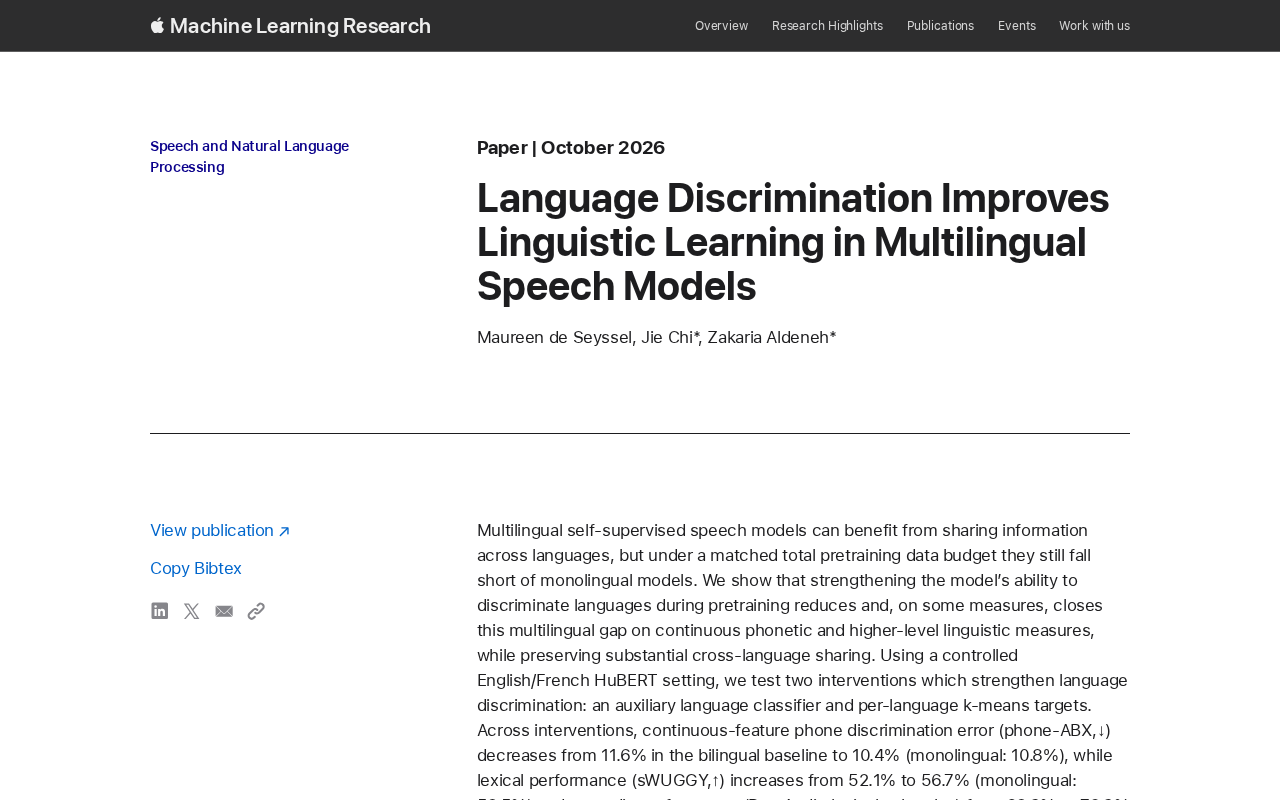
Boosting language discrimination in multilingual speech models closes the performance gap with monolingual models.
This article covers research addressing the "multilingual gap" in self-supervised speech models — where multilingual models underperform monolingual ones on phonetic and linguistic metrics due to diluted per-language training resources. The counterintuitive finding is that strengthening a model's language discrimination ability during pretraining (via auxiliary language identification tasks) can narrow or eliminate this gap while preserving cross-lingual sharing. Validated on a controlled English/French HuBERT setup, the study shows discrimination and sharing can be jointly optimized, with practical implications for low-resource speech systems and multilingual voice assistants.
The "Sharing Dilemma" in Multilingual Speech Models
Self-supervised speech models have become a cornerstone of speech processing in recent years, with multilingual models drawing particular attention for their ability to share information across languages. In theory, when a model simultaneously learns multiple languages like English and French, it can leverage cross-lingual commonalities to improve representation quality — this is the appeal of cross-lingual transfer.
Reality, however, is less straightforward. Researchers have identified a thorny problem: given the same total pretraining data budget, multilingual models still lag behind their monolingual counterparts in language learning capability. In other words, when you distribute fixed training resources across multiple languages, each language receives diluted "attention," leading to degraded performance on phonetic and higher-level linguistic metrics. This performance gap is known as the "multilingual gap."
The rise of Self-Supervised Learning (SSL) in speech processing is fundamentally about bypassing the bottleneck of large-scale human annotation. Traditional supervised training requires transcriptions for every utterance, whereas self-supervised methods design "pretraining tasks" — such as predicting masked audio frames or contrasting similar segments — allowing models to learn useful representations from raw audio alone. These representations are then fine-tuned for downstream tasks like speech recognition and speaker verification. Multilingual SSL models (e.g., XLSR, MMS) extend this paradigm to dozens or even thousands of languages, aiming to cover low-resource languages with a single model. However, shared parameters in multilingual settings are both an advantage (cross-lingual transfer) and a source of resource competition — the "multilingual gap" was proposed and studied in precisely this context.
Stronger Language Discrimination Is the Key
This research puts forward a counterintuitive yet insightful core claim: enhancing a model's ability to discriminate between languages during pretraining can actually narrow or even eliminate the multilingual gap on certain metrics.
What makes this finding elegant is that it doesn't sacrifice cross-lingual sharing. The study shows that even as language discrimination ability is strengthened, the model still retains substantial cross-lingual information sharing. This means the model can clearly "know" which language it is processing while still leveraging shared cross-lingual regularities — the two objectives are not a zero-sum tradeoff, but goals that can be jointly optimized.
From a cognitive perspective, this actually parallels how humans learn multiple languages. A truly proficient bilingual speaker can clearly switch between language systems in their mind (strong discrimination) while using prior linguistic knowledge to accelerate acquisition of a new language (strong sharing).
Experimental Design: Two Intervention Methods
The study employed a controlled English/French HuBERT experimental setup. HuBERT is a widely used self-supervised speech representation model, and by conducting controlled experiments in a bilingual setting, researchers could precisely measure the impact of each intervention.
Two intervention approaches were tested to strengthen language discrimination:
Auxiliary Language Task
The first approach introduces an auxiliary language identification task. By requiring the model to additionally classify language identity during pretraining, its internal representations are encouraged to better encode language-specific features. This multi-task learning strategy allows the model to learn general speech representations while being explicitly required to distinguish language boundaries.
An auxiliary task is a common design pattern in multi-task learning: one or more additional prediction objectives are added alongside the primary training objective, and these auxiliary objectives share some of the model's parameters, thereby regularizing or guiding feature learning for the main task. Crucially, the auxiliary task is not the ultimate goal — but it compels the shared layers to encode additional information. In this study, language identity classification (determining whether a speech segment is English or French) serves as a canonical auxiliary task: it doesn't affect the model's final use as a general-purpose speech representation, but during training it provides gradient signals that force the model to "discriminate languages," shaping an internal representation space that is more language-aware.
Other Discriminative Interventions
The second intervention described in the paper also targets enhanced language discrimination. Together, both approaches validate the core hypothesis: as long as a model becomes better at distinguishing between languages, its overall linguistic learning ability improves.
HuBERT (Hidden-Unit BERT) is a self-supervised speech representation model proposed by Meta AI in 2021, drawing inspiration from BERT's masked prediction mechanism in NLP. Training proceeds in two stages: first, a simple clustering algorithm (e.g., K-means) generates pseudo-labels from audio features; then the model is trained to predict the pseudo-label category of randomly masked audio frames. This "predict discrete cluster centers" approach allows the model to learn rich speech representations without any human annotation. HuBERT was chosen as the experimental backbone because of its mature architecture and well-established community benchmarks, making it straightforward to compare intervention effects against existing research.
Implications for Multilingual Speech Technology
The value of this research lies not only in proposing a concrete technique, but in challenging a common assumption: that the advantages of multilingual models come from "blurring language boundaries and emphasizing commonalities." The evidence here suggests that moderately emphasizing language differences is actually the superior strategy.
This finding has practical implications for building speech systems for low-resource languages, developing multilingual voice assistants, and training models that cover multiple languages under limited compute budgets. It signals to engineers that when designing pretraining objectives, one should not solely pursue unified cross-lingual representations — instead, the right balance between sharing and discrimination should be sought.
It is worth noting that current experiments were validated only on English and French, two relatively similar languages. Whether these conclusions hold for more typologically distant language pairs (e.g., Chinese and English) remains to be seen. Whether improvements in phonetic and higher-level linguistic metrics translate to gains on actual downstream tasks is also a direction worth investigating in follow-up work.
Summary
This work reveals a previously overlooked dimension in multilingual self-supervised speech models: language discrimination ability. By reinforcing this ability through interventions such as auxiliary language tasks, the researchers successfully narrowed the performance gap between multilingual and monolingual models while preserving the benefits of cross-lingual sharing. This offers a promising path forward for designing more efficient multilingual speech models in the future.
Related articles

Chain of Thought Isn't Just for AI: How Humans Can Use CoT to Improve Thinking Quality
Chain of Thought isn't just a prompt trick for large models. Starting from a Hacker News discussion, this article analyzes why CoT works for human thinking too, breaks down actionable ways to transfer it, and highlights the key differences between human CoT and machine CoT.
Cloudflare Teams Up with OpenAI: Closi…
Cloudflare Teams Up with OpenAI: Closing the Loop from Vulnerability Discovery to Defense with AI
Cloudflare uses OpenAI Daybreak to investigate security vulnerabilities and generate reviewable remediation plans, while developers use Codex to boost coding efficiency and quality.

Orca Multi-Agent Orchestration in Practice: A Guide to Parallel Collaboration with Claude and Codex
Orca is Stable AI's free open-source agent workbench supporting 34 agents like Claude Code and Codex in parallel. Learn its Git worktree isolation, multi-model orchestration, and mobile management.