Laser-Equipped AI Submarine Robots Guard Norwegian Salmon Farms

Norway tests AI laser submarine robots to precisely kill sea lice, exploring a deployment path for AI agricultural robots.
Norway's salmon farming industry has long been troubled by sea lice, and chemical and mechanical control methods each have drawbacks. An AI submarine robot equipped with AI vision and lasers is patrolling farms, using underwater cameras to identify millimeter-scale sea lice and firing short-pulse lasers to kill them, avoiding drug contamination and fish stress. Norway's high-density farming and strict sea lice regulatory limits are the driving forces behind this technology's early deployment. Hacker News discussions also raise concerns about misfire risk, equipment cost, and long-term ecological impact. This case shows that AI vision is more commercially viable in agricultural fields with narrow scenarios, strong demand, and quantifiable results.
From Sci-Fi to Fish Farms: How Laser Submarine Robots Are Solving the Sea Lice Problem
Norway's salmon farming industry has long been plagued by sea lice. These parasitic crustaceans attach to the surface of fish, causing wounds and weakening immunity, and in severe cases leading to mass mortality that inflicts huge economic losses on farmers. Traditional control methods include chemical treatments and mechanical removal, but the former can pollute water bodies and lead to pesticide resistance in sea lice, while the latter easily causes stress and injury to fish. According to discussions in the Hacker News community, an AI submarine robot equipped with lasers is patrolling Norwegian farms, specifically identifying and killing sea lice—this sounds like a sci-fi movie plot, but it is already a real solution under testing.
Sea lice (scientific name Lepeophtheirus salmonis) are copepod crustaceans that are obligate parasites of salmonid fish, rather than "lice" in the ordinary sense. Their life cycle includes a free-swimming planktonic larval stage and a parasitic stage attached to fish, with adults feeding on fish epidermis, mucus, and blood. The high-density environment of aquaculture net pens makes it easy for planktonic larvae to spread among fish schools; dozens of sea lice attached to a single fish can cause anemia, secondary infections, or even death. Because of Norway's massive salmon farming scale, sea lice control has become one of the core bottlenecks for the industry's sustainable development.
Technical Principles: AI Visual Recognition + Precision Laser Strikes
How to Lock onto Targets in Turbid Seawater
The core of this system lies in real-time computer vision. The submarine robot is equipped with underwater cameras, and the AI model identifies the morphological features of sea lice among swimming fish schools and distinguishes targets from the fish themselves. The key is precision: the laser must hit only millimeter-scale sea lice without harming the salmon. From public discussions, the system relies on training with large amounts of annotated images and can complete detection under complex underwater lighting and fast-moving fish schools.
The biggest difference between underwater computer vision and terrestrial vision is the absorption and scattering of light by the medium. Seawater strongly absorbs red light, so images tend to be blue-green with low contrast, and suspended particles also create an "underwater haze" effect. Therefore, such systems usually need to be combined with active illumination (such as LED fill lights at specific wavelengths), image dehazing and color correction algorithms, and training data that covers different turbidity levels, lighting conditions, and fish postures. In addition, motion blur caused by swimming fish requires detection models to have high inference speed, often running lightweight networks on edge computing chips to ensure real-time performance.
Laser Power Control Logic
The laser energy required to kill sea lice is not high, but safety redundancy must be sufficient. The robot fires short pulses only after confirming the target, with extremely short action times, keeping thermal impact on the fish within an acceptable range. This "surgical" removal method avoids contamination of the entire water area by chemicals and also reduces fish stress caused by manual handling.
The effect of lasers on biological tissue depends on wavelength, power density, and action time. Sea lice are only millimeter-sized, and the required energy is far below the threshold for thermal damage to fish; the key lies in beam focusing precision and pulse control. Systems usually use short pulses rather than continuous irradiation, which can instantly destroy the sea louse's exoskeleton or nervous system while leaving heat dissipation gaps for fish tissue. To meet farm animal welfare requirements, the equipment also needs target confirmation, distance measurement, and fail-safe mechanisms to ensure automatic cessation of firing when recognition confidence is insufficient or fish are too close.
Why Norway Leads: Farming Density and Regulatory Pressure
Norway is the world's largest producer of Atlantic salmon, with high net pen density and rapid sea lice transmission. At the same time, the Norwegian government sets strict upper limits on sea lice numbers at farms, and exceeding them may restrict farming scale. This regulatory pressure forces companies to seek more efficient and environmentally friendly control solutions. Laser robots can patrol around the clock, and data is traceable, which precisely aligns with regulatory requirements for "quantifiable treatment."
Norway's regulation of sea lice numbers on farms uses a "threshold trigger" mechanism: when the average number of sea lice per wintered fish exceeds the prescribed upper limit, the farm must take treatment measures within a certain period, or it may be restricted in biomass growth. This system makes sea lice counting a mandatory compliance indicator and also creates demand for traceable, quantifiable treatment methods. Each kill by the laser robot can record time, location, and images, naturally forming an audit data chain—this is precisely its hidden advantage over traditional methods.
Controversies and Limitations: Calm Voices in Community Discussions
Discussion heat on Hacker News is not high (only 8 points and 2 comments), but the comments reflect some real concerns. First, the risk of laser misfire: although AI recognition accuracy is improving, the underwater environment is variable, and reflections from fish scales and changes in seawater turbidity may interfere with judgment. Second, cost: the unit price and maintenance costs of such robots are considerable, and whether they are economically feasible for small and medium-sized farms remains unknown. Third, ecological impact: whether large-scale use of laser equipment causes cumulative effects on surrounding marine life currently lacks long-term data.
Comparison with Existing Solutions
Compared with chemical delousing, the advantage of the laser solution is no drug residues and no resistance development; compared with mechanical removal, it reduces fish injury caused by physical contact. But it is not a panacea: for fish already heavily infested with sea lice, patrol-based killing alone may be insufficient, and it still needs to be combined with other methods.
Implications for AI Agricultural Robots
This case demonstrates the path for AI vision and robotics technology to land in traditional agriculture: starting from high-value, high-regulatory-pressure niche scenarios and replacing extensive interventions with precise execution. The economic density of salmon farming is sufficient to support higher equipment investment, and the clarity of the sea lice problem makes results easy to measure. For practitioners focused on AI application deployment, this combination of "narrow scenario, strong demand, quantifiable results" is more commercially viable than general-purpose agricultural robots.
Laser submarine robots will not replace traditional delousing methods overnight, but they point to a clearer trend: AI is moving from screens into the physical world, finding its place in fields where human labor cannot be sustained and chemical methods are constrained.
One-line Summary
Norway is testing AI laser submarine robots to precisely kill sea lice, exploring a deployment path for AI agricultural robots.
Paragraph Summary
Norway's salmon farming industry has long suffered from sea lice, and chemical and mechanical control methods each have drawbacks. An AI submarine robot equipped with AI vision and lasers is patrolling farms, using underwater cameras to identify millimeter-scale sea lice and firing short-pulse lasers to kill them, avoiding drug contamination and fish stress. Norway's high-density farming and strict sea lice regulatory limits are the driving forces behind this technology's early deployment. Hacker News discussions also raise concerns about misfire risk, equipment cost, and long-term ecological impact. This case shows that AI vision is more commercially viable in agricultural fields with narrow scenarios, strong demand, and quantifiable results.
Related articles
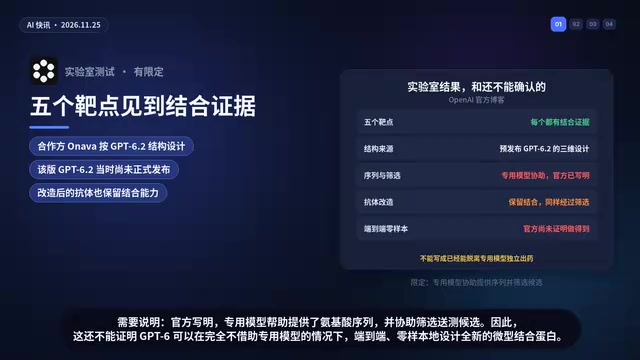
GPT-6 Designs Proteins, Claude Creations Become Apps with One Click, DeepMind Releases New Benchmark
OpenAI says GPT-6 can design protein 3D structures, Anthropic lets Claude creations install as desktop apps, DeepMind's HIP benchmark tests stability on simple questions, Google Workspace opens agent MCP interfaces.

OpenAI Weekly Roundup: GPT-6.2 Rolls Out to ChatGPT, GPT-6 Designs Proteins
OpenAI's week: GPT-6.2 rolls out to ChatGPT, GPT-6 claims independent protein design, agent research share surges, perplexity proposed as a shared metric, and internal safety concerns surface.

Is the Crypto Industry About to "Turn Blue"? The Truth Behind Tech and Politics' Shifting Allegiances
Vergecast discusses whether the crypto industry will shift from the right to the Democrats, revealing the pragmatic nature of tech's politics and the costs of a crypto pivot.