Last Day of ICLR Rebuttal: Will Reviewers Be More Engaged?
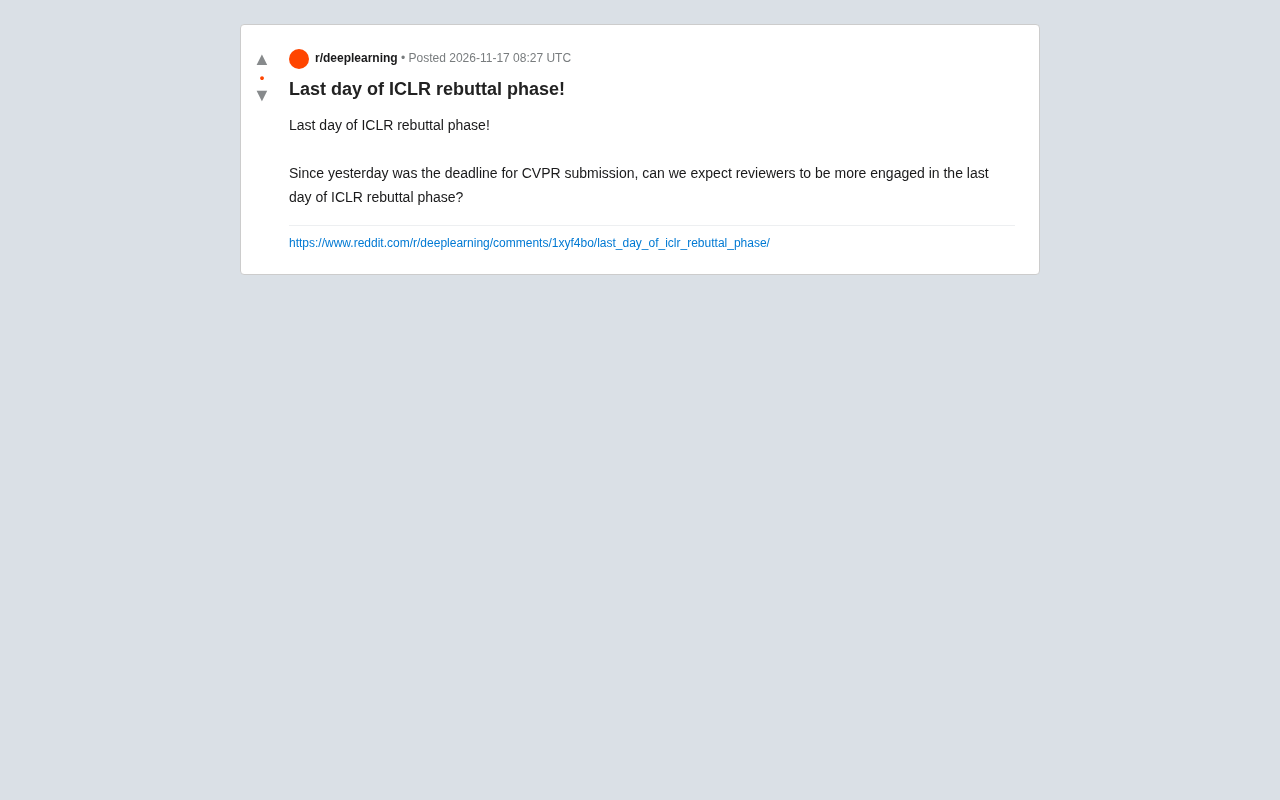
CVPR's submission deadline overlaps with the ICLR rebuttal, distracting reviewers; authors should focus on response quality.
On the final day of the ICLR rebuttal, just after the CVPR submission deadline has passed, Reddit users speculate that reviewers may therefore be more engaged in ICLR discussions. The article argues that reviewers' attention may indeed be pulled between the two conferences, but engagement on the final day is influenced by multiple factors: the usual pattern of reviewers concentrating their responses near the deadline, as well as the quality and relevance of author responses. For authors, rather than speculating about reviewers' schedules, it is better to keep monitoring the discussion forum, supplement evidence and clarify misunderstandings in a timely manner, and make the controllable part—response quality—as good as possible. That is the key to influencing rebuttal outcomes.
ICLR's rebuttal phase is entering its final day, and a Reddit user has raised a question that resonates with many: now that the CVPR submission deadline has just passed, will reviewers be more engaged on the last day of the ICLR rebuttal? At first glance, this seems like a mere scheduling coincidence, but it reflects the real pressure created by overlapping review cycles across academic conferences.
Reviewers' Attention Pulled Between Two Conferences
The core observation of the original post is that CVPR's submission deadline happens to fall during the ICLR rebuttal period. For reviewers involved in both conferences, their attention in the earlier period is inevitably occupied by CVPR submissions and reviewing work. The poster therefore speculates that once the CVPR deadline passes, reviewers may finally be able to turn their attention back to the ICLR rebuttal discussions.
This speculation has some plausibility. CVPR and ICLR overlap heavily in the computer vision and machine learning fields, and it is very common for the same group of researchers to serve as reviewers or authors for both. When two key deadlines collide, the time reviewers can devote to the ICLR rebuttal is naturally compressed, and the final day may instead become a window for concentrated rebuttal work.
However, this is still only a schedule-based speculation, and the original discussion does not provide actual data on changes in reviewer behavior.
The ICLR rebuttal phase is a key part of the conference review process. After a paper receives reviews, authors have a limited time window (usually one to two weeks) to write a response, addressing reviewers' concerns point by point, clarifying misunderstandings, and adding experiments. Reviewers then read these responses and may update their scores or continue interacting with authors in the discussion forum. Unlike some conferences that use one-shot rebuttals, ICLR's discussion forum is open, and authors and reviewers can have multiple rounds of exchange. As a result, the final day of rebuttal is often a peak period when reviewers work through accumulated discussions and give final scores. This mechanism means that the timeliness and quality of authors' responses directly affect reviewers' judgments.
The overlap between CVPR and ICLR review cycles is not accidental. CVPR typically has a submission deadline in November each year, followed by the review phase; ICLR's rebuttal period often falls in a similar time window. The two conferences draw heavily from the same pool of researchers in computer vision and machine learning, and many reviewers take on reviewing duties for both, making schedule conflicts the norm. This overlap not only affects how reviewers allocate their attention but may also indirectly affect review quality and decision fairness at both conferences.
Why Engagement on the Final Day Is Hard to Predict
Even after the CVPR deadline has passed, whether reviewers will be more engaged remains uncertain.
On the one hand, the final day of rebuttal is itself a normal period for reviewers to concentrate on responding. Many reviewers are accustomed to carefully reading author responses and updating scores only near the deadline, regardless of whether another conference deadline exists.
On the other hand, authors' performance during the rebuttal phase also affects the quality of interaction. Clear, targeted responses that directly address reviewer comments are more likely to prompt further discussion; vague responses, even if reviewers have time, may not attract more effort.
In other words, reviewer engagement is not determined unilaterally by schedules; the quality and relevance of author responses are also key variables.
Practical Implications for Authors
For ICLR authors currently waiting for reviewer responses, the practical value of this discussion is a reminder: do not assume that reviewers will necessarily give feedback before the final day, and do not become overly anxious just because early responses are lukewarm.
A more pragmatic approach is to keep monitoring the discussion forum during rebuttal and to supplement evidence and clarify misunderstandings in a timely manner. If reviewers concentrate their activity on the final day, whether authors can respond quickly and accurately often determines the final outcome of that round of discussion.
Based on the consensus in the community discussion, overlapping review cycles do distract reviewers, but whether a particular reviewer will be more engaged on the final day remains highly uncertain. For authors, doing the controllable part well—the quality of their responses—is more meaningful than speculating about reviewers' schedules.
One-line Summary
CVPR's submission deadline overlaps with the ICLR rebuttal, distracting reviewers; authors should focus on response quality.
Paragraph Summary
On the final day of the ICLR rebuttal, just after the CVPR submission deadline has passed, Reddit users speculate that reviewers may therefore be more engaged in ICLR discussions. The article argues that reviewers' attention may indeed be pulled between the two conferences, but engagement on the final day is influenced by multiple factors: the usual pattern of reviewers concentrating their responses near the deadline, as well as the quality and relevance of author responses. For authors, rather than speculating about reviewers' schedules, it is better to keep monitoring the discussion forum, supplement evidence and clarify misunderstandings in a timely manner, and make the controllable part—response quality—as good as possible. That is the key to influencing rebuttal outcomes.
Related articles

Why Learn Python in the AI Era? A Deep Dive with the Author of 'Python Crash Course'
Eric Matthes, author of 'Python Crash Course', discusses why Python remains essential in the AI era, the democratization and risks of AI coding tools, and the value of human creators.

Convex Skill Allegedly Uploads User App Ideas to Remote Servers Without Consent
Convex backend skill allegedly sends user app ideas to remote servers without disclosure, sparking Hacker News debate. We analyze the privacy risks and transparency issues.

The Coding Data Market Booms: How Frontier Labs Buy Training Data
The coding data market is rapidly expanding, with frontier labs as major buyers. This article analyzes the types of data traded, labs' procurement logic, and concerns such as licensing compliance and data contamination.