Latch: A Walk-to-Unlock App Blocker That Brings Focus Back to the Body

Latch unlocks distracting apps via physical actions like NFC stickers, QR codes, or steps—turning focus into spatial behavior design.
Latch is a focus tool ranked #17 on Product Hunt that puts the key to unlocking distracting apps somewhere you must physically walk to. Users scan an NFC sticker on the fridge, a printed QR code, or walk enough steps to lift the lock. It supports iPhone and Android, costs $9.99 one-time for Pro, with no account, ads, or analytics, and unlock logic runs entirely on-device. Physical distance is harder to bypass than pop-ups, but its features are minimal—no cross-device sync, stats, or family sharing—making its value proposition narrow: interrupt mindless scrolling with physical action.
Most app blockers have a fatal flaw: they're too easy to bypass. One tap on "Ignore" and you're back to scrolling. Latch, ranked #17 on Product Hunt, takes a different approach—it puts the unlock key somewhere you have to physically walk to.
Core Mechanism: Trading Physical Movement for Access
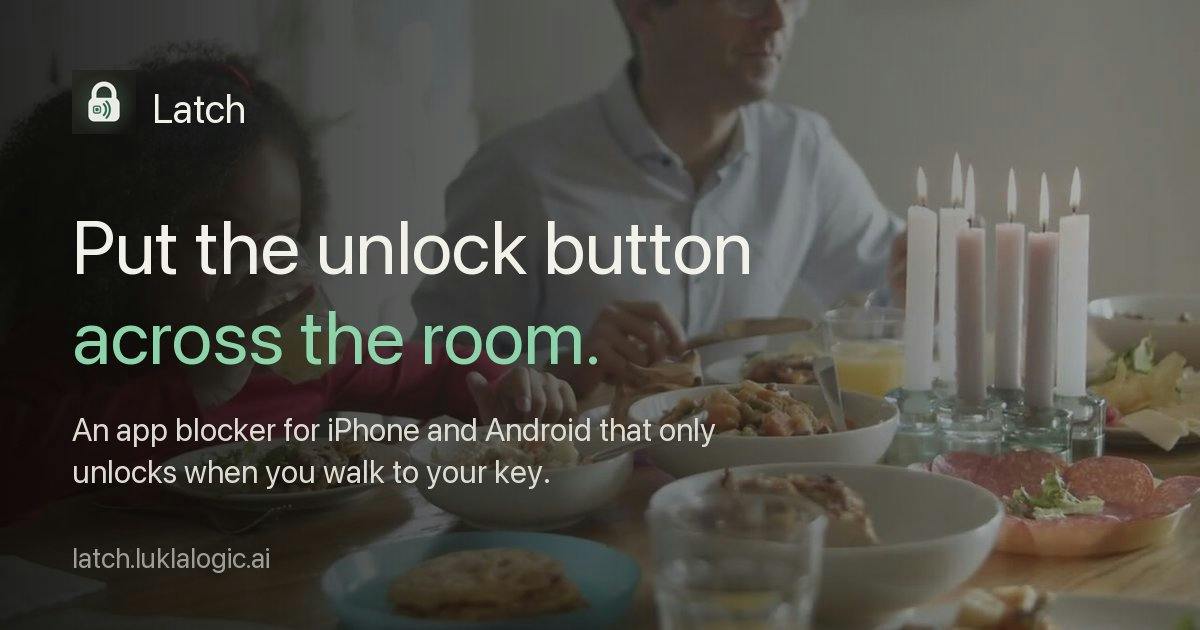
Latch locks the distracting apps you choose until you complete a physical action: scan an NFC sticker on your fridge, scan a printed QR code, or walk a set number of steps. The key isn't in your phone—it's somewhere you have to get up and reach.
This design turns the "unlock cost" from a single tap into a walk. It supports iPhone and Android, and the Pro version is a one-time $9.99 purchase with no account system, no ads, and no analytics tracking.
NFC (Near Field Communication) is a short-range wireless technology that typically operates within about 4 centimeters, commonly found in mobile payments, access cards, and transit taps. In Latch's use case, an NFC sticker is a cheap passive tag (a few dollars each) with no internal power source—it's powered by the electromagnetic field generated when a phone comes close, and exchanges a unique identifier. Users stick the tag on their fridge, entryway, or desk, and Latch pre-records that tag's ID; the lock is only released when a matching ID is scanned. Compared to QR codes, NFC's advantage is that you "must actually be close"—a phone camera can scan a QR code from a distance, but NFC requires you to nearly touch the tag, creating a stronger physical constraint that's also harder to fake with a screenshot or photo. This is the technical reason Latch lists NFC as its preferred unlock method.
Why Physical Distance Beats Willpower
Traditional app blockers rely on pop-up reminders or delay timers, which users can easily tap through even half-asleep. Latch's difference is that it embeds friction into real space—unless you're willing to walk to the fridge, that app simply won't open.
For people who habitually scroll mindlessly in bed, this action threshold sits right between "impulse" and "action." According to the Product Hunt page, Latch collects no usage data and the unlock logic runs entirely on-device—uncommon among similar tools.
Behavior Design is a model proposed by Stanford scholar BJ Fogg, with the core formula "Behavior = Motivation × Ability × Prompt"—a behavior occurs only when all three are present simultaneously. Traditional blockers only change the "prompt" (the pop-up) without changing "ability"—users can keep scrolling with a single tap, so the ability threshold is extremely low. Latch's approach directly lowers the "ability" to unlock: it turns unlocking from a single tap into a compound action requiring getting up, walking, and scanning, while placing the prompt (the NFC sticker) in a different physical space. Behind this is also the idea of a "commitment device": users proactively set up obstacles beforehand to counteract their present-moment impulses later. Economically, this aligns with the self-control problem described by Thaler—trading a small present cost for a larger future benefit.
Pricing and Privacy: The Restraint of a One-Time Purchase
Latch uses a $9.99 one-time Pro purchase model rather than a subscription. Given that most focus apps have shifted to monthly subscriptions, this pricing strategy is friendlier to long-term users.
On privacy, the official listing explicitly states "no account, no ads, no analytics." NFC and QR code unlocks are all handled on-device, and step data isn't uploaded either. For users who care about their digital footprint, this is a substantive plus.
Who It's For, Who It's Not
Latch suits people who've tried built-in screen time management and repeatedly failed—especially proactive users willing to place NFC stickers around their living space.
But it's not a panacea: if you need cross-device sync, usage statistics reports, or family sharing controls, Latch's minimalist approach may fall short. Its value proposition is narrow—interrupt mindless scrolling with physical action, nothing more.
The Verdict in One Line
Latch turns "quitting your phone" from a software-layer pop-up battle into spatial behavior design. $9.99 one-time purchase, zero tracking, no account—for a tool that solves a single point problem, this restraint is itself the selling point.
Product information and screenshots from the Product Hunt page, with 65 votes, 3 comments, and Maker Sudarshan.
One-line Summary
Latch unlocks distracting apps via physical actions like NFC stickers, QR codes, or step counts, turning phone-quitting into spatial behavior design.
Paragraph Summary
Latch is a focus tool ranked #17 on Product Hunt that puts the key to unlocking distracting apps somewhere you have to walk to reach. Users must scan an NFC sticker on the fridge, a printed QR code, or walk a set number of steps to release the lock on specified apps. It supports iPhone and Android, with a $9.99 one-time Pro purchase, no account, no ads, and no analytics tracking, with unlock logic running entirely on-device. The article notes that physical distance is harder to bypass than pop-ups and delay timers, sitting right between "impulse" and "action"; but its features are extremely minimal, offering no cross-device sync, usage statistics, or family sharing—its value proposition is narrow: interrupt mindless scrolling with physical action.
Related articles

Is the Agent Harness Dead? Cursor's Early Engineer Breaks Down the Real Architecture of AI Coding Agents
Cursor early engineer Jediah breaks down the real architecture of the agent harness: why "the harness is dead" is only half right, how the data flywheel lets the harness obsolete itself, and how Grokbot, software factories, and primitive design open new frontiers for agents.
Python Visitor Pattern and Better Alternatives Explained
A deep dive into Python's visitor pattern and four alternatives: method pattern, pattern matching, dictionary mapping, and functools.singledispatch. Choose the best decoupling design by change frequency.

357 Days of Deep Experience: Why Omarchy Made Me Stop Distro-Hopping
A 357-day deep dive into Omarchy: 59-second install, out-of-the-box audio and GPU support, the Quattro QuickShell rewrite migration pains, and why Arch users should try it.