Latent Jump Models (LJM): Reimagining Continuous Time-Series Modeling with Event-Driven Dynamics

LJM replaces smooth ODEs with Poisson-driven instantaneous jumps, training 1–2 orders of magnitude faster via parallel-scan variational inference.
Existing continuous-time sequence models excel at smooth evolution but struggle with discrete shocks. The proposed Latent Jump Model (LJM) designs latent states to evolve deterministically between events and jump instantaneously at event times driven by a state-dependent Poisson process — semantically representing shocks rather than approximating them as numerical error. The companion training method SPVI samples a complete latent event configuration then evaluates state recursions via triangular affine parallel scans, compressing computational depth from linear to logarithmic. Experiments show LJM matches continuous-time baselines in predictive accuracy, requires fewer latent state updates, and trains one to two orders of magnitude faster.
From Smooth Dynamics to Event-Driven: A New Perspective on Time-Series Modeling
Irregularly observed time series are everywhere — financial transactions, medical monitoring, sensor data — and they rarely arrive at fixed intervals. The dominant approach for handling such data is continuous-time latent state-space models, which typically express uncertainty through a randomly initialized state evolving smoothly via ordinary differential equations (ODEs), or through Brownian perturbations accumulated by stochastic differential equations (SDEs).
This construction is entirely natural for smooth or diffusion-type systems, but it has a notable blind spot: it cannot directly characterize "a finite set of unobserved shocks." In many real-world systems, however, the timing, magnitude, and memory effects of such shocks are themselves uncertain. In other words, existing methods excel at describing "continuous gradual change" but struggle to express "sudden discrete jumps."
A new study proposes Latent Jump Models (LJMs) to address exactly this gap, paired with a training method called Scan-Parallel Variational Inference (SPVI) that resolves the efficiency challenges inherent in this class of models.
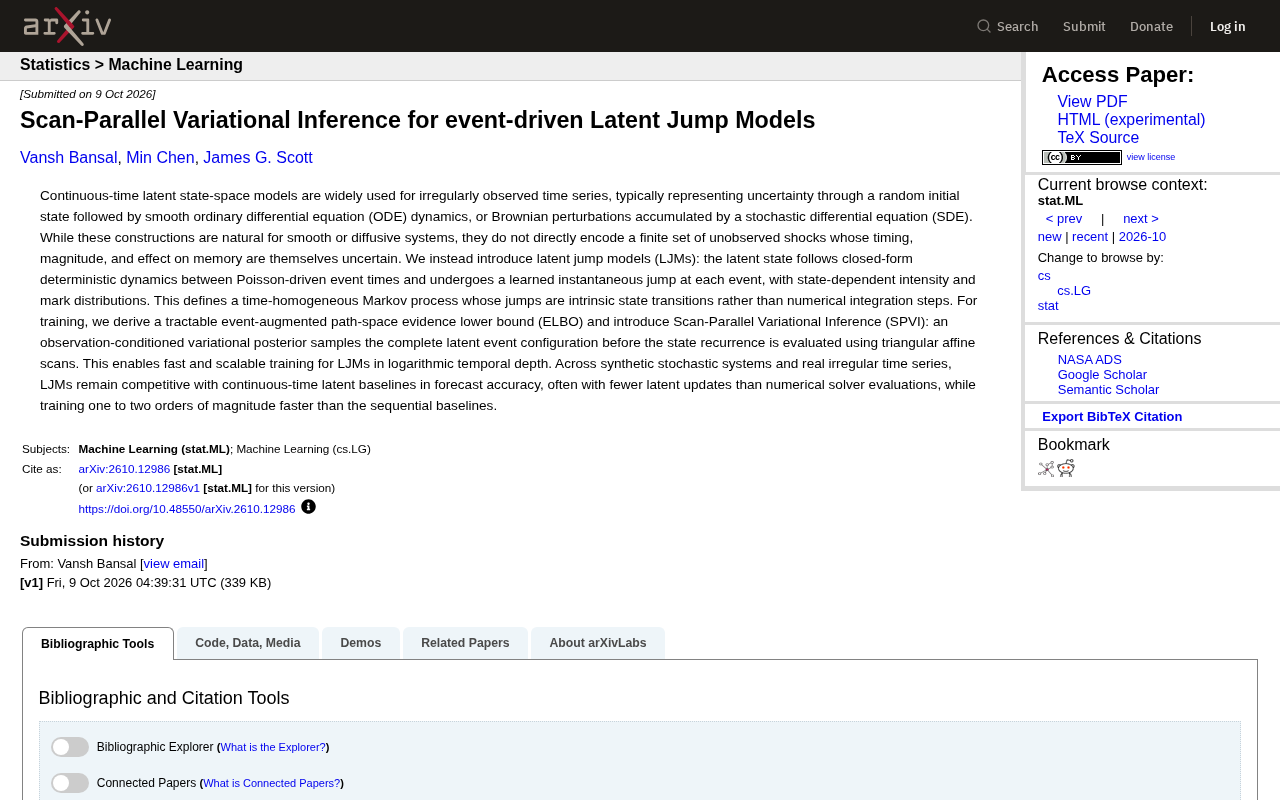
The Core Idea Behind Latent Jump Models (LJM)
LJM is built around an intuitive physical picture: the latent state evolves smoothly between events according to closed-form deterministic dynamics, while at each event moment driven by a Poisson process, the state undergoes a learned instantaneous jump.
This process has two key properties:
Jumps Are Intrinsic State Transitions, Not Numerical Integration Steps
Both the jump intensity and the mark distribution are state-dependent, making the entire process a time-homogeneous Markov process. The most fundamental distinction from traditional ODE/SDE methods is that jumps here are intrinsic state transitions within the model — not discrete integration steps introduced by a numerical solver to approximate a continuous trajectory. This means the model semantically represents the concept of a "shock" rather than approximating it as numerical error.
The Poisson process is a classical mathematical tool for modeling the arrival of random events: within any time window of length $\Delta t$, the probability of an event occurring is determined by the intensity parameter $\lambda$, and events in different windows are mutually independent. LJM uses the generalized form of a marked point process — each event carries not only a timestamp but also a "mark" that encodes additional information (such as the magnitude or direction of a shock). Furthermore, the intensity $\lambda$ in LJM is not constant but depends on the current latent state, making it a self-exciting or state-modulated point process capable of expressing feedback dynamics like "the more the system is in a certain state, the higher the probability of a future shock." This shares mathematical foundations with Hawkes processes in finance and spike-train modeling in neuroscience.
Closed-Form Intra-Segment Dynamics
Because the evolution between events uses closed-form deterministic dynamics, the model does not need to invoke expensive numerical integrators between jumps. This lays the groundwork for efficient training and is the fundamental reason LJM can remain competitive with fewer latent state updates.
SPVI: Training Jump Models One to Two Orders of Magnitude Faster
While jump models are appealing in terms of modeling capacity, training them has traditionally been bottlenecked by sequential computation. The researchers derived a tractable event-augmented path-space ELBO and proposed Scan-Parallel Variational Inference.
The SPVI workflow can be broken into two steps:
- First, sample the complete latent event configuration: An observation-conditioned variational posterior samples the full latent event configuration in one shot — including event timestamps and their corresponding marks.
- Then, evaluate state recursions in parallel: Once the event configuration is fixed, triangular affine scans are used to evaluate the state recursions.
The key benefit of this design is logarithmic temporal depth. Traditional sequential models scale linearly in computational depth with the number of time steps, but with parallel scanning, SPVI compresses this depth to logarithmic scale, enabling fast and scalable training.
Variational Inference (VI) is the core method for training latent variable models: since the true posterior $p(z|x)$ is typically intractable, VI approximates it with a parameterized distribution $q(z)$ and maximizes the Evidence Lower BOund (ELBO) as a surrogate objective. The ELBO decomposes into a reconstruction term and a KL divergence term — the former encourages the model to explain the observed data, while the latter constrains the approximate posterior from straying too far from the prior. In the LJM setting, latent variables include not only the continuous state trajectory but also discrete event timestamps and marks, requiring the ELBO to be defined over path space — i.e., integrated over all possible event sequences. SPVI sidesteps this computational challenge by transforming the integral into a sampleable, parallelizable computation graph.
Parallel scan is the concrete algorithmic technique for achieving logarithmic temporal depth, originating from the parallel prefix sum technique: a sequential recursion of length $N$ is decomposed into $\log_2 N$ rounds of parallel reduction, where operations within each round execute simultaneously. The triangular affine scan is its application to affine recursions of the form $h_t = A_t h_{t-1} + b_t$, fully exploiting hardware parallelism on modern GPUs/TPUs to compress the original $O(N)$ sequential depth to $O(\log N)$ — the algorithmic foundation for SPVI's one-to-two-order-of-magnitude speedup.
Experimental Results: Accuracy Maintained, Speed Dramatically Improved
The researchers evaluated LJM on both synthetic stochastic systems and real-world irregular time series. The results can be summarized in a few key points:
- In terms of predictive accuracy, LJM remains competitive with continuous-time latent baselines — adopting jump-based modeling does not sacrifice accuracy.
- The number of latent state updates required by LJM is often fewer than the number of function evaluations performed by numerical solvers, reflecting the computational advantage of closed-form intra-segment dynamics.
- The most striking result is training speed: compared to sequential baseline methods, LJM trains one to two orders of magnitude faster.
These results demonstrate that the event-driven modeling paradigm not only offers new expressive capabilities, but also delivers tangible speedups in practical training efficiency.
Significance and Outlook
LJM's value lies in how it redefines the representation of "uncertainty" in continuous time-series models. When a system is fundamentally driven by discrete shocks — sudden market volatility, abrupt changes in physiological indicators, triggered equipment failures — explicitly modeling these with jump processes is more physically faithful and interpretable than approximating them with smooth ODEs or diffusion SDEs.
Meanwhile, SPVI's use of parallel scanning to achieve logarithmic temporal depth directly addresses the longstanding practical concerns about training jump models. The ability to train expressive, competitively accurate models at lower computational cost is a crucial step toward real-world deployment. For researchers and engineers working with high-frequency, irregular, and shock-prone time-series data, LJM offers a new tool that balances modeling fidelity with training efficiency.
Related articles

Chain of Thought Isn't Just for AI: How Humans Can Use CoT to Improve Thinking Quality
Chain of Thought isn't just a prompt trick for large models. Starting from a Hacker News discussion, this article analyzes why CoT works for human thinking too, breaks down actionable ways to transfer it, and highlights the key differences between human CoT and machine CoT.
Cloudflare Teams Up with OpenAI: Closi…
Cloudflare Teams Up with OpenAI: Closing the Loop from Vulnerability Discovery to Defense with AI
Cloudflare uses OpenAI Daybreak to investigate security vulnerabilities and generate reviewable remediation plans, while developers use Codex to boost coding efficiency and quality.

Orca Multi-Agent Orchestration in Practice: A Guide to Parallel Collaboration with Claude and Codex
Orca is Stable AI's free open-source agent workbench supporting 34 agents like Claude Code and Codex in parallel. Learn its Git worktree isolation, multi-model orchestration, and mobile management.