LatentCP-DPO: Conformal Prediction Empowers Preference Optimization with Guarantees Under Limited Samples

LatentCP-DPO uses conformal prediction to build reward uncertainty sets and performs pessimistic optimization, improving robustness of preference learning with small data.
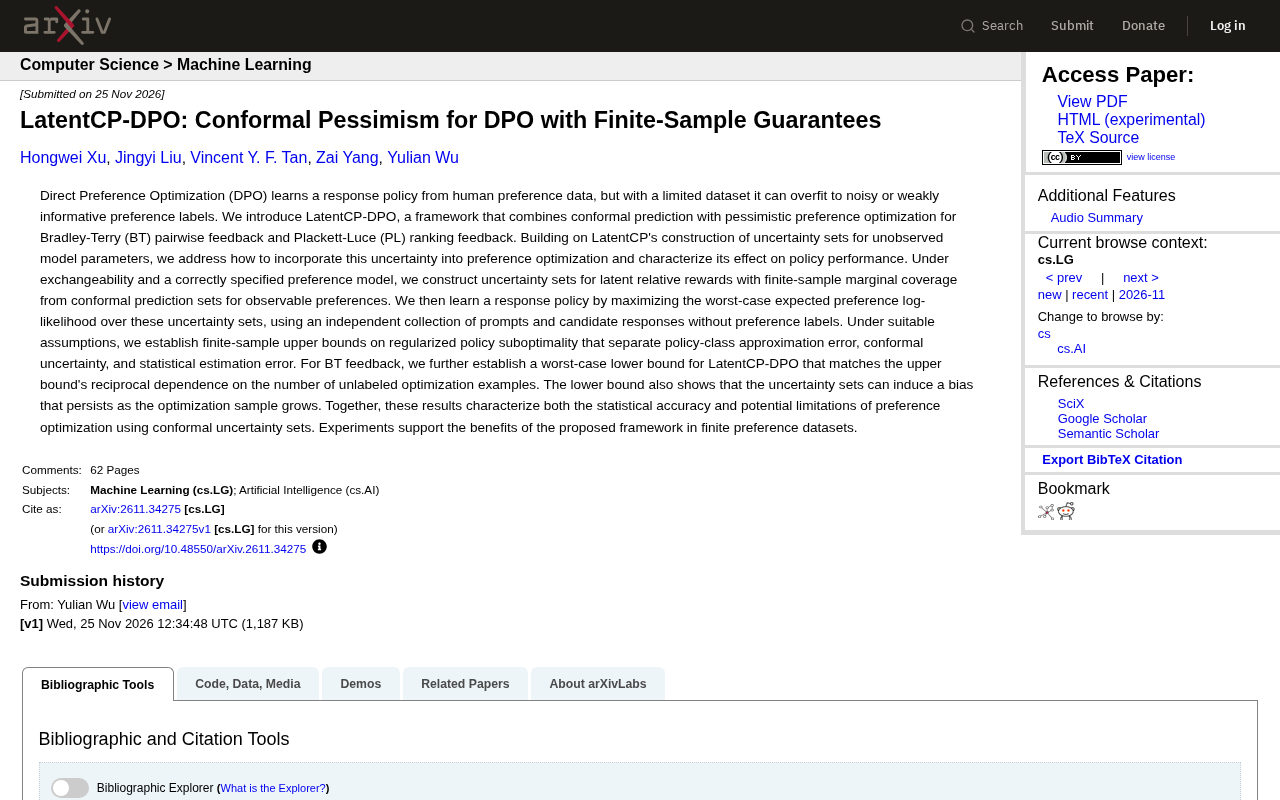
LatentCP-DPO tackles DPO's overfitting under small-scale preference data by combining conformal prediction with pessimistic preference optimization. It constructs uncertainty sets for latent relative rewards with finite-sample coverage guarantees and maximizes worst-case expected log-likelihood over these sets, requiring only unlabeled prompts and candidate responses. Theoretical analysis gives a tight suboptimality upper bound but also reveals a persistent bias from the uncertainty set that does not vanish with more optimization samples.
Preference learning is a core method for aligning large models with human preferences, but when you only have a small batch of preference-annotated data, DPO (Direct Preference Optimization) easily overfits to noisy labels or comparisons that carry insufficient information. A recent arXiv study proposes LatentCP-DPO, which attempts to add a layer of "pessimistic" insurance to DPO using conformal prediction, making the policy robust even under limited preference data.
Problem Background: DPO's Small-Data Dilemma
DPO learns response policies directly from pairwise preference data via the Bradley-Terry (BT) model or the Plackett-Luce (PL) ranking model. Its advantage is that it eliminates explicit reward modeling and reinforcement learning stages, making training more stable. However, when the preference dataset is limited, the learned policy may be overly sensitive to noise or weak preference signals in the training set, leading to degraded generalization performance.
The core tension is this: preference labels provide only indirect, incomplete information about the latent reward. The model needs to infer the unobserved reward structure from these limited observations, and statistical estimation error propagates directly into policy optimization.
Bradley-Terry and Plackett-Luce Models
These two models are the foundation for converting "preference" into a learnable mathematical form. The Bradley-Terry (BT) model assumes each response has a latent reward score, and the probability of winning in a pairwise comparison is given by the sigmoid of the difference between the two rewards, i.e., $P(y_w \succ y_l) = \sigma(r(y_w) - r(y_l))$. It only handles pairwise comparisons and is the most commonly used assumption in DPO. The Plackett-Luce (PL) model is a multi-way generalization of BT: when a comparison involves multiple candidate responses, PL gives the probability of the complete ranking via the softmax over candidate rewards. Both model preference as a function of latent rewards, so preference learning is essentially about estimating these latent rewards. Understanding this is necessary to see why LatentCP-DPO constructs uncertainty sets for the "unobserved reward structure."
LatentCP-DPO's Core Idea: Conformal Uncertainty Sets + Pessimistic Optimization
LatentCP-DPO builds on prior work on LatentCP. LatentCP can construct uncertainty sets for unobserved model parameters, and this paper addresses: how to inject this uncertainty into preference optimization and characterize its impact on policy performance.
Specifically, under the exchangeability assumption and a correctly specified preference model, the authors use conformal prediction to construct prediction sets for observable preferences, and thereby construct uncertainty sets for the latent relative reward with finite-sample marginal coverage guarantees. Then, the policy learning objective becomes: maximize the worst-case expected log-likelihood of preferences over these uncertainty sets.
Interestingly, this optimization process uses a separate set of prompts and candidate responses without preference labels. This "unlabeled optimization set" design allows the framework to leverage additional unlabeled data to tighten the worst-case bound without incurring additional preference annotation costs.
Conformal Prediction and the Exchangeability Assumption
Conformal prediction is a distribution-free uncertainty quantification method. Its core operation is: use a calibration set to compute "nonconformity scores," then construct prediction sets for new samples such that, under the exchangeability assumption, the true value falls within the set with a preset probability (e.g., 90%). The exchangeability assumption means the joint distribution of samples is insensitive to order; it is weaker than i.i.d. but typically requires the calibration set and test samples to come from the same distribution. LatentCP-DPO leverages this framework by using preference data as the calibration set to construct uncertainty sets for latent rewards with finite-sample marginal coverage guarantees. This guarantee does not depend on the specific parametric form of the reward model, making it more robust than traditional Bayesian or bootstrap methods.
Pessimistic Optimization
Pessimistic optimization is a principle for decision-making under uncertainty: rather than pursuing the average optimum under the estimated model, it maximizes the worst-case objective. In reinforcement learning and offline learning, it is often used to counter distribution shift and estimation error—since the model is uncertain about certain regions, optimize according to the least favorable case, thereby preventing the policy from exploiting model error. LatentCP-DPO introduces this idea into preference optimization: over the reward uncertainty sets given by conformal prediction, maximize the worst-case expected log-likelihood of preferences. In this way, the policy does not over-rely on potentially noisy preference signals in the training set but remains conservative against fluctuations in reward estimates. The degree of pessimism is controlled by the size of the uncertainty set, which in turn depends on the calibration sample size and confidence level, forming an adjustable conservativeness.
Theoretical Guarantees: Upper Bound, Lower Bound, and Bias Revelation
The paper provides a finite-sample upper bound on policy suboptimality and decomposes it into three interpretable parts: policy class approximation error, error from conformal uncertainty, and statistical estimation error. This decomposition allows researchers to clearly see each part's contribution to final performance.
For BT feedback, the authors further establish a worst-case lower bound that matches the upper bound in its inverse dependence on the number of unlabeled optimization samples. This means the upper bound is tight in order. But the lower bound also reveals an important phenomenon: the uncertainty set may introduce a bias that does not vanish as the optimization sample size grows. In other words, even with infinitely many unlabeled optimization data, the conservativeness induced by the conformal uncertainty set may still cause the policy to deviate from the true optimum.
This finding has dual significance: on one hand, it confirms the statistical validity of conformal pessimistic optimization under finite samples; on the other hand, it reminds practitioners that the construction of the uncertainty set itself introduces persistent bias, requiring a trade-off between conservativeness and optimality.
Suboptimality Upper and Lower Bounds
In statistical learning theory, the upper bound on suboptimality characterizes: with high probability, the performance gap between the learned policy and the true optimal policy does not exceed some value. LatentCP-DPO's upper bound decomposes into three terms—policy class approximation error (whether the policy function space can approximate the optimal policy), conformal uncertainty error (the conservativeness cost induced by the uncertainty set), and statistical estimation error (estimation fluctuation due to finite samples). The lower bound indicates the minimum performance loss any method must suffer under the same information conditions, used to judge whether the upper bound is tight. If the upper and lower bounds match in the order of sample size, the upper bound is tight and the theoretical analysis is not overly pessimistic. The paper finds that the lower bound matches the upper bound in inverse dependence on the number of unlabeled optimization samples, but also reveals that the bias introduced by the uncertainty set does not vanish as optimization samples increase—a persistent cost unique to conformal methods.
Experimental Validation and Implications
The paper's experimental results show that on limited preference datasets, LatentCP-DPO exhibits advantages over standard DPO. Although the abstract does not disclose specific datasets and metric details, the consistency between theoretical results and experimental trends supports the framework's effectiveness.
From a broader perspective, this work introduces the distribution-free guarantees of conformal prediction into preference optimization, providing a principled path for alignment training in small-data scenarios. It does not rely on large-scale preference annotations but instead improves robustness through pessimistic optimization on unlabeled data. For teams with limited resources and scarce preference data, such methods are worth attention. Meanwhile, the persistent bias problem revealed by the lower bound also points to future improvement directions: how to design tighter uncertainty sets that reduce distortion of policy optimality while maintaining coverage guarantees.
Key Takeaways
- LatentCP-DPO combines conformal prediction with pessimistic preference optimization, providing finite-sample guarantees for BT pairwise feedback and PL ranking feedback.
- The framework uses independent unlabeled prompts and candidate responses for worst-case optimization, avoiding the need for additional preference annotations.
- The theoretical decomposition clearly separates policy class approximation error, conformal uncertainty, and statistical estimation error.
- The lower bound shows that the uncertainty set introduces a bias that does not vanish as optimization samples grow, revealing the cost of conservativeness.
- Experiments support the framework's benefits on limited preference datasets, offering a new direction for small-data alignment training.
One-line Summary
LatentCP-DPO uses conformal prediction to build reward uncertainty sets and perform pessimistic optimization, improving robustness of preference learning with small data.
Paragraph Summary
LatentCP-DPO addresses the problem that DPO easily overfits under small-scale preference data by combining conformal prediction with pessimistic preference optimization. It uses conformal prediction to construct uncertainty sets for latent relative rewards with finite-sample coverage guarantees, and maximizes the worst-case expected log-likelihood of preferences over these sets, while the optimization process requires only independent unlabeled prompts and candidate responses, with no additional preference annotations. Theoretical analysis provides a suboptimality upper bound decomposed into policy class approximation error, conformal uncertainty error, and statistical estimation error, and establishes a lower bound of matching order, proving the upper bound is tight. The lower bound also reveals that the uncertainty set introduces a bias that does not vanish as optimization samples grow, indicating a persistent trade-off between conservativeness and optimality. Experiments show the method outperforms standard DPO on limited preference datasets.
Related articles

Michael Nielsen Takes Down His Classic Neural Network Textbook, Sparking Community Discussion
Michael Nielsen's classic free textbook Neural Networks and Deep Learning has been taken offline, sparking discussion on Hacker News about the reasons and impact.

Inside the AI Training Data Market: The Trade-off Between Exclusivity and Discounts
G2i founder Gabe Greenberg reveals the dual-track pricing of the AI training data market: labs pay a premium for exclusive data or accept discounts that allow others to buy it.

SessionGraph: Unifying All Coding Agent Sessions in One Interactive Graph
SessionGraph aggregates coding agent sessions into an interactive graph, helping developers review, debug, and manage AI coding workflows across sessions. This article examines its positioning, value, and open questions.