Latin American News Search: LLM Sources Less Diverse and Less Local Than Search Engines

Study finds LLM search has lower news source diversity than search engines and amplifies geographic hierarchy bias.
A study covering 9 Latin American countries and 1,901 news items compared three search engines with four language models across 49,207 requests. LLM search returned significantly less diverse news sources, with local news at only 41.3% via search engines and 3.6–11.6 points lower via LLMs. Researchers warn LLM search replicates and amplifies geographic hierarchy, weakening Global South voices, and released an open dataset advocating source diversity and geographic balance as explicit evaluation metrics.
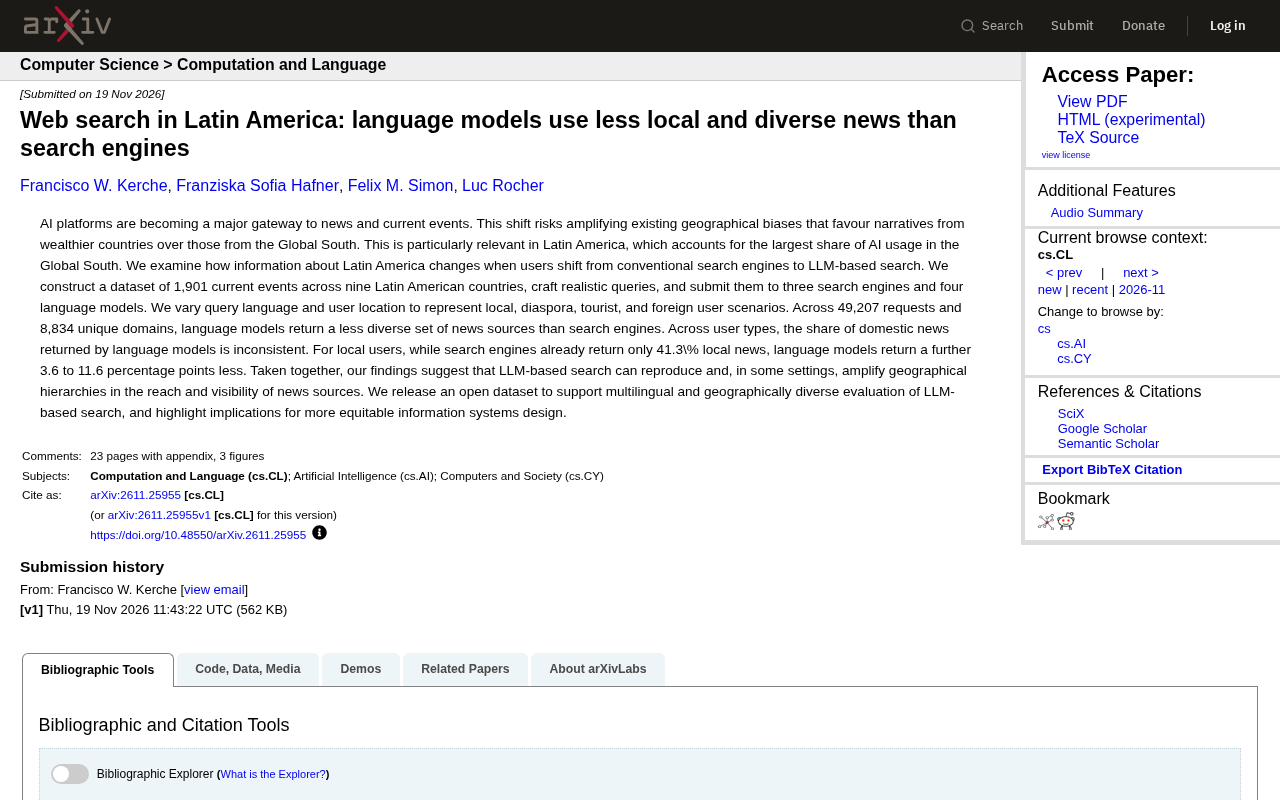
What happens to news information about Latin America when users shift from traditional search engines to large language model (LLM)-based search? A study covering 9 Latin American countries and 1,901 current-events news items offers a sobering answer: language models return significantly less diverse news sources than search engines, with a smaller share of local news—and in certain user scenarios, this geographic hierarchy bias is further amplified.
Study Design: 49,207 Requests and 8,834 Domains
The research team built a dataset covering 9 Latin American countries with 1,901 current-events news items, and designed queries that closely mirror real-world usage scenarios, submitting them to three search engines and four language models.
To simulate different user groups, the researchers varied query language and user location, covering four scenarios: local users, diaspora, tourists, and foreign users. In total, 49,207 requests were made, involving 8,834 unique domains. This scale allowed the study to statistically observe systematic differences in news source distribution across platforms.
LLM search (large language model-based search) refers to generative retrieval systems such as ChatGPT, Perplexity, and Google AI Overviews. Unlike traditional search engines that return ranked lists of web links, these systems typically retrieve a handful of candidate webpages, then have the LLM read and synthesize them into a consolidated answer—so users often see only a few cited sources. This "retrieve-then-generate" architecture means that source selection criteria shift from traditional ranking signals (link weight, click behavior, etc.) to the model's retrieval recall and summarization preferences, potentially increasing source concentration significantly—models tend to cite a small number of highly accessible, high-authority sites rather than surfacing long-tail media. This also explains why researchers need to evaluate source diversity in LLM search separately, rather than directly reusing evaluation frameworks from the search engine era.
Key Finding: Language Models Offer Less Diverse News Sources
The most direct conclusion of the study is that the set of news sources returned by language models is less diverse than that of search engines. This means users obtaining information through LLM search see a relatively more concentrated range of media types, geographic distributions, and viewpoints.
For local Latin American users, the problem is more pronounced. Among news returned by search engines, local news accounts for only 41.3%, and language models drop a further 3.6 to 11.6 percentage points below that. In other words, even though search engines already suffer from insufficient local news coverage, LLM search may further widen this gap.
A notable detail: across different user types, the share of local news returned by language models is inconsistent. This inconsistency suggests that geographic bias in LLM search is not a simple uniform pattern, but fluctuates with factors such as query language and user location.
Source diversity in information retrieval research is typically measured across multiple dimensions: the number and distribution of domains (the count of distinct sites returned for a query and their concentration, often characterized by the Gini coefficient or Shannon entropy), geographic composition (proportions of local, regional, and global media), media type (mainstream outlets, independent media, public broadcasting, etc.), and the distribution of viewpoints. Low diversity does not necessarily mean poor quality—citing a few highly credible media outlets in a concentrated manner may improve factual accuracy—but it narrows the perspectives and topics users are exposed to, particularly disadvantaging local and minority-language media. In LLM search scenarios, because the model's output citation slots are limited (typically just a few), diversity metrics are more sensitive than on traditional search results pages; even a small deviation in a single source-selection strategy can cause a marked skew in visibility.
Geographic Hierarchy: Continuity and Amplification from Search Engines to LLMs
The study's overall assessment is that LLM-based search replicates—and in some scenarios amplifies—the geographic hierarchy in news source reach and visibility. That is, narratives from wealthy countries are relatively more likely to be retrieved and presented, while voices from Global South countries remain in a relatively weaker position.
This finding is particularly relevant for Latin America, which accounts for the largest share of AI usage in the Global South. AI platforms are becoming an important gateway to news and current events; if this gateway systematically favors sources from certain geographic regions, existing information inequality may be entrenched or even exacerbated.
Geographic hierarchy is borrowed from communication studies and information geography, describing the hierarchical structure of source availability and visibility across different geographic regions in information systems: at the top are English-language and mainstream media from a handful of high-income countries, which are more fully indexed and more frequently cited; at the bottom are Global South countries, local media, and non-English media. This structure is maintained by multiple mechanisms working together—the English skew of training corpora, retrieval indices' preference for high-weight domains, models' implicit judgments about "authoritative" sources, and the language filtering effect arising from users' query language itself. The core question the research addresses is: when the search gateway shifts from link lists to generative answers, is this existing hierarchy weakened or reinforced? If LLMs only summarize from a few top-tier sources, exposure opportunities for long-tail and local media will shrink further, creating a Matthew effect of "the cited get richer."
Open Dataset and Design Implications
The researchers also released an open dataset to support multilingual, geographically diverse evaluation of LLM search. This provides a reproducible foundation for future research and raises a clear agenda for more equitable information system design: when building and evaluating LLM search, source diversity and geographic balance need to be explicit metrics, not just relevance or answer fluency.
For users and content producers who rely on AI search for news, this study offers a reality check: the migration of the search gateway is not just a change in interaction mode—it also redistributes the visibility of media from different regions and languages.
One-line Summary
Study shows LLM search has lower news source diversity than search engines and amplifies geographic hierarchy bias.
Paragraph Summary
A study covering 9 Latin American countries and 1,901 current-events news items compared news source distributions across three search engines and four language models through 49,207 requests. Results show that language models return significantly less diverse news sources than search engines, with more concentrated sourcing. For local users, search engines return only 41.3% local news, and language models drop a further 3.6 to 11.6 percentage points below that, with the gap fluctuating by query language and user location. The researchers conclude that LLM search replicates and in some scenarios amplifies the geographic hierarchy of news sourcing, further weakening the voices of Global South countries. The team also released an open dataset and calls for incorporating source diversity and geographic balance as explicit evaluation metrics for LLM search.
Related articles

Driving a Lamborghini Around the World: A Reality Show of Adventure and a Proposal
Mr. Beast initiates a Lamborghini round-the-world driving challenge. Jim and Monica cross Europe, Asia, and America, facing arguments, injuries, and reconciliation, culminating in a successful proposal at the finish line.

Can a Fine-Tuned Model on Consumer Hardware Easily Beat Jev AI? A Hands-On Investigation
A developer shares how fine-tuning a local decision model on consumer hardware easily beat Jev AI, using Sonnet for data annotation—simple, fast, and insightful.

Code-Generated Images More Practical Than Dedicated Graphics Models?
Frontier LLMs generate editable images like SVG, HTML, and 3D assets by writing code—more practical than dedicated text-to-image models for explanatory diagrams, posters, UI components, and game assets. This article analyzes the advantages and boundaries of code-driven images.