Laya AI Local Deployment Review: An Agent Powerhouse with 35ms Decisions
Laya AI achieves low-latency decisions with a non-autoregressive architecture, an 850MB footprint, and 35ms inference
The article introduces Laya AI, a non-autoregressive decision model based on a BERT/M-BERT backbone that directly scores candidate answers instead of generating text, outputting calibrated probabilities in a single forward pass in about 35ms. At only 850MB, it runs on CPU and GPU, using about 30% of a 20-core CPU in tests. Based on a Bilibili tutorial, the article covers deployment: creating a Python virtual environment, pip installation, automatic model download, and a customer service ticket routing demo using the "state + question + options" pattern. The author notes Laya excels at closed-ended multiple-choice tasks, complements traditional LLMs, and supports fine-tuning, making it suitable for real-time robotics and agent semantic guardrails.
In the fields of AI agents and robotics, decision latency often determines success or failure. Traditional large language models routinely take hundreds of milliseconds—or even seconds—to infer, leaving real-time scenarios struggling to keep up. Recently, a non-autoregressive decision model called Laya AI (referred to as LIA in the video) has caught developers' attention—it can output precise answers with calibrated probabilities in a single forward pass in just about 35 milliseconds, and it runs on both CPU and GPU. A Bilibili creator demonstrated the entire process from installation to testing in a single video. Based on that tutorial and the model's characteristics, this article breaks down Laya's deployment essentials and applicable scenarios.
What Is Laya AI: A Non-Autoregressive Model Built for Decision-Making
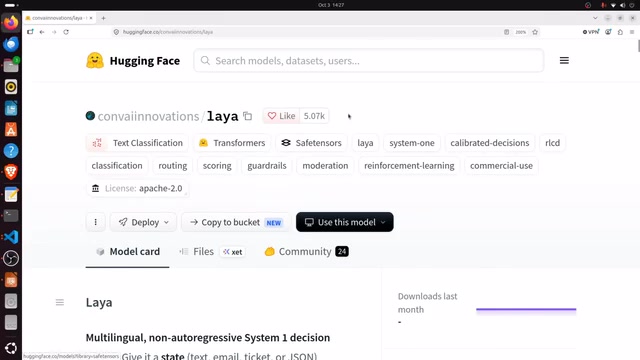
According to the video, Laya AI is fundamentally different from traditional generative models. It does not generate text word by word; instead, it feeds the input state and structured questions into a BERT/M-BERT backbone and directly scores candidate answers. This non-autoregressive architecture eliminates the token-by-token decoding overhead of heavy Transformers, making it extremely fast—in the official example, a single inference takes only about 35 milliseconds.
The model file (saved tensors) is only about 850MB, which is compact and means it can run efficiently on an ordinary CPU without a high-end GPU. In the video, the creator specifically corrected his own slip of the tongue: "This model is not super slow—actually, it's very fast." For robotic platforms, Laya can serve as a semantic guardrail, scoring safety criteria in real time and selecting behavior primitives; for AI agents, it can turn structured telemetry data into instant probabilistic decisions without invoking a massive generative model.
Non-autoregressive is an architectural paradigm contrasted with the token-by-token autoregressive generation of GPT-style models. Autoregressive models must predict one word at a time serially, with each step depending on the previous output, so latency grows linearly with output length. Non-autoregressive models assume conditional independence across output positions and can predict scores for all candidates in parallel at once. Laya uses a BERT/M-BERT backbone, essentially modeling decisions as discriminative scoring over candidate answers rather than generative decoding, so a single forward pass suffices and latency is independent of answer length. The trade-off is the loss of open-ended text generation in exchange for determinism and low latency.
M-BERT (Multilingual BERT) is the multilingual pretrained version of BERT, trained jointly on Wikipedia corpora in 104 languages with a shared vocabulary and parameters. This explains why the model in the example can directly identify the language of a customer complaint text (outputting "language is English")—the multilingual backbone lets Laya handle cross-lingual input without an additional language detection module, which is especially practical for international customer service scenarios.
Installation: Virtual Environment Isolation Is Key
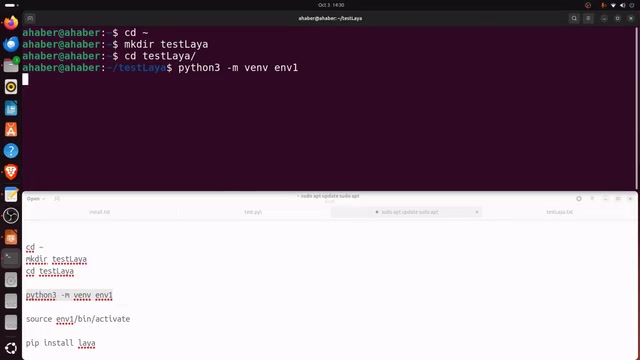
The creator emphasized that installing Laya is "super simple," but recommended always testing in a Python virtual environment to isolate dependencies. The tutorial operates in a Linux terminal: first update system packages (sudo apt update && sudo apt upgrade), then return to the home directory to create a workspace folder, enter it and run python3 -m venv venv to create a virtual environment, then activate it with source venv/bin/activate.
Next, install the Laya library. What looks like a simple pip command actually pulls in a large number of dependencies, including NVIDIA CUDA-related libraries, transformers, tokenizers, huggingface-hub, and more. The creator reminded viewers that the model will be downloaded automatically on first run, so a stable network connection is required.
Hands-On Code: A Customer Service Ticket Routing Example
After installation, the creator used VS Code to create test.py and copied the example code from the Hugging Face repository. The code logic is clear: import router and initialize it, define the "state"—for example, a customer complaint text: "Hi, we were billed twice for March. Please refund the duplicate today or we will cancel our plan."
Then define the questions: department, urgency, churn risk. The type is choice, the instruction is "which department should handle this," and the candidate answers are billing, invoices, payments, refunds, technical bugs, outage, etc. After running the code, the model outputs: should be routed to the billing department, along with the probability of "yes," and the language is English. The whole process requires no lengthy text generation—it directly provides a decision and confidence level.
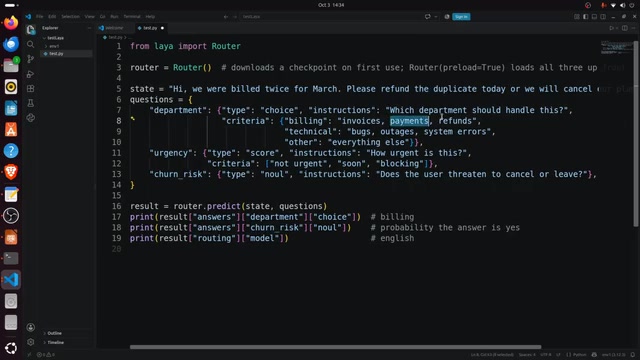
The "type is choice" in the example refers to the discrete multiple-choice task format supported by Laya: the caller provides a set of candidate labels (such as billing, refunds, technical bugs), and the model scores each candidate independently and normalizes the scores into a probability distribution. This differs from the softmax of classification models—the candidate set is specified dynamically at runtime with no fixed output dimension, so the same set of weights can serve any number of options. The "yes" probability in the output is the confidence for a binary judgment question (such as "is this a churn risk"). This structured question-answering (state + question + choices) interface makes decision results naturally interpretable: probabilities directly reflect the model's relative preference for each option, making it easy to set thresholds that trigger human fallback or escalation workflows.
Performance Test: Only 30% CPU Usage
To verify resource consumption, the creator opened two terminals: one running nvtop to monitor the GPU, and another running htop to monitor the CPU. Re-running the model on a system with a 20-core CPU, he observed that the process used only about 30% CPU. This confirms Laya's lightweight nature—it does not need to saturate compute and is suitable for coexisting with other tasks.
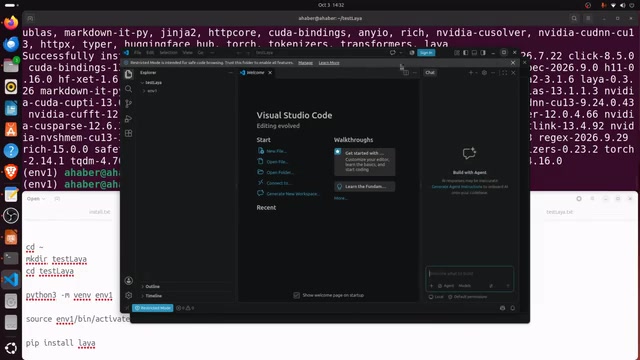
In the video, the creator opened VS Code, trusted the workspace folder, and then completed writing and running the code. The entire process involved no complex configuration and is beginner-friendly.
Applicable Scenarios and Customization Potential
Laya's positioning is very clear: instant decision-making and agents. In robotics scenarios, it can evaluate sensor data and environmental states in real time to quickly select behaviors; in customer service automation, it can accurately route tickets to the right department and provide interpretable probabilities. The video mentions that base checkpoints can be fine-tuned on custom domain data to improve accuracy for specific tasks. This means enterprises can train Laya with their own business data and turn it into a dedicated decision engine.
However, Laya is not a general-purpose chat model. What it excels at is closed-ended questions—given a state and options, it scores them quickly. If your scenario requires open-ended generation, multi-turn dialogue, or complex reasoning, traditional LLMs remain the better choice. The two can complement each other: LLMs handle understanding and generation, while Laya handles low-latency deterministic decisions.
Fine-tuning base checkpoints means continuing training on top of the official pretrained weights using domain-labeled data. Because Laya uses a discriminative scoring architecture, fine-tuning data only needs triples of "state—question—correct option," without constructing generative target text, making labeling costs significantly lower than training dialogue models. A typical approach is to freeze the BERT backbone and train only the top classification head (parameter-efficient), or perform full fine-tuning when sufficient data is available. Enterprises can use the handling department of historical tickets as labels to let the model learn their own business routing rules; in robotics scenarios, logs of behavior primitive selections can serve as supervision signals.
Conclusion: A Small, Fast Model Built for Decision-Making
With its 850MB size, 35-millisecond inference speed, and CPU-friendly characteristics, Laya AI offers a pragmatic choice for real-time agents. The Bilibili tutorial demonstrated a minimalist installation process and an intuitive customer service routing case, verifying its ease of use. For edge devices or robotic platforms that require rapid decisions and have limited resources, Laya is worth trying. But note that it solves "multiple-choice questions," not "open-ended questions"—understanding its boundaries is the key to getting the most value from it.
One-line Summary
Laya AI achieves low-latency decisions with a non-autoregressive architecture, an 850MB footprint, and 35ms inference
Paragraph Summary
The article introduces Laya AI, a non-autoregressive decision model based on a BERT/M-BERT backbone that does not generate text word by word but directly scores candidate answers, outputting calibrated probabilities in a single forward pass in about 35 milliseconds. The model is only 850MB and runs on both CPU and GPU, using about 30% of a 20-core CPU in testing. Based on a Bilibili tutorial, the article breaks down the deployment process: creating a Python virtual environment, pip installation (automatically pulling in dependencies such as CUDA and transformers), automatic model download on first run, and demonstrating the "state + question + candidate options" invocation pattern with a customer service ticket routing example. The author notes that Laya excels at closed-ended multiple-choice tasks rather than open-ended generation, can complement traditional LLMs, and supports fine-tuning on custom domain data, making it suitable for real-time robotic decision-making and agent semantic guardrails.
Related articles
DeepSeek Harness: Taking AI Testing from Standalone Tools to a Team Platform
DeepSeek Harness changes AI testing collaboration with server-side operation and a plugin mechanism. This article analyzes its core differences from standalone tools like Codex and explores how test development can build team-level AI testing capabilities through platform thinking.

Expected Volume of Two Intersecting Spheres: A Geometric Probability Puzzle
A geometric probability puzzle: two unit spheres intersect randomly; find the expected volume of their intersection. This article explains the problem setup, probabilistic modeling, and the integration framework—a great challenge for math enthusiasts.

iPhone Duo Foldable: A Step Back for Vertical Video, or a Return to Landscape?
YouTube analysis says the iPhone Duo foldable's identical outer/inner aspect ratios crop vertical video into a square, hurting the experience. If the Duo catches on, landscape video may return.