Lazy-CPBS: Making Industrial AGV Fleet Coordination More Efficient

Proposes the AGV-MAPF_R-CTC framework and Lazy-CPBS algorithm to efficiently deploy continuous-time MAPF in industrial AGV fleet coordination.
Industrial AGV road networks are highly connected and redundant, making direct MAPF application inefficient. This study proposes the AGV-MAPF_R-CTC formal framework that precomputes continuous-time conflicts to enable MAPF_R solvers for AGV fleet coordination with minimal modification. It re-examines CPBS's SIPP boundary conditions, implements earlier solution detection, and analyzes the priority search space to reveal wasted low-level searches on unexpanded nodes. Lazy-CPBS then lazily materializes high-level nodes, eliminating overhead for unexpanded siblings. Experiments show CPBS-based solvers scale to far more agents than optimal MAPF_R solvers, with Lazy-CPBS offering the best robustness/runtime trade-off.
Title
Lazy-CPBS: Making Industrial AGV Fleet Coordination More Efficient
Meta Description
A new study proposes the AGV-MAPF_R-CTC formal framework and the Lazy-CPBS algorithm, which significantly reduces the search overhead of continuous-time MAPF in industrial AGV fleet coordination through lazy materialization of high-level nodes. Experiments show it achieves the best robustness/runtime trade-off on industrial road networks.
Article Content
Coordinating automated guided vehicle (AGV) fleets in industrial settings has always been a challenge: maps are highly connected with redundant paths, and applying multi-agent path finding (MAPF) algorithms directly often proves inefficient. A recent study proposes the AGV-MAPF$_R$-CTC formal framework and introduces the Lazy-CPBS algorithm, making the deployment of continuous-time MAPF on industrial road networks feasible.
From MAPF to Industrial AGVs: A Formal Bridge
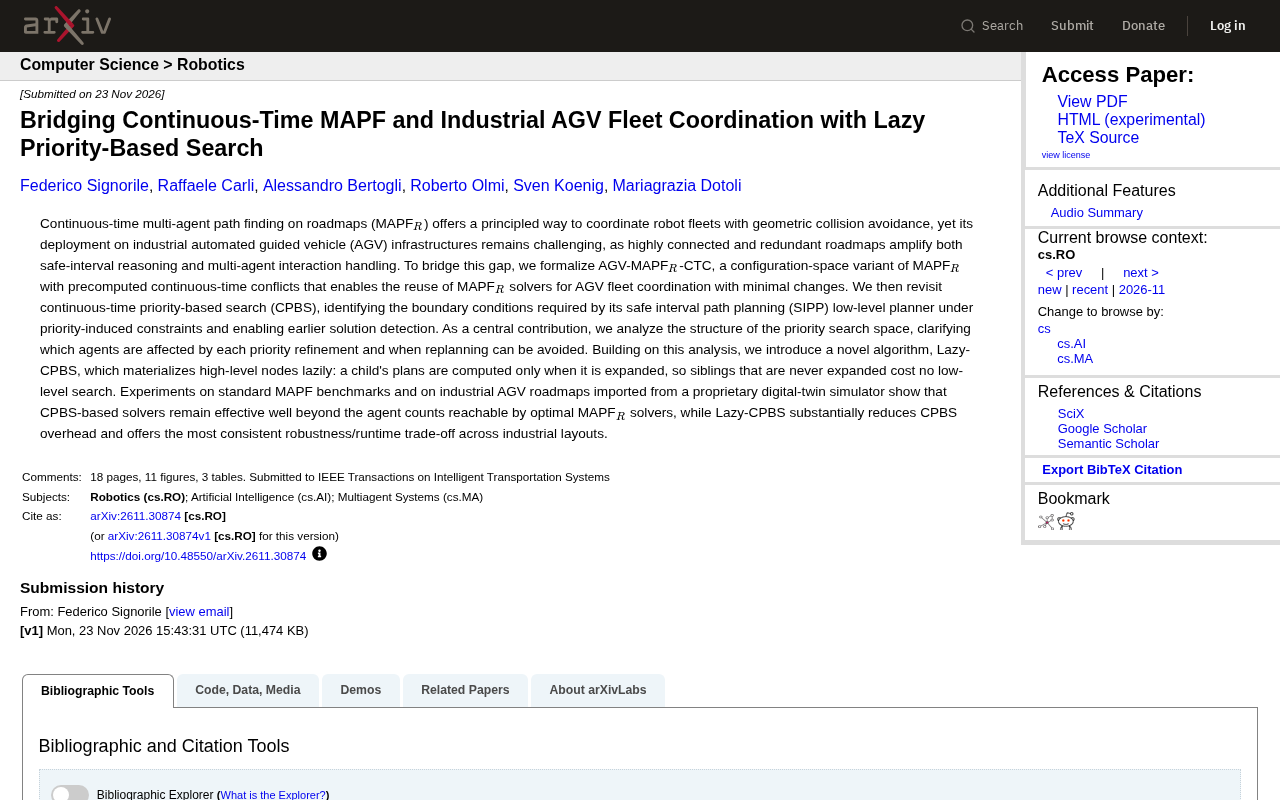
Continuous-time multi-agent path finding (MAPF$_R$) provides a principled approach to robot fleet coordination, enabling geometric collision avoidance. However, industrial AGV infrastructure maps are highly connected and redundant, which amplifies the complexity of safe-interval reasoning and multi-agent interaction handling.
The research team formalizes the problem as AGV-MAPF$_R$-CTC—a configuration-space variant that precomputes continuous-time conflicts, allowing MAPF$_R$ solvers to be used for AGV fleet coordination with almost no modification. This provides a standard interface for bringing academic algorithms into industrial settings.
Safe Interval Path Planning (SIPP) is a single-agent path planning algorithm designed for dynamic environments. It compresses paths into a series of "safe intervals"—time periods during which an agent can wait without conflicting with other moving obstacles—thereby efficiently handling collision avoidance constraints along the temporal dimension. In the priority-based search framework of MAPF, SIPP is often used as a low-level planner to find a feasible path for a given agent under high-level constraints. The core advantage of SIPP lies in avoiding layer-by-layer search over the time-expanded graph, but its correctness depends on precise handling of safe-interval boundary conditions—which is exactly why the original paper notes that the boundary conditions of CPBS need to be re-examined.
Revisiting CPBS: Boundary Conditions and Earlier Solution Detection
Continuous-time priority-based search (CPBS) is a classic approach to MAPF, but the boundary conditions of its underlying SIPP (Safe Interval Path Planning) planner under priority-induced constraints had not been previously clarified. The authors re-examined these conditions and implemented earlier solution detection, thereby improving search efficiency.
This improvement may seem minor, but it directly affects the algorithm's usability in complex road networks—unclear boundary conditions can cause the planner to frequently fail or produce suboptimal solutions.
Conflict-Based Search (CBS) and Priority-Based Search (PBS) are two classic high-level search frameworks in MAPF. CBS branches by detecting conflicts between multi-agent paths and generating constraints, with completeness and optimality guarantees, but the constraint tree can grow explosively. PBS plans paths for agents sequentially in priority order, treating already-planned agents as dynamic obstacles, resulting in a smaller search space and faster speed, but it is generally incomplete. CPBS (continuous-time PBS) is an extension of PBS to continuous-time MAPF, where high-level nodes represent a priority ordering and the corresponding set of paths, and the low level invokes continuous-time planners such as SIPP. The re-examination of CPBS boundary conditions in the original paper is precisely to ensure the correctness and efficiency of this classic framework in the continuous-time setting.
Structural Analysis of the Priority Search Space
As one of the core contributions, the study provides an in-depth analysis of the structure of the priority search space, clarifying which agents are affected by each priority refinement and when re-planning can be avoided.
This analysis reveals the root cause of CPBS's high overhead: many high-level nodes are generated but never expanded, and their low-level searches are purely wasted. With this structure understood, the optimization direction becomes clear.
Lazy evaluation is a common algorithmic optimization strategy: deferring expensive computation until the result is actually needed, thereby avoiding the cost of intermediate results that will never be used. In search algorithms, lazy materialization means generating only a lightweight description of a node, and computing its full content (such as low-level path planning) only when the node is selected for expansion. This contrasts with the eager strategy of "generate-and-compute" in breadth-first or best-first search. Lazy-CPBS applies this idea to high-level priority search: sibling nodes that are never expanded no longer trigger low-level SIPP calls, thereby eliminating a large amount of redundant computation.
Lazy-CPBS: Lazy Materialization of High-Level Nodes
Based on the above analysis, the authors propose the Lazy-CPBS algorithm, whose core is lazy materialization of high-level nodes: child nodes are planned only when expanded, so sibling nodes that are never expanded incur no low-level search overhead.
Experiments on standard MAPF benchmarks and industrial AGV road networks imported from a proprietary digital twin simulator show that CPBS-based solvers scale to far more agents than optimal MAPF$_R$ solvers can handle, while Lazy-CPBS substantially reduces CPBS overhead and provides the most consistent robustness/runtime trade-off across various industrial layouts.
Implications for Industrial Deployment
The value of this work lies in its two-way bridging: it adapts continuous-time MAPF theory to industrial AGV constraints, and it addresses the performance bottleneck in practical deployment through Lazy-CPBS. For factories that rely on digital twins for fleet scheduling, this means that principled algorithms can be used for larger-scale fleets rather than relying on heuristic rules.
However, the diversity of industrial road networks and the handling of dynamic obstacles remain open problems, and whether Lazy-CPBS's robustness advantages can be reproduced on real production lines requires further validation.
Key Takeaways
- The AGV-MAPF$_R$-CTC formal framework enables MAPF$_R$ solvers to be used for industrial AGV fleet coordination with minimal modifications.
- The boundary conditions of the SIPP planner in CPBS are redefined, enabling earlier solution detection.
- The structure of the priority search space is analyzed, clarifying the scope of priority refinement effects and the conditions for avoiding re-planning.
- Lazy-CPBS eliminates the low-level search overhead of unexpanded sibling nodes through lazy expansion of high-level nodes.
- Experiments show that CPBS-based solvers can handle far more agents than optimal MAPF$_R$ solvers, and Lazy-CPBS achieves the best robustness/runtime trade-off in industrial layouts.
One-line Summary
Proposes the AGV-MAPF_R-CTC framework and the Lazy-CPBS algorithm, enabling efficient deployment of continuous-time MAPF in industrial AGV fleet coordination.
Paragraph Summary
Industrial AGV road networks are highly connected and redundant, making direct application of multi-agent path finding (MAPF) inefficient. This study proposes the AGV-MAPF_R-CTC formal framework, which precomputes continuous-time conflicts so that continuous-time MAPF_R solvers can be used for AGV fleet coordination with almost no modification. The authors re-examine the boundary conditions of the SIPP planner in CPBS and implement earlier solution detection, while also analyzing the structure of the priority search space, revealing that many high-level nodes are generated but never expanded, causing wasted low-level search. Based on this, they propose Lazy-CPBS, which lazily materializes high-level nodes so that unexpanded sibling nodes incur no low-level overhead. Experiments show that CPBS-based solvers can handle far more agents than optimal MAPF_R solvers, and Lazy-CPBS provides the most consistent robustness/runtime trade-off across various industrial layouts.
Related articles

From 0 to 1: Vibe Coding an AI Knowledge Base — A Practical Retrospective and Tech Stack Breakdown
A retrospective on building the AI knowledge base OilBook from scratch with Vibe Coding: Next.js+Neon stack, Oil Dev Skill workflow, Stripe paywall security, interview-style writing, AI-flavor control, and Vercel deployment.

GLM-5.4 Hands-On: Native Vision Meets a New Vibe Coding Workflow
Hands-on with Zhipu GLM-5.4: native vision tested across a 3D product demo, pure-code video generation, and remote-control Vibe Coding, compared with GPT-6.2 and Gemini Neon.

AI and Humans Claim to Prove the Riemann Hypothesis: Machine-Verified, Yet Nobody Can Understand It
Anthropic mathematician and AI Claude claim to prove the Riemann Hypothesis with 17 million lines of Lean code, machine-verified but unreadable by humans. This article analyzes the event, the zero proportion record from 41.6% to 67.2%, and the gap between machine verification and human understanding.