LazySusan: One API Key to Access All Major AI Models

LazySusan unifies Claude, GPT, Gemini, and more under a single API key with team-level usage governance.
LazySusan is a hosted AI model aggregation service that lets developers call models from Claude, GPT, Gemini, FLUX, Veo, and other providers using a single API key and prepaid credit balance — switching models requires changing just one string. Its zero-dependency Python SDK supports streaming, tool calling, structured JSON output, image input, and async video generation. Every response returns token usage and credit cost, and per-key controls include monthly budgets, model allowlists, expiration dates, and metadata tags for multi-project cost attribution. The author has disclosed this is their own product; real-world latency, stability, and pricing should be tested against your specific use case.
One Key to Rule All Major AI Models
In modern AI development, developers often need to integrate multiple model providers simultaneously: Claude for reasoning, GPT for general conversation, Gemini for multimodal tasks, FLUX for image generation, and Veo for video generation. Every new provider means a separate API key, a separate billing system, and a different SDK convention. LazySusan aims to solve exactly this fragmentation problem — unifying chat, image, and video models under a single API key and prepaid balance.
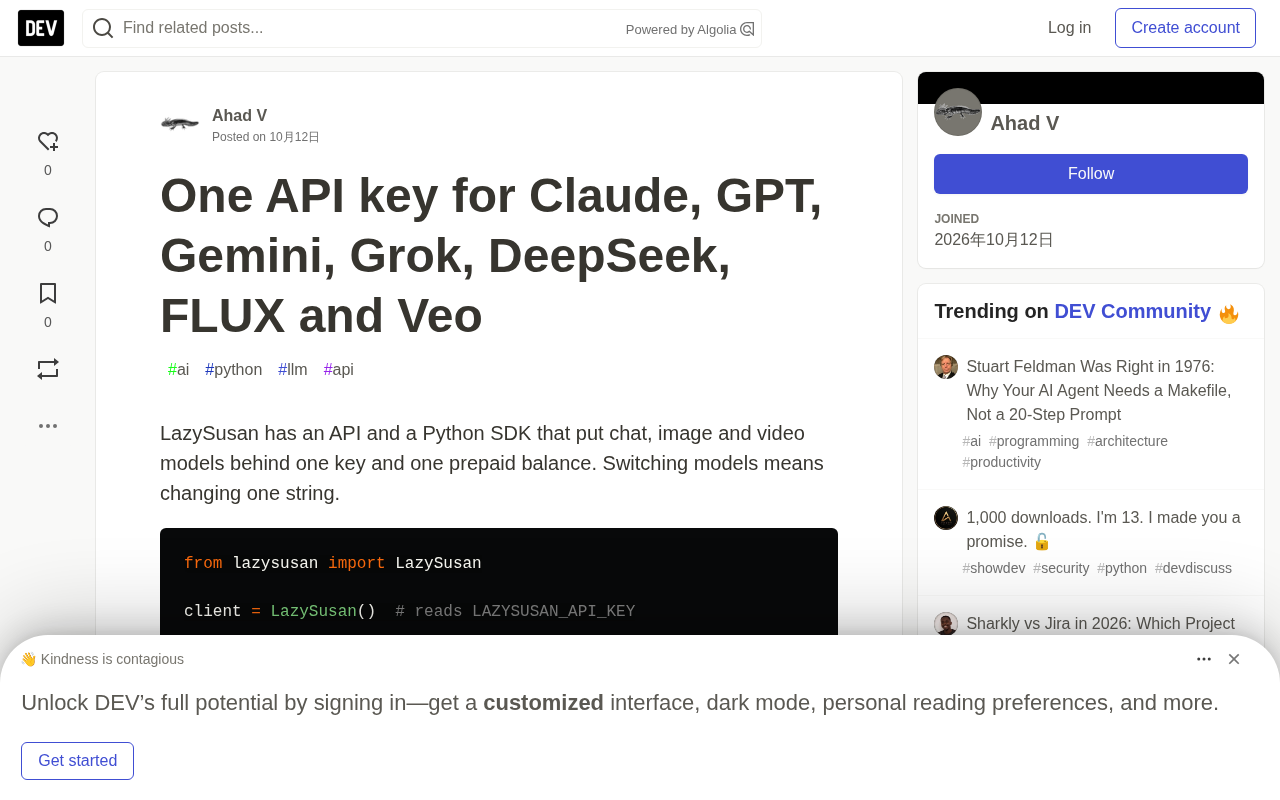
According to the official description, switching models requires changing just one string. Developers no longer need to rewrite request logic for each provider or manage multiple accounts and invoices. This design philosophy follows in the footsteps of aggregation-layer products like LiteLLM and OpenRouter, with the core value proposition being a lower integration cost for multi-model workflows.
LiteLLM and OpenRouter are the two most representative aggregation-layer solutions available today, and understanding them helps clarify LazySusan's differentiated positioning. LiteLLM is an open-source library that runs on the developer's own infrastructure, proxying calls to various models through a unified OpenAI-compatible interface — its strength lies in keeping data off third-party servers and supporting self-hosting. OpenRouter, on the other hand, is a hosted API aggregation service that charges per use with no self-maintenance required, though traffic passes through OpenRouter's nodes. LazySusan belongs to the same category as OpenRouter — a hosted aggregation service — with the distinction that it uses a prepaid credit system and offers more granular enterprise-level controls at the key governance layer. For small teams that lack the capacity to maintain self-hosted infrastructure, hosted aggregation layers can dramatically lower the operational barrier; however, for scenarios with strict data compliance requirements, self-hosted solutions remain the preferred choice.
A Zero-Dependency Python SDK
From the code examples, LazySusan's usage pattern is quite clean:
from lazysusan import LazySusan

client = LazySusan()  # reads LAZYSUSAN_API_KEY

reply = client.chat.create(
    model="anthropic/claude-sonnet-5-5",
    messages=[{"role": "user", "content": "Summarise this in two lines: ..."}],
)
print(reply.text)
print(reply.usage.cost_credits)
Model names follow a provider/model naming convention (e.g., anthropic/claude-sonnet-5-5), which aligns with common aggregation-layer conventions in the industry and makes it easy for developers to understand and migrate.
Notable engineering characteristics of the SDK include: zero dependencies, full type annotations, and support for Python 3.9+. Zero dependencies mean no version conflicts with existing libraries in your project — particularly friendly for production environments. Type annotations enable better IDE autocompletion and static analysis. Installation is straightforward: pip install lazysusan.
Feature Coverage
According to the official documentation, LazySusan covers most capabilities needed for modern LLM applications:
- Streaming: Supports token-by-token responses, ideal for building real-time interactive interfaces
- Tool Calling: Supports function calling, a foundational capability for building Agent applications
- JSON Output: Structured responses for easy programmatic parsing
- Image Input: Supports multimodal understanding scenarios
- Async Video Generation: Handles long-running tasks for video models like Veo asynchronously
This feature set covers the full spectrum from simple chat to complex Agents, and from text to multimodal use cases — indicating that the product is not merely an API proxy, but aims to support complete development workflows.
Tool Calling is worth explaining on its own, as it is the core mechanism behind AI Agents. In essence, it allows a model to "declare" during response generation that it needs to invoke an external function (such as querying a database, performing a search, or reading/writing files). The host application executes the function and returns the result to the model, forming a multi-turn interaction loop. After OpenAI standardized this capability in 2023, major model providers followed suit, converging on a relatively consistent interface specification. For an aggregation layer to correctly support tool calling, it must handle format translation between different providers' tool calling schemas — the quality of this implementation directly affects whether Agent applications can switch seamlessly across models, and is a key capability to test when evaluating any aggregation-layer product.
Cost and Usage Governance
LazySusan has invested considerable effort in billing transparency and usage management, which sets it apart from simple model proxies.
Every response returns token usage and credit cost (as shown by reply.usage.cost_credits in the example), giving developers real-time visibility into the cost of each call. This is highly practical for teams that need fine-grained budget control.
At the key governance level, it offers several features aimed at teams and enterprises:
- Per-key monthly budgets: Prevent overspending on individual keys
- Model allowlists: Restrict a key to only specific models
- Expiration dates: Set validity periods for keys
- Metadata tags: Filter usage by project or feature dimension
These features indicate that the product serves not only individual developers but also tries to address cost attribution and access control needs across multi-project, multi-team environments. Metadata tags are particularly worth highlighting — when multiple projects within an organization share the same AI infrastructure, splitting invoices by tag is a real necessity.
Use Cases and Positioning
LazySusan's value proposition is clear: use a unified interface and prepaid balance to reduce the management complexity of multi-model integration. For teams that need to flexibly switch models across different tasks, or want to compare results from multiple providers, this type of aggregation layer can significantly reduce engineering overhead.
It's worth noting that the project's author transparently disclosed in the original post that this is their own product ("Disclosure: I built this"). Therefore, all features mentioned in this article are based on official documentation. Actual stability, latency, pricing competitiveness, and differences compared to calling provider APIs directly still need to be evaluated by developers through hands-on testing in their own scenarios. Aggregation layers typically involve trade-offs between convenience and control — for example, they may introduce additional network hops or have some lag in supporting newly released models.
For developers evaluating multi-model integration approaches, LazySusan is a worthwhile addition to the comparison list. The official documentation is available at https://www.lazysusan.ai/developers/docs.
Related articles

ChatGPT Space Launches: Team Collaboration and New Pages Features Explained
ChatGPT Space is OpenAI's new team collaboration feature with Pages, real-time collaboration, and Slack/Google Drive sync. We break down its privacy design, multi-platform integration, and the full workflow from conversation to document.

Migrating Apache Spark UDFs to GPU Acceleration with AI Agents
NVIDIA developer blog explains how AI Agents rewrite Apache Spark UDFs for GPU acceleration, covering migration criteria, agent rewriting and verification workflows, plus pitfalls like result consistency and CPU-GPU transfer overhead.

Zed Editor v0.40.4-rc2 Released: Usage Credits Now Available Without Upgrading
Zed editor releases v0.40.4-rc2, allowing users to use usage credits for AI features without upgrading to a paid plan, lowering the trial barrier.