Leaked Before Launch: Moto Tag 3 Now Available for Preorder on Amazon

Motorola's unannounced Moto Tag 3 has surfaced on Amazon UK and is on sale, just five months after the previous generation launched.
Motorola's yet-to-be-announced Moto Tag 3 has suddenly appeared on Amazon UK and is available for purchase, only five months after the Moto Tag 2 launched in the US, with no official teaser. The page shows the new product in a Pantone Lucent White colorway, but pricing, shipping dates, and core specs are not disclosed. The article suggests this unusual cadence could be a channel error, an accidentally public placeholder page, or Motorola intentionally compressing its product cycle and accelerating lineup changes. For consumers, ordering early carries the risk of canceled orders and no review references; waiting for an official announcement is safer. The leak has already cost Motorola control over its launch cadence and may affect previous-generation sales while prompting competitors to react early.
An Unusual Early Listing
Motorola's yet-to-be-announced Moto Tag 3 has suddenly appeared on Amazon UK and is already available for purchase—just five months after the Moto Tag 2 launched in the US, and with no official teaser for the new generation. The discovery was made by X user @matteventu, and the product page shows the tracker in a "Pantone Lucent White" colorway.
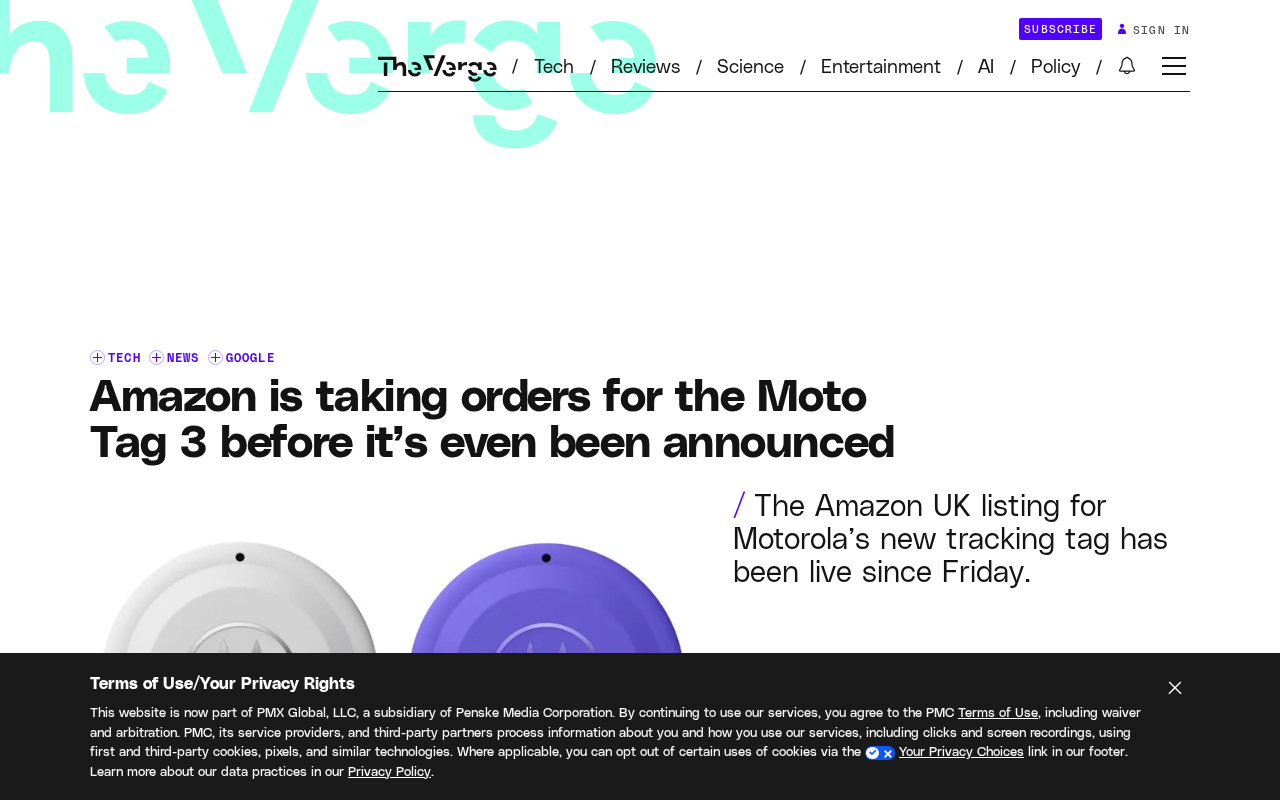
For an iterative product, a sales page for a successor appearing less than six months after the previous model launched is clearly an abnormal cadence. This could be a channel error, a placeholder page accidentally made public, or Motorola intentionally compressing its product cycle. Regardless of the cause, the premature listing has already exposed the new product's existence and some of its appearance.
Why This Leak Matters
The Bluetooth tracker market has grown increasingly competitive in recent years, and Motorola entered the space occupied by Apple's AirTag and Samsung's SmartTag with its Moto Tag series. Product iterations typically run on an annual cycle, so a new version appearing after five months suggests Motorola may be accelerating hardware changes or correcting certain shortcomings of the previous generation.
Based on the leaked information, the Moto Tag 3 will at least offer a new white colorway, but it remains unclear whether core specs, battery life, or anti-loss features have been upgraded. Amazon pages usually include pricing and shipping dates, but the currently public screenshots and descriptions do not reveal these details, making it impossible to determine whether the new product is a routine refresh or a substantive upgrade.
A Bluetooth tracker is a small piece of hardware that communicates with phones, tablets, and other devices via low-power Bluetooth (BLE), typically attached to keys, bags, or placed in a wallet for reverse-finding lost items. Its basic working principle: the tracker continuously broadcasts a Bluetooth signal, and when a paired phone is within range, it can locate it directly; once out of range, it relies on other nearby users' devices forming a "finding network" (such as Apple's Find My or Google's Find My Device network) to anonymously and encrypted relay detected locations, enabling rough positioning on a global scale. Because these products rely on crowdsourced networks rather than GPS, they must balance privacy design, power consumption, and positioning accuracy—and ecosystem integration often matters more to the experience than individual hardware specs.
Pantone is a company known for color standardization, and its Pantone Matching System (PMS) is widely used in design, printing, and manufacturing to ensure different vendors have a consistent understanding of the same color. When consumer electronics manufacturers cite Pantone color names in marketing, it is usually to emphasize the design sensibility and accuracy of the colorway rather than technical specifications. For small accessories like trackers, colorways are often one of the main ways to distinguish generations and encourage upgrades, so names like "Pantone Lucent White" are primarily marketing-level information and do not themselves represent a hardware upgrade.
The Practical Impact of the Early Listing on Consumers
For ordinary users, the already-listed Moto Tag 3 means they can place an order, but the risk is that the product has not undergone an official launch or media reviews, so the actual experience is unknown. If this is merely a placeholder page, orders may subsequently be canceled; if the product is indeed ready, early buyers will get the device before official marketing.
The safer approach is to wait for Motorola's official announcement. Products like trackers rely heavily on ecosystem integration and software experience, and an Amazon product page alone cannot determine whether its integration with phones and map apps is mature.
A placeholder page is a common practice in e-commerce operations: merchants create a page before a product officially goes on sale, filling in a temporary title, images, and placeholder price to test the listing process, reserve product codes, or coordinate with advertising. Such pages are sometimes mistakenly set to public visibility, causing unreleased products to be exposed prematurely. To judge whether a page is a placeholder, look for abnormal pricing, vague inventory descriptions, missing shipping dates, and whether the page is taken down within a short period. If it is indeed a placeholder, placed orders are usually canceled by the platform or cannot be fulfilled.
Possible Strategies Behind the Official Silence
Motorola has so far made no response regarding the Moto Tag 3. A five-month product interval is uncommon in consumer electronics; one possibility is that the Moto Tag 2's market performance prompted the company to quickly release an improved version; another is that the Amazon page was a misconfiguration and the actual launch is still months away.
Either way, this leak has cost Motorola control over its launch cadence. In the fiercely competitive tracker market, prematurely exposing product information may affect sales of the previous generation and prompt competitors to react early. What's worth watching next is whether the Amazon page will be taken down and when Motorola will issue an official statement.
Related articles

From 0 to 1: Vibe Coding an AI Knowledge Base — A Practical Retrospective and Tech Stack Breakdown
A retrospective on building the AI knowledge base OilBook from scratch with Vibe Coding: Next.js+Neon stack, Oil Dev Skill workflow, Stripe paywall security, interview-style writing, AI-flavor control, and Vercel deployment.

GLM-5.4 Hands-On: Native Vision Meets a New Vibe Coding Workflow
Hands-on with Zhipu GLM-5.4: native vision tested across a 3D product demo, pure-code video generation, and remote-control Vibe Coding, compared with GPT-6.2 and Gemini Neon.

AI and Humans Claim to Prove the Riemann Hypothesis: Machine-Verified, Yet Nobody Can Understand It
Anthropic mathematician and AI Claude claim to prove the Riemann Hypothesis with 17 million lines of Lean code, machine-verified but unreadable by humans. This article analyzes the event, the zero proportion record from 41.6% to 67.2%, and the gap between machine verification and human understanding.