@ai-sdk/harness-fx 1.0.107 Released: MCP Dependency Upgrade, Patch Update
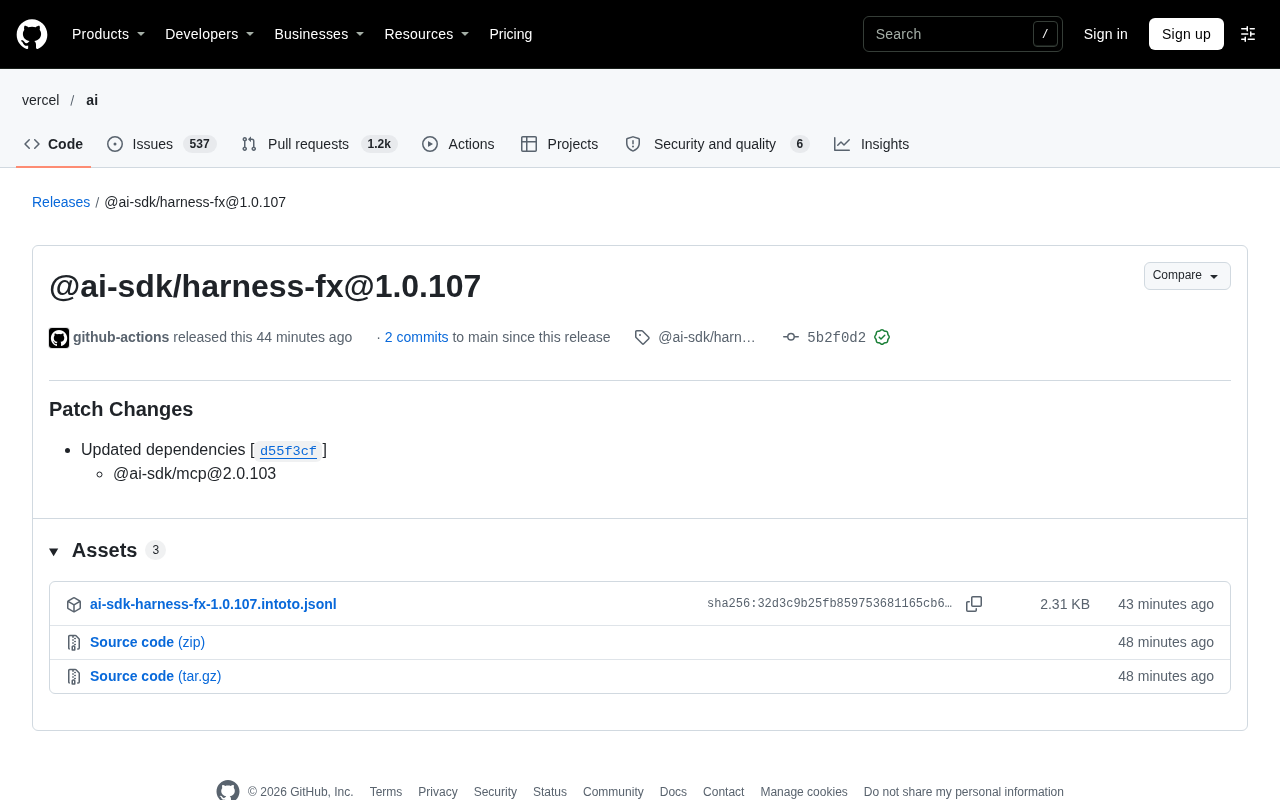
@ai-sdk/harness-fx releases patch 1.0.107, updating dependency @ai-sdk/mcp to 2.0.103.
@ai-sdk/harness-fx released patch 1.0.107, automatically published by GitHub Actions with commit hash 5b2f0d2 and GitHub signature verification. This is a Patch Changes release whose core action is upgrading the dependency @ai-sdk/mcp to 2.0.103. Since @ai-sdk/mcp handles standardized access to external tools and data sources via the Model Context Protocol, the upgrade means following up on protocol compatibility and bug fixes. The release note does not list specific changes in mcp 2.0.103, so developers should verify MCP connections and tool calls and may consult commit d55f3cf. Overall, this is a low-risk routine dependency sync suitable for projects keeping pace with the MCP ecosystem.
Title
@ai-sdk/harness-fx 1.0.107 Released: MCP Dependency Upgrade, Patch Update
Meta Description
@ai-sdk/harness-fx 1.0.107 released, primarily updating the dependency @ai-sdk/mcp to 2.0.103. Learn about the contents of this patch update, its impact on AI SDK developers, and upgrade recommendations.
Article Content
A minor component in the AI SDK ecosystem, @ai-sdk/harness-fx, has released version 1.0.107. For developers deeply using the AI SDK to build applications, changes in such patch versions may be small, but they are often tied to the stability of the underlying dependency chain.
Version Release Overview
@ai-sdk/harness-fx@1.0.107 was automatically released by GitHub Actions, with commit hash 5b2f0d2 and a GitHub verified signature. This version is a Patch Changes release, and its main action is to update the dependency @ai-sdk/mcp to version 2.0.103. From the release process perspective, this is a typical automated dependency maintenance operation.
The release page itself also showed a loading error message, which may be a temporary GitHub page failure when rendering release information, and does not affect the actual release and download of the version package.
About Patch Versions and Semantic Versioning (SemVer)
In the semantic versioning specification, the three segments of the version number MAJOR.MINOR.PATCH each carry different commitments: a major version change indicates incompatible API breaking changes; a minor version increase represents backward-compatible new features; and an incremented patch number is only used for backward-compatible bug fixes. @ai-sdk/harness-fx going from 1.0.x to 1.0.107 and @ai-sdk/mcp to 2.0.103 are both changes to the third number, which according to the specification should not introduce breaking changes. However, in the actual ecosystem, patch versions occasionally also include minor behavioral adjustments or transitive dependency updates, so the article suggests that verification in a test environment is not unnecessary. In addition, the AI SDK ecosystem is driven by pnpm workspace and Changesets for releases: when a PR is merged, contributors submit a changeset describing the type of change, and CI then automatically calculates the version number, generates the CHANGELOG, and triggers the npm release based on it. This is exactly the mechanism behind "automatically released by GitHub Actions" mentioned in the article.
The Significance Behind the Dependency Upgrade
@ai-sdk/mcp is the module in the AI SDK related to the Model Context Protocol (MCP). MCP aims to provide a standardized context access method for AI applications, allowing models to access external tools and data sources in a more standardized way. As a testing or runtime framework, harness-fx's updates to the mcp dependency version usually mean following up on protocol compatibility or bug fixes.
This upgrade to 2.0.103 is a minor version iteration and does not mention breaking changes. For developers using harness-fx, this is a patch worth following up on to ensure synchronization with the MCP ecosystem.
About the Model Context Protocol (MCP)
MCP is an open protocol proposed and open-sourced by Anthropic at the end of 2024, with the goal of unifying the interaction between large language models and external tools and data sources. Before this, each AI application that needed to connect to databases, file systems, or third-party APIs often had to implement its own function calling schema and transport layer logic, causing a large amount of duplicate work and ecosystem fragmentation. MCP adopts a client-server architecture: the model side acts as the client and requests resources, invokes tools, or obtains prompt templates from the MCP server through a JSON-RPC-style protocol. The protocol itself is independent of specific models, so Vercel AI SDK, Claude Desktop, and various IDE plugins can all share the same set of server implementations. @ai-sdk/mcp is exactly the official encapsulation of this protocol by the AI SDK. It abstracts away details such as connection management, capability negotiation, and message serialization, allowing developers to connect to any service that conforms to the MCP specification through a unified TypeScript interface. Understanding this makes it clear why version changes in the mcp module directly affect the runtime behavior of upper-layer frameworks such as harness-fx.
Impact Assessment for Developers
Patch-level dependency updates are usually low-risk, but developers are still advised to verify existing functionality in a test environment. If a project directly or indirectly depends on specific behavior of @ai-sdk/mcp, after upgrading, attention should be paid to whether MCP connections, tool calls, and other steps work properly.
Because the release note information is limited, the specific changes in @ai-sdk/mcp 2.0.103 are not listed. Developers who are accustomed to tracking details can further consult the change record of the corresponding commit d55f3cf.
Summary and Recommendations
@ai-sdk/harness-fx 1.0.107 is a routine dependency synchronization update, suitable for projects that want to keep their versions active. Against the backdrop of the rapid evolution of the AI SDK, such small, fast patch releases help reduce long-term maintenance costs.
Background Supplement
About the Dependency Chain and Transitive Dependency Risks
A fact that is often overlooked is that when developers install @ai-sdk/harness-fx, they are actually pulling the entire dependency tree. harness-fx depends on @ai-sdk/mcp, and mcp itself may depend on underlying transport libraries (such as SSE and WebSocket clients) and JSON schema validation tools. Although patch-level upgrades are usually safe, they may still change the resolved versions of certain transitive dependencies through "hoisting," thereby causing hard-to-detect behavioral differences in monorepos or projects where multiple versions coexist. It is recommended to use pnpm why @ai-sdk/mcp or npm ls during upgrades to confirm the actually resolved version, and to review changes in indirect dependencies with the help of a lockfile diff; for critical production projects, you can first run integration tests related to tool calls in a staging environment before merging the upgrade.
One-line Summary
@ai-sdk/harness-fx releases patch 1.0.107, updating the dependency @ai-sdk/mcp to 2.0.103.
Paragraph Summary
@ai-sdk/harness-fx has released patch version 1.0.107, automatically released by GitHub Actions, with commit hash 5b2f0d2 and GitHub signature verification. This version is a Patch Changes release, and its core action is upgrading the dependency @ai-sdk/mcp to 2.0.103. @ai-sdk/mcp is the module in the AI SDK that connects to the Model Context Protocol and is responsible for standardizing model access to external tools and data sources. Therefore, this upgrade means following up on protocol compatibility and bug fixes. Since the release note does not list the specific changes in mcp 2.0.103, the article suggests paying attention to whether MCP connections and tool calls work properly, and consulting the change record of commit d55f3cf. Overall, this is a low-risk routine dependency synchronization, suitable for projects that want to stay synchronized with the MCP ecosystem.
Related articles

What Happened to Silicon Valley? O'Reilly Long-Form Piece Sparks Heated Debate on Hacker News
O'Reilly Radar's "What Happened to Silicon Valley?" earned 302 points and 153 comments on Hacker News, sparking debate on the valley's innovation ecosystem and culture.

After Maduro's Arrest, Where Does Venezuela Go From Here?
After Maduro's capture by U.S. forces and detention in Brooklyn, Venezuela faces a power vacuum, no election date, and a geopolitical struggle over its oil.

The Birds of GTA 6: Audubon Explores Vice City's Wild Ecology
Audubon magazine publishes a GTA 6 bird field guide, comparing Vice City and Leonida's virtual ecology with real Florida avian communities. The article sparked discussion on Hacker News about ecological accuracy in game environment design and educational potential.