Learn AI Agents from Scratch: A Four-Step Roadmap from Beginner to Real-World Deployment

Beginners should follow a four-step hands-on roadmap to learn AI Agents, focusing on deployment capability over concept memorization.
The article addresses the common dilemma that AI Agent tutorials stay at the concept level, proposing a four-step hands-on learning roadmap. The author notes that Agent roles really assess task decomposition, workflow orchestration, knowledge base construction, tool invocation, and hallucination governance, cost optimization, and exception fault tolerance — none of which can be learned by watching videos. The path includes: building Agent thinking, hands-on building a basic Agent, mastering workflow design for real scenarios, and tackling advanced engineering challenges. Completing it yields commercial-grade project experience and a portfolio.
More and more people want to learn AI Agents, but most tutorials on the market stay at the level of concept explanations and Prompt techniques. After finishing them, when faced with a real need — building a working agent project — you still have no idea where to start. A Bilibili creator, drawing on their own career-change experience of spending over 20,000 RMB on courses and hitting pitfalls, offers a learnable AI Agent roadmap for beginners. The core logic: don't rely on memorizing terminology — rely on building things with your hands.

Why Most AI Agent Tutorials Are Useless
At the start of the video, the creator points out a common dilemma: most AI Agent tutorials online are "too shallow." The typical state after finishing is — you can say a few things about concepts, write Prompts that look decent, but when actually asked to build a deployable Agent project, you have no idea where to begin.
When changing careers, they spent over 20,000 RMB on courses, all of which were empty theory. It seemed like they understood, but they couldn't build workflows, couldn't implement scenarios, and when asked about practical details in interviews, they were left speechless.
The root of the problem: what AI Agent roles really assess is not how many terms you've memorized, but whether you can solve deployment challenges. According to the creator's summary, the core skills that appear frequently in interviews and actual work include: task decomposition, workflow orchestration, knowledge base construction, tool invocation, as well as model hallucination governance, invocation cost optimization, and task execution stability assurance. None of these can be acquired by just "watching videos" — they must be built through hands-on work.

The Four-Step Learning Roadmap: From Core Fundamentals to Commercial-Grade Projects
The creator breaks the beginner learning path into four progressive stages, each with a clear output goal.
Step 1: Build Core Fundamentals and Develop Agent Thinking
This stage doesn't require diving into complex code. The focus is on clarifying a fundamental question: What exactly is the difference between an Agent and a regular large model call?
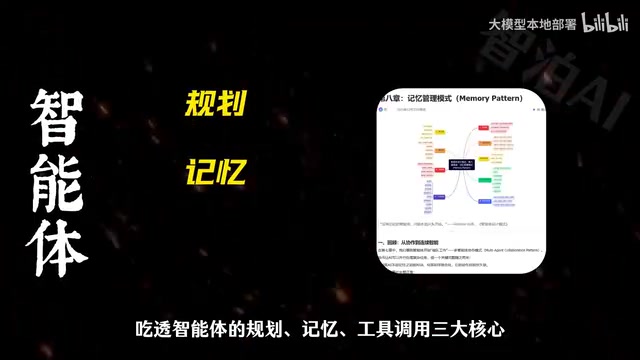
The answer lies in the three core capabilities of an agent: Planning, Memory, and Tool Use. A regular large model is "you ask, I answer," while an Agent can autonomously decompose tasks, remember context, and invoke external tools to accomplish complex goals. Understanding how these three work together is what truly establishes Agent thinking — all subsequent hands-on work builds on this cognitive framework.
The ReAct paradigm is the key mechanism for understanding how Planning and Tool Use coordinate. It alternates between two phases: Reason (reasoning) and Act (action). The model first outputs a thought, judges what information is still missing for the current task, then decides which tool to invoke. After receiving the tool's return result, it continues thinking about the next step, looping until the task is complete. Compared to generating an answer in one shot, ReAct gives the Agent the ability to "think while doing," and makes planning no longer a one-time static decomposition but a dynamically adjusted process based on environmental feedback. The underlying loops of most mainstream Agent frameworks (such as LangChain and AutoGPT) can be traced back to this paradigm. After understanding ReAct, when you then look at memory mechanisms (short-term conversation memory, long-term vector memory, external knowledge bases) and tool invocation (Function Calling, MCP protocol), you can string the three core capabilities into a complete execution chain rather than memorizing three isolated terms.
Function Calling is the standard interface for large models to invoke external tools. The model doesn't execute code directly; instead, based on user intent and tool descriptions, it outputs a structured JSON (containing the tool name and parameters), which an external program parses and actually executes, then returns the result to the model. It decouples "model decision-making" from "system execution" and is the prerequisite for an Agent to operate databases, query weather, and send emails. Understanding this layer is what allows you to understand why Agent tool invocations fail and why parameters get passed incorrectly — these are exactly the focus of subsequent debugging.
Step 2: Get Hands-On and Build Your First Agent
With the thinking framework in place, the next step is to get hands-on. The goal of this stage is to build a basic Agent, involving specific skills such as: knowledge base configuration, plugin integration, and parameter tuning.
The creator specifically mentions that during this process, you will definitely encounter common issues like task interruptions and chaotic responses — these are not "learning mistakes" but inevitable steps in building an Agent. The process of solving these problems is itself the most valuable learning.
Step 3: Master Workflow Design for Scenario Deployment
The gap between running a Demo and solving real business problems is workflow design capability. At this stage, you need to learn to decompose complex tasks and design complete deployment solutions for specific scenarios such as office work, operations, and enterprise services.
In other words, you not only need to know how to "build," but also how to "write" — writing project proposals and drawing architecture flows. This is the key step in transitioning from a technician to a solution designer.

Workflow orchestration is fundamentally different from mere Prompt writing. Prompts focus on the input and output of a single interaction, while workflows focus on data flow and control logic between multiple nodes: which node executes first, under what conditions branching occurs, how to retry or roll back on failure, and how to parallelize multiple subtasks. Common forms include serial chains, conditional routing, loop iteration, and human-in-the-loop nodes. When deploying at the enterprise level, workflows also bear observability responsibilities — the input and output of each step must be recordable and reproducible; otherwise, problems in production cannot be located. This is also why interviewers focus on asking "how did you design this workflow" — because solution design capability often reflects engineering maturity more than individual Prompt techniques.
Step 4: Focus on Optimization and Iteration, Conquer High-Frequency Topics
The final stage focuses on engineering challenges: hallucination governance, cost optimization, and exception fault tolerance. The creator points out that these three are exactly the highest-frequency assessment points in the workplace and interviews.
The reason is not hard to understand: anyone can build a Demo-level Agent, but making an Agent run stably in a production environment, control costs, and handle various edge cases — that is where the real gap emerges.
Model hallucination refers to the model fabricating plausible-sounding content when it lacks factual basis. In Agent scenarios, the harm is further amplified: the model may fabricate a non-existent tool, pass incorrect parameters, or treat irrelevant retrieved documents as the basis for answering. Common governance methods include RAG (Retrieval-Augmented Generation, which requires the model to answer based on recalled real documents and cite sources), structured output constraints (forcing JSON format for easier validation), tool invocation result feedback validation, and confidence threshold triggering manual review. Invocation cost optimization involves strategies such as tiered model routing (using small models for simple tasks, large models for complex tasks), Prompt caching, context compression, and result pruning. Exception fault tolerance typically relies on retry mechanisms, timeout circuit breakers, state snapshots, and idempotent design to ensure tasks can recover after failure. Together, these three form the threshold for an Agent to move from Demo to production environment.
Who This Roadmap Is For and What You Can Achieve
According to the creator's plan, after completing these four stages, the final output is a complete set of commercial-grade project practical experience and an exclusive portfolio. In interviews, you have cases to discuss; at work, you have deployment capability.
The greatest value of this roadmap lies in its pragmatic orientation: every step points to "what you can do," not "what you know." For beginners wanting to seize the AI wave, rather than fragmented tutorial browsing, it's better to advance systematically along this path.
Of course, the actual difficulty of the four stages increases progressively, especially steps three and four, which involve a lot of engineering practice and scenario thinking and require investing in real projects for hands-on practice. The creator also admits they took detours themselves — this roadmap essentially helps latecomers avoid the biggest pitfall: "only learning theory without hands-on practice."
One-line Summary
Beginners learning AI Agents should follow a four-step hands-on roadmap, focusing on deployment capability rather than concept memorization.
Paragraph Summary
The article addresses the common dilemma that AI Agent tutorials remain at the concept level and can't be applied after learning, proposing a four-step hands-on learning roadmap. The author points out that Agent roles really assess task decomposition, workflow orchestration, knowledge base construction, tool invocation, as well as hallucination governance, cost optimization, and exception fault tolerance — capabilities that can't be acquired by watching videos. The learning path: Step 1, build Agent thinking and understand the three core capabilities of planning, memory, and tool use; Step 2, hands-on build a basic Agent, configure knowledge bases and plugins, and solve common issues like interruptions and chaos; Step 3, master workflow design and deliver complete solutions for office, operations, and enterprise service scenarios; Step 4, focus on advanced engineering challenges like hallucination governance, cost optimization, and exception fault tolerance. Completing the whole journey yields commercial-grade project experience and a portfolio — cases for interviews and deployment capability for work.
Related articles

Chain of Thought Isn't Just for AI: How Humans Can Use CoT to Improve Thinking Quality
Chain of Thought isn't just a prompt trick for large models. Starting from a Hacker News discussion, this article analyzes why CoT works for human thinking too, breaks down actionable ways to transfer it, and highlights the key differences between human CoT and machine CoT.
Cloudflare Teams Up with OpenAI: Closi…
Cloudflare Teams Up with OpenAI: Closing the Loop from Vulnerability Discovery to Defense with AI
Cloudflare uses OpenAI Daybreak to investigate security vulnerabilities and generate reviewable remediation plans, while developers use Codex to boost coding efficiency and quality.

Orca Multi-Agent Orchestration in Practice: A Guide to Parallel Collaboration with Claude and Codex
Orca is Stable AI's free open-source agent workbench supporting 34 agents like Claude Code and Codex in parallel. Learn its Git worktree isolation, multi-model orchestration, and mobile management.