Learn English with Travel Vlogs: How Comprehensible Input Helps You Master 3000 High-Frequency Words

A Bilibili creator teaches 3000 high-frequency words through real travel scenes, illustrating the logic and limits of comprehensible input.
The article introduces a Bilibili creator's method of teaching the 3000 most common English words through "travel + real scenes," grounded in Comprehensible Input theory. Walking through Ecuador's historic center, he ties vocabulary to real scenes—takeout boxes, metro stations, plaza crowds—and naturally brings out polysemous words (like speaker) and near-synonym distinctions (like bumpy vs. smooth). The videos offer optional manually created subtitles, balancing listening practice with comprehension support. The article notes that this method strengthens motivation and context binding but is one-way input lacking interaction and correction, requiring active output practice to convert into speaking ability.
Most people have studied English for over five years yet still can't speak fluently. The problem isn't a lack of effort—it's the wrong method. A content creator who shares English-learning material on Bilibili is teaching the 3000 most commonly used English words through a "travel + real-world" approach—every time he arrives at a real scene, he puts the corresponding vocabulary to use. This method is called Comprehensible Input, and according to the creator, it has already helped thousands of people improve their English.
What Is Comprehensible Input? Why It Works Better Than Vocabulary Lists
The core logic of comprehensible input is that language acquisition happens when you receive input you "mostly understand but that's slightly challenging," not when you memorize vocabulary lists by rote. When words are tied to real scenes, visuals, and actions, the brain builds multi-channel memories rather than isolated word-meaning pairs.
The creator's approach is straightforward: he takes the camera into the historic center of Ecuador, eating takeout, riding the metro, and strolling through plazas while narrating everything he sees in English. Vocabulary isn't learned first and used later—it emerges naturally through use. For learners, the video itself is a corpus of comprehensible input—the visuals provide context, and the subtitles provide anchors.
Comprehensible Input originates from linguist Stephen Krashen's input hypothesis, whose core principle is "i+1": the learner's current level is "i," and input material should be slightly above that level (+1) to effectively promote acquisition. Krashen argued that language ability isn't gained through deliberately memorizing rules and vocabulary, but rather develops naturally through understanding large amounts of input slightly above one's current level. This theory emphasizes the comprehensibility, interest, and non-grammatical sequencing of input, standing in sharp contrast to traditional vocabulary memorization and grammar nitpicking. Real-world videos happen to provide a rich "i+1" environment: visuals and actions lower the difficulty of comprehension, while new vocabulary and expressions constitute an appropriate challenge.
Real-World Vocabulary Teaching: From Takeout Boxes to Metro Stations
At the start of the video, the creator shows a takeout meal: a styrofoam bowl containing fried rice and beef noodles, with plastic utensils. This approach of starting from everyday details gives vocabulary an immediate foothold.
He then moves into the city-exploration segment. The metro station, a train pulling in, the streets after exiting the station—every scene is turned into a vocabulary lesson. Yellow garbage bags, flyers pasted on utility poles, a church dome, a traffic light, a crosswalk, roll up doors, a dirt bike, a bicycle shop, cyclists, and BMX bikes—all explained while walking.

In the main plaza of the historic center, he encounters a hat vendor, a person giving a speech, the presidential palace, and a cathedral. When the crowd gets dense, he seizes the moment to teach the word crowded—"this place is crowded because there are so many people." Vocabulary maps directly onto the immediate physical experience—something textbooks can't do.
Polysemy and Nuanced Expressions in Real Contexts
One highlight of this method is that it naturally brings out polysemous words and subtle distinctions. Take speaker: it can mean "a person who is speaking" or "an electronic device that amplifies sound." When the creator encounters a preacher speaking into a microphone in the plaza, he demonstrates both meanings at once.
Similar examples include the difference between roll up doors and garage doors, and the contrast between bumpy and smooth—walking on cobblestones, he explains a bumpy road as one where "the vehicle keeps shaking." This comparative approach builds language intuition better than single definitions.
On La Ronda street, he sees hanging flags from various countries, including Japan, the UK, South Korea, Switzerland, and Canada, and also introduces the traditional poncho and cobblestone streets. Vocabulary, culture, and geography merge within the same stretch of footage.

Disambiguating polysemous words in real contexts is an important component of deep vocabulary knowledge. Take "speaker" as an example: its core senses include "one who speaks" and "a loudspeaker," both sharing the semantic feature of "emitting sound," but the specific referent depends on context. Other high-frequency polysemous words include "run" (to jog / to manage / to flow), "light" (illumination / not heavy), and "bank" (financial institution / riverbank). Traditional vocabulary lists often give only one or two definitions, leaving learners unable to activate other senses when they encounter them in actual listening or reading. Real-world teaching presents multiple senses simultaneously through visuals and situations, helping learners build networked representations of polysemous words—this is precisely the underlying mechanism by which language intuition forms.
Listening Training and "Thinking in English" Practice
Beyond vocabulary, the video also emphasizes listening input and "thinking in English." The creator personally wrote and uploaded non-auto-generated subtitles, and viewers can select "English United States" in the subtitle options. This step is crucial: auto-generated subtitles often contain errors, while manually created subtitles guarantee input quality.
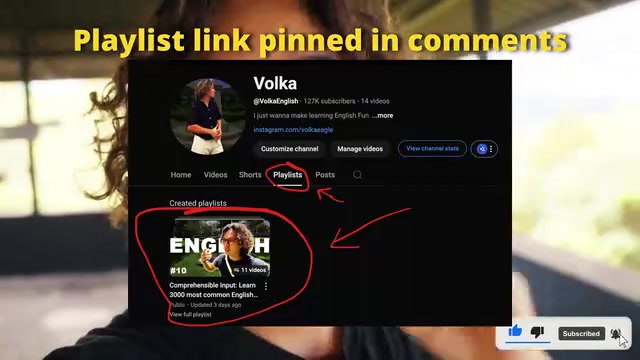
Throughout the video, he repeatedly reminds viewers to turn on subtitles and explains that subtitles are optional—turn them off to practice listening, turn them on for comprehension support. This flexibility allows the same material to serve learners at different levels. The video description and comment section also provide a playlist of all the vocabulary for easy review.
The Value and Limitations of the Travel + Learning Model
The greatest value of embedding language learning in real travel scenes is the dual binding of motivation and context. You're no longer memorizing words for an exam—you're doing it to describe what's happening right in front of you. This immediate feedback loop makes memories stick.
The limitations are also obvious: video is one-way input, lacking interaction and error correction; vocabulary coverage focuses on everyday scenes, making academic or specialized vocabulary hard to reach; and learners who only watch without practicing still can't convert it into spoken output. The creator himself notes that this method requires consistent input and active thinking to be effective.

For Chinese-speaking learners, this type of content has an additional advantage: Chinese explanations lower the comprehension barrier while preserving pure-English real-world corpus. You can first watch a version with Chinese subtitles to understand the content, then turn off subtitles and listen purely, and finally shadow and imitate. After these three steps, the same material's utility is much higher.
From a second language acquisition perspective, one-way video input is "receptive skill" training, while spoken output is a "productive skill," and deliberate practice is needed to bridge the two. Swain's output hypothesis points out that learners only notice gaps in their own expression when they attempt to produce language, which in turn promotes input processing. Therefore, real-world videos are better suited as input material, and only when combined with active output activities such as shadowing, retelling, and shadowing practice can "understanding" be converted into "speaking." In addition, videos lack immediate error correction, so learners may fossilize incorrect pronunciation or usage; it's advisable to regularly record yourself for comparison or seek feedback.
Who It's For and How to Use It
If you already have some foundation but struggle to speak, this real-world input method is worth trying. Start with scenes you're interested in—food, travel, daily commuting—first building the confidence of "I can understand," then gradually challenging yourself with subtitle-free versions. Vocabulary size isn't the goal; being able to call on words in real contexts is.
Related articles

English Version of 'Thank You for Your Love' Gains Traction on Bilibili: A Cross-Cultural Rendition of a Classic Love Song
The English version of 'Thank You for Your Love,' titled 'I'll give you all my love,' trends on Bilibili with rewritten lyrics about giving all your love. This article analyzes its emotional expression, cross-cultural adaptation strategy, and differences from the Chinese original.

Claude Code vs Cursor vs GitHub Copilot: How to Choose Among the Three Major AI Coding Tools
A clear explanation of Claude Code, Cursor, and GitHub Copilot through the lens of 'degree of delegation': Copilot embeds in your editor for autocomplete, Cursor is an AI-first full editor with multi-file batch editing, and Claude Code executes tasks end-to-end in the terminal. Includes selection advice.

Behind the Viral Dynamic Comic Commentary: Deconstructing the Narrative of Family Finance and Emotional Conflict
Deconstructing a Bilibili dynamic comic episode on family financial conflict: how dense dialogue and emotional hooks retain viewers, and where AI script generation falls short in narrative coherence.