Learn Python from Scratch: A Three-Phase Systematic Learning Path and Practical Guide
A systematic three-phase guide to learning Python from scratch with practical project applications.
This article presents a structured three-phase approach to learning Python for complete beginners: fundamentals (environment setup, variables, control flow, functions), intermediate (OOP and functional programming), and practical applications (web scraping, office automation, data analysis). It addresses common pain points in online programming education and offers actionable tips including project-driven learning and proper tool selection.
Why Is Learning Python from Scratch Still So Hard?
As one of the hottest programming languages today, Python is indispensable whether you're a graduate student doing data analysis and AI research, or a working professional looking to boost productivity. Python's prominent position is inseparable from its unique design philosophy. First released by Guido van Rossum in 1991, Python's core design principles emphasize code readability and simplicity—the famous "Zen of Python" includes principles like "Beautiful is better than ugly" and "Simple is better than complex." According to the TIOBE Programming Language Index and Stack Overflow's annual developer survey, Python has ranked among the most popular languages for several consecutive years, thanks to its massive third-party library ecosystem (over 500,000 packages on PyPI), cross-platform compatibility, and widespread applications in artificial intelligence, data science, web development, and more.
However, faced with thousands of Python tutorials on video platforms, beginners often encounter an awkward dilemma: There are too many tutorials, but far too few that are truly systematic and easy to understand.
Recently, a content creator released a brand-new Python tutorial series, claiming it was designed specifically for complete beginners and could be completed in just 3 hours. The design philosophy and content structure of this course actually reflect some core issues and trends in programming education today, making it worth a deeper look.

Three Major Pain Points of Existing Python Beginner Tutorials
According to the creator, before producing the course, he spent a month studying various Python tutorials on video platforms—from viral videos with hundreds of thousands or millions of views to niche content with only dozens or hundreds of views. His conclusion: Not systematic enough, not complete enough.
This is actually a common problem in online programming education, manifesting in the following ways:
Severe Fragmentation and Broken Knowledge Chains
Most tutorials either cover only specific topics (like list operations or file I/O) or assume you already have some background and jump straight to advanced content. For true beginners, the knowledge chain is broken—after studying, they often only remember scattered syntax but can't independently complete a full project.
This problem has a deep theoretical explanation in cognitive science. According to Cognitive Load Theory, learners have limited working memory capacity. When knowledge points lack logical connections, each isolated concept occupies independent cognitive resources, dramatically reducing learning efficiency. Programming learning particularly relies on "Schema Construction"—organizing scattered syntax knowledge into meaningful cognitive structures. This is why systematic course design is far more effective than explaining individual knowledge points: it helps learners build associative networks between concepts in their minds, allowing new knowledge to "anchor" onto existing cognitive frameworks.
Lack of Practice Components—Learning Without Applying
There's a huge gap between "understanding it" and "being able to write it." Many tutorials only explain concepts without providing exercises or hands-on practice, trapping learners in a cycle of "I get it when I watch, but I'm lost when I try to code."
Insufficient Engagement, High Dropout Rates
Programming is inherently abstract. If the teaching style is too dry, beginners easily give up within the first few lessons. How to maintain professionalism while adding engagement is a key challenge for tutorial creators.
Detailed Breakdown of the Three-Phase Python Learning Path
This course adopts a "Fundamentals → Intermediate → Practical" three-stage structure. This progressive design itself is worth referencing.
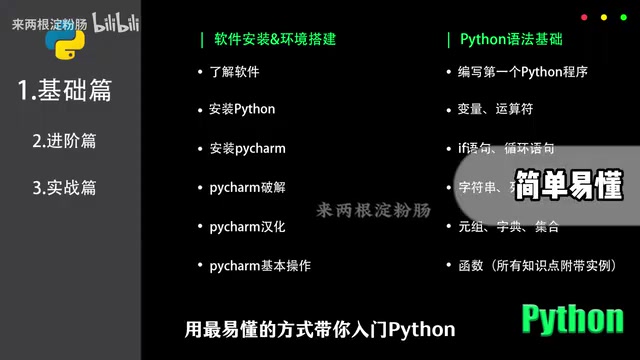
Phase 1: Fundamentals—Setting Up the Environment and Building Programming Thinking
The fundamentals phase starts with Python environment setup, then sequentially covers variables, data types, control flow, and functions. This order follows the classic path for learning a programming language—first set up the environment to ensure code can run, then start with basic data storage (variables), gradually transition to logic control (if/for/while), and finally learn code reuse (functions).
For beginners, the most important thing at this stage isn't memorizing syntax, but developing the mindset of "solving problems with code." Once you understand the basic model of "input → processing → output," subsequent learning becomes much more efficient.
Phase 2: Intermediate—Mastering Object-Oriented and Functional Programming
The intermediate phase covers two major paradigms—Object-Oriented Programming (OOP) and Functional Programming—along with Python's advanced features and techniques. The goal at this stage is to evolve from "being able to write code" to "writing elegant code."
Object-Oriented Programming is one of Python's core features and a programming paradigm centered around "objects," first proposed by Alan Kay in the 1960s and fully implemented in the Smalltalk language. OOP's four core characteristics include: Encapsulation—binding data and methods that operate on that data together while hiding internal implementation details; Inheritance—subclasses can reuse parent class attributes and methods for code reuse; Polymorphism—the same interface can have different implementations; Abstraction—extracting common characteristics of things to form models. In Python, everything is an object—integers, strings, functions, and even classes themselves are objects. Understanding OOP is not only a prerequisite for using web frameworks like Django and Flask, but also a fundamental skill for reading and contributing to open-source projects.
Functional Programming originates from Lambda Calculus in mathematics, proposed by Alonzo Church in the 1930s. Unlike OOP's emphasis on "state changes," functional programming's core concepts are "no side effects" and "immutable data"—a function's output depends only on its input, without depending on or changing external state. Although Python isn't a purely functional language, it provides rich functional programming tools: lambda expressions for creating anonymous functions, map() for applying a function to each element in a sequence, filter() for selecting elements based on conditions, and reduce() for reducing a sequence to a single value. Additionally, Python's List Comprehensions and Generator Expressions are deeply influenced by functional programming ideas. Mastering these tools makes data processing code more concise and readable, especially useful in data analysis scenarios.
Phase 3: Practical—Web Scraping, Office Automation, and Data Analysis
The practical phase is the highlight of the entire course, covering several of the most practically valuable directions:
- Python Web Scraping: Collecting images, videos, and other web resources
- Office Automation: Processing Excel, Word, and other daily documents
- Data Analysis and Mining: Extracting valuable information from data
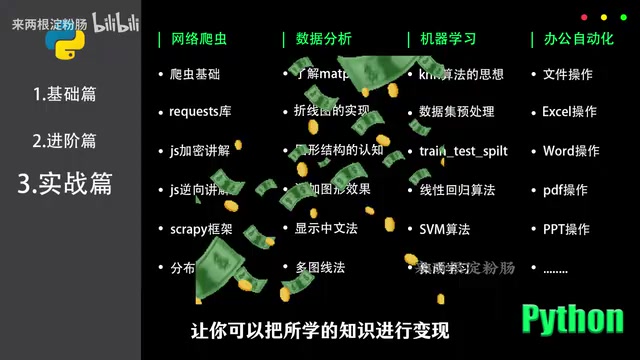
Python web scraping refers to the technique of automatically extracting data from web pages through programs. Python has become the preferred language for scraping development thanks to its rich ecosystem of related libraries: the Requests library for sending HTTP requests, BeautifulSoup and lxml for parsing HTML/XML documents, Scrapy as a full-featured scraping framework, and Selenium for simulating browser behavior to handle JavaScript-rendered dynamic pages. However, web scraping has legal and ethical boundaries. Learners should comply with websites' robots.txt protocols, control request frequency to avoid burdening target servers, avoid scraping personal privacy data, and observe relevant laws and regulations.
These directions correspond precisely to the most frequent use cases for Python among non-professional developers. For graduate students in particular, web scraping can efficiently collect research data, office automation can save enormous amounts of repetitive labor, and data analysis is an essential skill for writing papers.
Four Practical Tips for Learning Python from Scratch
Whether or not you choose to follow this specific course, the following tips have universal value:
Don't Overthink Environment Setup—If It Runs, It's Good Enough
Many beginners waste enormous time and energy on installing Python and configuring IDEs. The recommendation is to simply use Anaconda + VS Code or PyCharm Community Edition and follow the tutorial step by step.
Anaconda is a Python distribution for data science developed by Continuum Analytics, pre-installed with hundreds of commonly used scientific computing libraries like NumPy, Pandas, Matplotlib, and Scikit-learn. It includes the conda package manager for conveniently creating and managing virtual environments to resolve dependency conflicts between different projects. VS Code (Visual Studio Code) is a lightweight code editor developed by Microsoft that provides syntax highlighting, intelligent code completion, debugging, and linting through its Python extension. PyCharm is an IDE specifically designed for Python development by JetBrains—the Community edition is free yet powerful, offering deeper code analysis and refactoring tools.
If you really can't get the local environment working, start with Google Colab or Jupyter Notebook for online programming—zero configuration needed to start writing code. Google Colab is a cloud-based programming environment built on Jupyter Notebook that provides free GPU/TPU computing power, particularly suitable for machine learning experiments and teaching scenarios.
Writing Code Matters More Than Understanding Tutorials
Programming is a practical skill. Watching a tutorial 10 times is less effective than writing the code yourself once. After learning each concept, immediately try to solve a small problem with it—even if it's just writing a simple calculator or number-guessing game.
Project-Driven Learning Is More Efficient
If you have a clear use case (like needing to batch-process experimental data), you can directly target that need and learn as you build. Look up unfamiliar syntax as you encounter it. This "project-driven" approach is far more efficient than linear learning from start to finish.
Project-Based Learning (PBL) is a teaching method centered on real problems or projects, with theoretical roots traceable to educator John Dewey's "Learning by Doing" philosophy. In programming education, PBL's effectiveness has been confirmed by extensive research: when learners face a specific, meaningful goal, the brain automatically enters "active retrieval" mode, actively seeking and integrating needed knowledge—this is several times more efficient than passively receiving information. Additionally, project-driven learning provides immediate feedback—code either runs or throws an error—and this clear feedback loop is a key element of skill acquisition. MIT's Scratch project and Harvard's CS50 course both extensively employ this teaching philosophy.
Make Good Use of Mind Maps and Supporting Resources

The value of supporting resources like mind maps, lecture notes, and e-books should not be overlooked. A systematic knowledge framework helps you build a big-picture perspective and avoid getting lost in details.
Conclusion: Starting Is More Important Than Being Perfect
In today's world where the AI wave is sweeping across every industry, Python is no longer an exclusive tool for programmers. For graduate students, data analysts, product managers, and even content creators, mastering Python fundamentals can significantly boost work efficiency.
This course's design philosophy—systematic, engaging, and practical—represents the right direction for programming education. However, it's worth noting that "3-hour speed run" is more of a marketing phrase. Truly mastering Python requires continuous practice and project accumulation. Getting started can be quick, but going from beginner to proficient still requires investing sufficient time and patience.
The key takeaway: Starting is more important than being perfect. Choose a tutorial that suits you, open your editor, and write your first print("Hello, World!") — your programming journey begins right here.
Related articles
ajisai: A Preset Management Tool for Unifying Rules and Prompts Across AI Coding Assistants
ajisai is a Go-based preset manager for AI coding assistants like Cursor and Claude Code. Package rules and prompts once, deploy everywhere. Early-stage but promising.
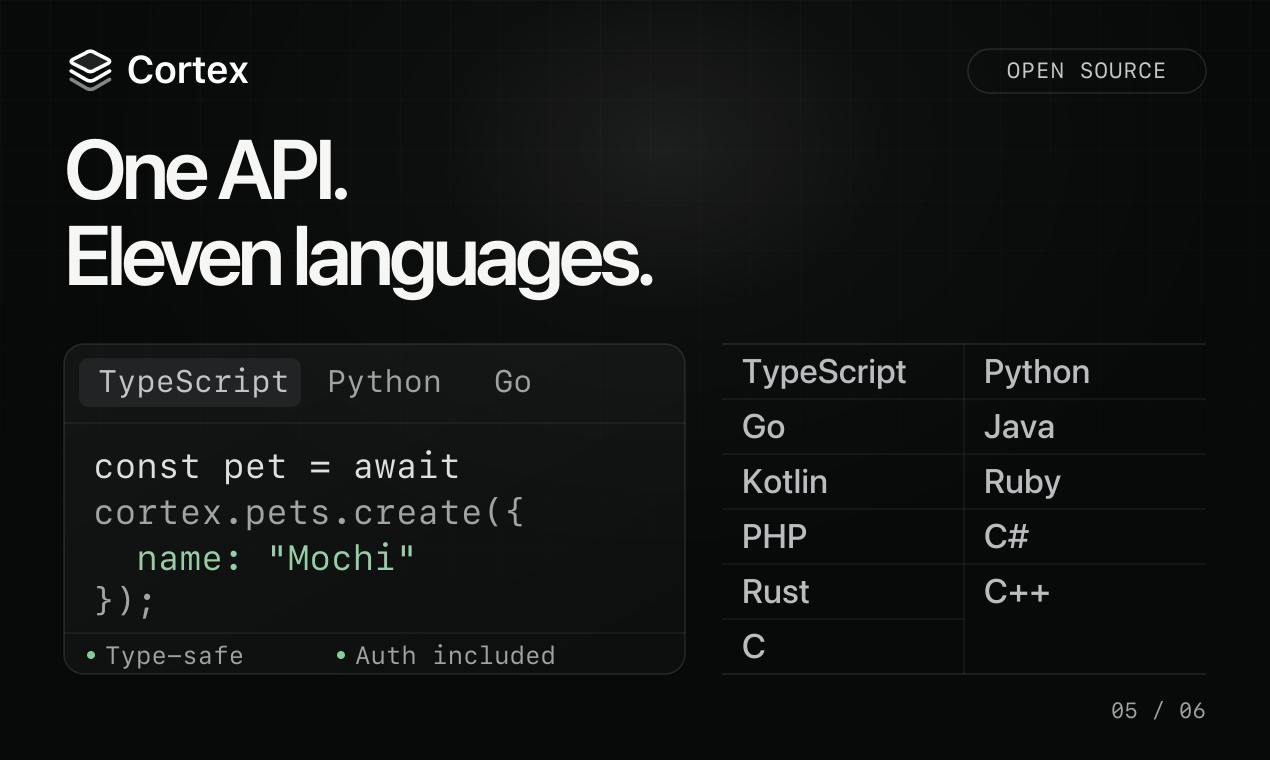
Cortex: Convert API Specs into Docs, SDKs, and MCP Servers in One Click
Cortex is an open-source tool that converts OpenAPI, GraphQL, gRPC and more into interactive docs, typed SDKs in 11 languages, and MCP servers for AI agents.
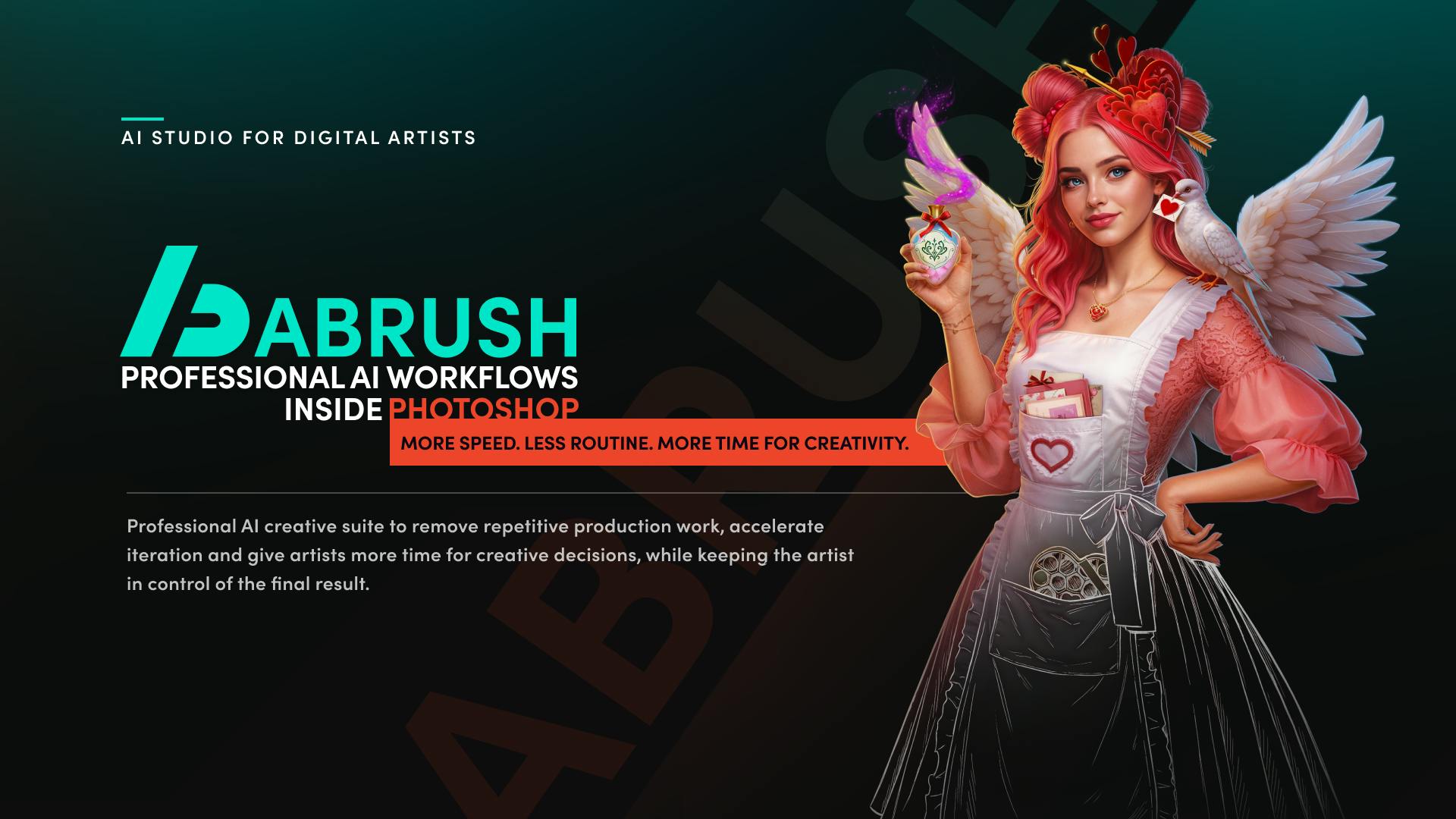
ABrush: An AI Studio Built for Digital Artists
ABrush is an AI studio for digital artists, ranked #4 on Product Hunt. It embeds leading AI models into existing workflows to remove repetitive tasks, speed up iteration, and keep artists in control.