Learning Machine Learning at 16 with No Background: A Complete Learning Path and Practical Advice

A complete roadmap for teenagers to learn machine learning from scratch, with math, coding, and project advice.
This article addresses a common concern among teenage beginners: can you learn machine learning at 16 with only basic algebra? It provides a structured learning path covering essential math (linear algebra, calculus, probability), Python programming preparation, recommended courses (Andrew Ng, fast.ai, 3Blue1Brown), and project-based practice strategies, emphasizing a "learn by doing" approach over endless preparation.
A 16-Year-Old's Dilemma
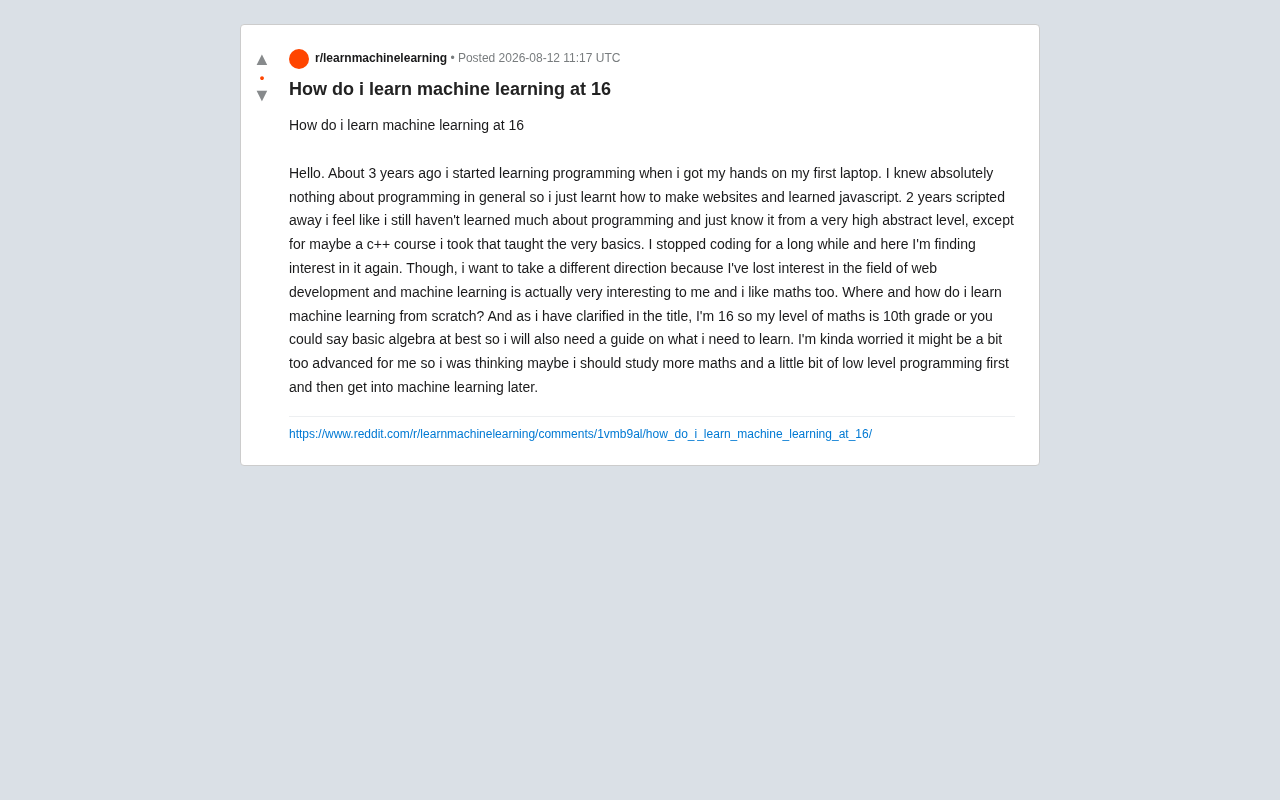
I recently came across a very representative question on Reddit: a 16-year-old wanted to transition into machine learning but didn't know where to start. His experience is actually quite typical—three years ago he got his first laptop and started learning to code from scratch. He built websites, wrote JavaScript, and took an introductory C++ course. But two years later, he felt his understanding of programming was still stuck at a "very abstract, high level" without solid foundations.
Now he's reignited his interest, only to find that he's lost his passion for web development and is instead deeply drawn to machine learning, while also enjoying math. But concerns followed: his current math level is only 10th grade (basic algebra), and he worries that machine learning is "too advanced" for him. He's even debating whether he should first catch up on math, then learn some low-level programming, before finally tackling machine learning.
Behind this question lies a common anxiety shared by many teenagers (and even adult beginners) when entering the AI field. Let's systematically break it down: with a 16-year-old's average math background, how should you scientifically plan a learning path for machine learning?
What Math Background Does Machine Learning Require
The biggest misconception among beginners is thinking they need to master all the math before starting machine learning. This is actually putting the cart before the horse. Machine learning does rely on math, but that doesn't mean you need to become a mathematician first.
The Three Core Math Areas Machine Learning Actually Needs
The core mathematics of machine learning is concentrated in three areas:
-
Linear Algebra: Vectors and matrix operations are the foundation of neural networks and data representation. This is the most important part. In actual machine learning systems, data is typically stored and processed in matrix form—for example, an image can be represented as a matrix of pixel values, and a batch of training samples forms a 2D matrix where each row is a sample and each column is a feature. Each layer of a neural network is essentially a matrix multiplication followed by a nonlinear transformation. When we say a model has "millions of parameters," those parameters are stored in a series of weight matrices. Understanding the geometric meaning of matrix multiplication—that it's a linear transformation in space—helps you intuitively grasp what the model is doing: mapping data from one representation space to another that's more favorable for decision-making.
-
Calculus: Primarily the concepts of derivatives and gradients, used to understand how models "learn" (gradient descent). You don't need to master complex integration techniques. The core idea of gradient descent is actually very intuitive: imagine standing on a mountain, trying to find the lowest point (i.e., where model error is minimized), but surrounded by thick fog so you can't see the overall terrain. The only thing you can do is feel the slope under your feet—which direction is steepest—then take a step downhill. Repeat this process, and you'll gradually reach the valley floor. Mathematically, the "slope" is the gradient of the function (the multi-dimensional extension of derivatives), and "taking a step" means updating parameters in the direction of the gradient. This is the core mechanism behind all model training in machine learning. What you truly need to understand is partial derivatives and the chain rule (the mathematical basis of backpropagation), not the complex substitution integration tricks from university calculus courses.
-
Probability and Statistics: Understanding data distributions, expectations, variance, and Bayesian thinking. Probability is everywhere in machine learning—from the most basic classifier outputting "the probability of belonging to a certain class," to generative models (like GPT) that are essentially learning probability distributions over text. Bayes' theorem (the mathematical rule for updating beliefs based on new evidence) is the theoretical foundation of many ML methods, including naive Bayes classifiers, Bayesian optimization, and the entire probabilistic graphical models family. Statistical concepts like overfitting (the model memorizing noise in the training data rather than true patterns) and regularization (preventing overfitting by constraining model complexity) also require probabilistic thinking for deep understanding.
For a 16-year-old learner with a basic algebra foundation, these topics are entirely achievable through gradual mastery. In fact, you don't need to master them before starting machine learning—a better strategy is to learn as you go. When you encounter an algorithm that uses gradient descent, that's when you dive deeper into derivatives. This "learn on demand" approach is often far more efficient than grinding through entire textbooks.
Recommended Math Learning Resources
- 3Blue1Brown (YouTube channel): The "Essence of Linear Algebra" and "Essence of Calculus" series use extremely intuitive visualizations to explain abstract concepts, making them ideal for teenagers building mathematical intuition. Founded by Grant Sanderson, who developed a math animation engine called Manim that can precisely render abstract mathematical transformations as animations. This visual approach is particularly effective because it lets you "see" how matrix multiplication warps space and how derivatives describe rates of change, rather than just memorizing formulas. Many MIT and Stanford students also use this channel to supplement their intuitive understanding.
- Khan Academy: Free, systematic, covering everything from basic algebra to calculus and statistics—perfect for filling knowledge gaps. Founded by Sal Khan in 2008, its unique strength lies in "mastery learning" instructional design—the system tracks your proficiency on each concept, ensuring you truly understand current material before moving to the next stage, preventing cumulative knowledge gaps.
The Real Position of Programming Skills
The young person mentioned feeling like he "didn't learn much," but this kind of self-doubt is extremely common among beginners. You already know JavaScript and have been exposed to C++—that's already a decent starting point. The key is that the mainstream language for machine learning is Python, not the web frontend stack.
Why Python Is the First Choice for Machine Learning
Python became the de facto standard for machine learning for deep historical and technical reasons. In the mid-2000s, the scientific computing community began migrating from MATLAB and R to open-source tools. Python stood out with its clean syntax (readability close to pseudocode) and its positioning as a "glue language"—it allows developers to write high-level logic in Python while the underlying computations are executed by high-performance libraries written in C/C++ or Fortran. This architecture means that when you call NumPy for matrix operations in Python, the actual execution speed approaches pure C code, but the difficulty of writing it is an order of magnitude lower. It was this combination of "ease of use + high performance" that meant the Python ecosystem was already prepared when the deep learning explosion hit in the 2010s, forming today's unrivaled scientific computing ecosystem:
- NumPy: Efficient array and matrix operations. NumPy is the cornerstone of the entire Python scientific computing stack. It provides the ndarray (N-dimensional array) data structure supporting vectorized operations—meaning you can perform batch computations on millions of data points with a single line of code, without writing explicit loops. Implemented in C at the bottom layer, its performance far exceeds pure Python code. Nearly all other scientific computing libraries are built on top of NumPy.
- Pandas: Data processing and analysis. Pandas provides the DataFrame data structure (similar to Excel spreadsheets or SQL tables), allowing you to conveniently read, clean, transform, and analyze structured data. In real machine learning projects, data preprocessing often takes 60%-80% of the time, and Pandas is the core tool for handling this work.
- Matplotlib / Seaborn: Data visualization. Matplotlib is the most fundamental plotting library in Python, while Seaborn provides more aesthetically pleasing default styles for statistical charts on top of it. Visualization is extremely important in machine learning—from exploratory data analysis (EDA) to model performance evaluation and training process monitoring, charts are indispensable.
- Scikit-learn: The "Swiss Army knife" of classical machine learning algorithms. Scikit-learn provides a unified, consistent API covering almost all classical ML algorithms (classification, regression, clustering, dimensionality reduction, etc.), along with a complete model evaluation and data preprocessing toolchain. Its design philosophy is to let you complete the entire pipeline from data preparation to model training to evaluation in just a few lines of code.
- PyTorch / TensorFlow: Deep learning frameworks. These two frameworks are the current mainstream for both deep learning research and industrial applications. PyTorch, developed by Meta (Facebook), dominates the research community with its dynamic computation graph and Pythonic programming style; TensorFlow, developed by Google, has a more mature ecosystem for industrial deployment. Both support GPU-accelerated computing, which can speed up deep learning training by tens to hundreds of times. For beginners, the community currently tends to recommend PyTorch because its debugging is more intuitive and the learning curve is friendlier.
The good news is that if you already understand basic programming logic (variables, loops, functions, conditionals), learning Python will be very fast. You don't need to dive into "low-level programming" first—unless you're personally interested in systems programming, C++ and assembly are not necessary for getting started with machine learning.
Recommended Programming Preparation
Spend 2 to 4 weeks going through a Python introductory course to build proficiency, focusing on basic NumPy and Pandas operations. This is enough to support you entering the practical stage of machine learning.
The Complete Path for Learning Machine Learning at 16 from Zero
Combining math and programming, here's a progressive learning roadmap suitable for a 16-year-old beginner:
Phase 1: Building Foundations (1-2 months)
- Solidify Python skills, become familiar with NumPy and Pandas.
- Simultaneously watch 3Blue1Brown's linear algebra series to build mathematical intuition.
- Don't aim for perfection—being able to understand and write code is enough.
Phase 2: Classical Machine Learning Introduction (2-3 months)
-
Learn basic concepts of supervised learning: linear regression, logistic regression, decision trees, KNN, etc. Although these algorithms seem relatively "simple" by today's standards, understanding them is the foundation for understanding all more complex models. Linear regression teaches you the essence of "fitting"—using a line (or hyperplane) to approximate patterns in data; logistic regression shows how to extend linear models to classification problems; decision trees embody a completely different "divide and conquer" approach—progressively asking questions to divide data into increasingly pure subsets; KNN (K-Nearest Neighbors) is the most intuitive "let the data speak" method—making predictions by looking at the K nearest known samples around a new sample. Understanding the strengths, weaknesses, and applicable scenarios of these basic algorithms gives you better judgment when facing real problems.
-
Strongly recommended: Andrew Ng's Machine Learning course (Machine Learning Specialization on Coursera). This course is known for its "intuition-first" approach, is math-friendly, and is globally recognized as the definitive introductory classic. Andrew Ng is a Stanford professor, co-founder of Google Brain, co-founder of Coursera, and was instrumental in bringing deep learning to Baidu. His teaching style is known for clarity and patience, using simple examples and visualizations to make complex concepts tangible. When this course was first offered free on Stanford in 2011, it attracted over 100,000 student registrations and is considered one of the courses that sparked the online education revolution. In 2022, he released a completely remade version using Python (replacing the original Octave/MATLAB) with more modern content.
-
Use Scikit-learn for hands-on implementation, practicing on real datasets (such as beginner datasets on Kaggle). Kaggle is the world's largest data science competition and community platform (now acquired by Google), hosting thousands of public datasets and ongoing machine learning competitions. For beginners, Kaggle offers "beginner-level competitions" (such as Titanic survival prediction and handwritten digit recognition). These competitions have thorough data descriptions, extensive community discussions, and reference code (Notebooks), making them an excellent training ground for converting classroom knowledge into practical skills. You can see how others approach the same problem and learn different feature engineering techniques and modeling strategies.
Phase 3: Deep Learning Advanced (3+ months)
-
Once you've developed a feel for basic algorithms, move into neural networks and deep learning. The fundamental difference between deep learning and classical machine learning lies in the automation of "feature engineering." In classical methods, you need to manually design effective features (like extracting edges, color histograms from images) and then feed them to the algorithm; deep learning automatically learns meaningful representations from raw data through multi-layer neural networks. This is why deep learning achieved revolutionary breakthroughs in image recognition, natural language processing, and other fields—in these domains, manually designing features is extremely difficult, but deep networks can automatically discover hierarchical patterns in data (from low-level edges and textures, to mid-level object parts, to high-level complete concepts).
-
Recommended: fast.ai courses, which adopt a "top-down" teaching method, letting you first run a working model and then gradually dive deeper into the principles—particularly suited for maintaining learning motivation. fast.ai was founded by Jeremy Howard and Rachel Thomas, and its teaching philosophy is deeply influenced by the "whole-game approach"—similar to learning to swim by jumping into the water rather than spending half a year studying fluid dynamics first. Their core belief is that confusion during practice naturally generates motivation to learn theory. The course uses their self-developed fastai library (built on PyTorch), which encapsulates many best practices, allowing students to train a decent image classifier in the very first lesson, then gradually "unbox" the underlying mechanisms in subsequent lessons. This approach is called "meaningful prior experience" in educational research and has been shown to significantly improve learner persistence and deep understanding.
-
At this point, go back and supplement the calculus and probability knowledge you need. By this stage, your need for these mathematical concepts is very specific—you know why you need the chain rule (because backpropagation is an application of the chain rule), you know why you need to understand probability distributions (because your model output is a probability). This goal-oriented learning is far more efficient than aimlessly grinding through textbooks.
Practical Advice for Young Learners
Don't Fall Into the "Preparing to Prepare" Trap
The biggest risk for this young person is falling into the infinite delay loop of "I need to finish A before I can learn B, and finish B before I can learn C." This phenomenon is called "analysis paralysis" or "preparatory procrastination" in educational psychology—people use endless preparation to avoid the sense of failure they might face when actually starting. Vygotsky's "Zone of Proximal Development" theory tells us that the most effective learning happens in that zone between "known" and "completely unknown"—you need moderate challenge and confusion to drive growth, rather than waiting until everything is ready before taking action.
Machine learning is an extremely practice-oriented field, and hands-on projects bring far more growth and sense of accomplishment than repeatedly drilling fundamentals. "Project-Based Learning" theory in modern educational research also confirms this: when learners have a specific, meaningful goal, their absorption and retention of knowledge significantly improves, because every new piece of knowledge has a clear answer to "why should I learn this." Even if your math isn't fully solid, you can still get a handwritten digit recognition model running (the MNIST dataset—machine learning's "Hello World," containing 70,000 grayscale images of handwritten digits). That excitement of "it actually works!" becomes the strongest fuel for continued learning.
Age Is Your Enormous Advantage
Starting to explore machine learning at 16, time is on your side. You have several full years to gradually accumulate math and programming foundations without needing to rush. At a steady pace of a few hours per week, in one to two years your level will far exceed what you can imagine today. In fact, many researchers who have made outstanding contributions to AI—including Ian Goodfellow (inventor of GANs) and Andrej Karpathy (former Tesla AI Director)—have emphasized the crucial role that early curiosity-driven exploration played in their later career development. The intuition and hands-on skills you build during high school will produce a tremendous "scaffolding" effect when you study more rigorous mathematical theory in college.
Use Projects to Connect Knowledge
Start with simple projects: house price prediction, spam classification, image recognition. With each project you complete, you'll naturally fill in the missing math and programming knowledge. This "learning by doing" approach is far more efficient than studying theory in isolation. A practical principle for choosing projects: pick problems you're personally interested in. If you love music, try using machine learning for music genre classification; if you're passionate about gaming, try training an AI to play simple games (intro to reinforcement learning). The intrinsic motivation that comes from personal interest is the most reliable fuel for sustaining long-term learning.
Conclusion
Returning to the original question: can you learn machine learning at 16 with an average math background? The answer is definitive—not only can you, but it's an excellent starting point. What matters is not how much you know right now, but whether you can establish a learning style of "learn while doing, supplement as needed." Start moving—take your first step with Python and Andrew Ng's course. Your math gaps will gradually be filled through practice. What truly holds you back is never the difficulty of math, but the hesitation of not daring to start.
Related articles

RAGFlow Deep Dive: An Open-Source Knowledge Engine Combining RAG and Agent Capabilities
Deep dive into RAGFlow, an open-source RAG engine with 87K+ GitHub Stars. Explore its deep document understanding, Agent orchestration, traceable Q&A, and enterprise knowledge base applications.

Qwen 3.8 Weights Open-Sourced: Technical Analysis and Ecosystem Impact of Alibaba's Open-Source Model
Alibaba's Qwen 3.8 model weights are now open-source. This article analyzes Qwen's open-source strategy, the value of weight release for private deployment and fine-tuning, and its competitive position in the global open-source LLM landscape.

Tailscale Traces the Source: A 16-Year-Old SQLite WAL Reset Bug
Tailscale's engineering team discovered a 16-year-old hidden bug in SQLite's WAL reset mechanism in production. Learn how WAL works, what triggered the bug, and key takeaways for developers.