RAGFlow Deep Dive: An Open-Source Knowledge Engine Combining RAG and Agent Capabilities

RAGFlow is an open-source RAG engine combining deep document understanding with Agent orchestration for reliable AI Q&A.
RAGFlow is a leading open-source retrieval-augmented generation engine that integrates deep document understanding with Agent orchestration capabilities. With 87K+ GitHub Stars, it addresses key RAG challenges including complex document parsing, intelligent chunking, multi-route retrieval with re-ranking, and answer traceability. Its architecture is particularly suited for enterprise knowledge bases, domain-specific assistants, and customer service automation in data-sensitive industries.
Introduction: Building a Stronger Context Layer for LLMs
As large language models (LLMs) rapidly gain traction in enterprise applications, enabling models to accurately understand and leverage private knowledge bases has become a core challenge for technical teams. Retrieval-Augmented Generation (RAG) is the key approach to solving this problem. The core idea behind RAG is to retrieve relevant information from external knowledge bases before the LLM generates an answer, injecting it as context into the prompt so the model can produce fact-grounded responses. This paradigm was formally proposed by Facebook AI Research (now Meta AI) in a 2020 paper, aiming to address two fundamental limitations of LLMs: training data cutoff dates and the tendency to produce "hallucinations" when lacking factual grounding.
Among the many open-source RAG solutions available, RAGFlow has quickly emerged as a standout project in the field, thanks to its deep document understanding capabilities and integration of Agent abilities.
As of now, RAGFlow has earned over 87,360 Stars and 10,293 Forks on GitHub, with 85 new stars per day, demonstrating sustained high community interest.
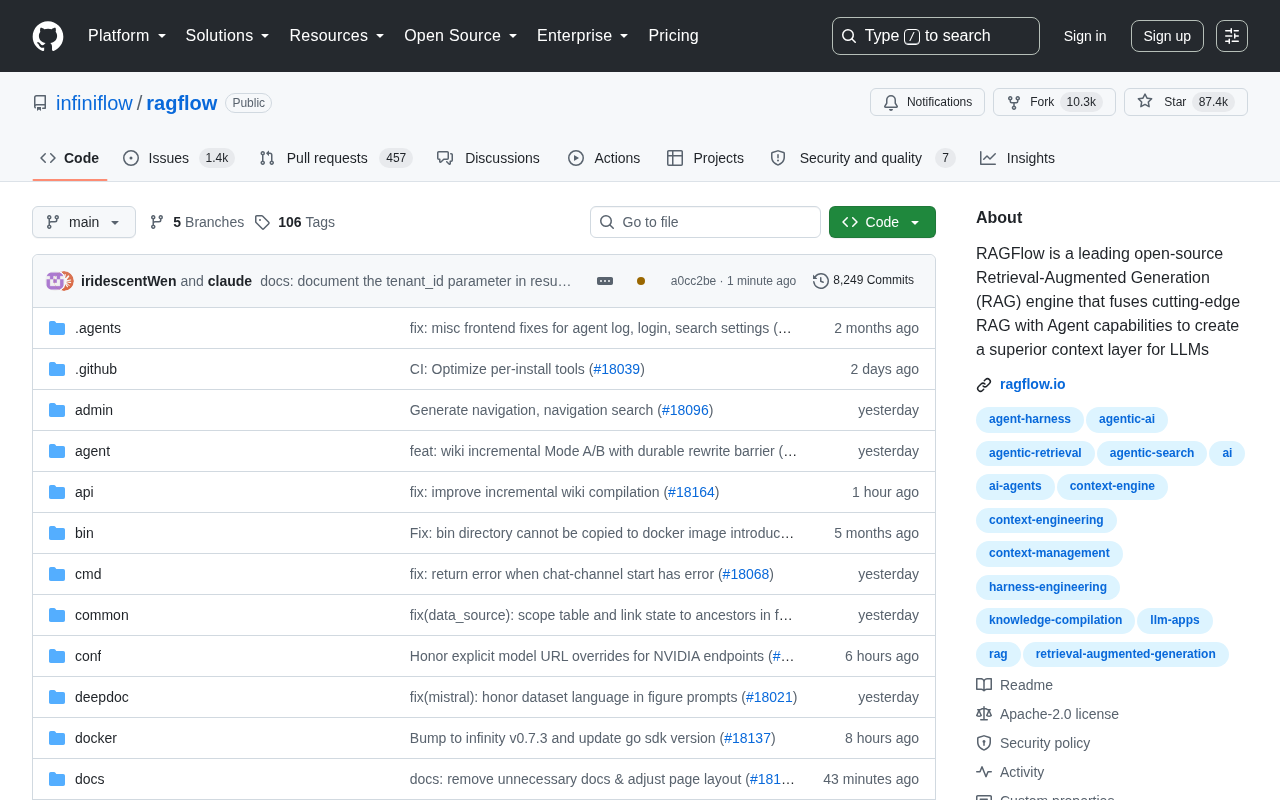
What is RAGFlow: Deep Document Understanding + Agent Orchestration in an Open-Source RAG Engine
RAGFlow is a leading open-source retrieval-augmented generation engine. Unlike traditional RAG frameworks, it deeply integrates cutting-edge RAG technology with Agent capabilities, aiming to provide LLMs with a superior, more accurate context layer.
In simple terms, RAGFlow addresses the two most challenging problems in RAG applications:
- Insufficient depth in document understanding: Many RAG solutions parse complex-format documents (PDFs, tables, scanned documents, etc.) poorly, leading to degraded retrieval quality.
- Disconnect between retrieval and reasoning: Pure vector retrieval struggles with multi-step reasoning tasks, while the introduction of Agent capabilities enables more complex task orchestration.
Deep Document Understanding: RAGFlow's Core Competitive Advantage
One of RAGFlow's core competitive advantages lies in its knowledge extraction capability based on deep document understanding. It can precisely extract effective information from documents of various complex formats containing large amounts of unstructured data, and perform intelligent chunking.
Document chunking is one of the most underrated yet high-impact components in RAG systems. Common chunking methods include fixed-length splitting, semantic boundary-based splitting, recursive character splitting, and more—but these methods perform poorly when dealing with PDFs containing tables, charts, and multi-column layouts. RAGFlow's deep document understanding approach involves layout analysis, table recognition, OCR (Optical Character Recognition), and other computer vision technologies. It identifies the logical structure of documents rather than relying solely on physical layout for splitting, ensuring semantic completeness and self-consistency of each document chunk.
This step directly determines the quality of downstream retrieval—high-quality chunking means fewer "hallucinations" and more accurate answer traceability.
Merging RAG with Agents: Beyond Simple Retrieval-Generation
In recent years, the industry has increasingly recognized that pure RAG is insufficient for complex scenarios. AI Agents refer to AI systems with autonomous planning, tool invocation, and feedback loop capabilities. Introducing Agents into RAG scenarios means the system is no longer a simple "retrieve once, generate once" single-turn process. Instead, it can dynamically determine retrieval strategies based on query complexity—for example, decomposing complex questions into multiple sub-queries, deciding whether multi-round retrieval is needed, or automatically adjusting retrieval parameters or switching data sources when results are unsatisfactory.
This capability draws from the ReAct (Reasoning + Acting) framework, giving the system a human-like "think-act-observe" reasoning loop. RAGFlow incorporates this Agent orchestration capability into its architecture, enabling it not only to "retrieve-generate" but also to handle more complex query logic through multi-step task planning and tool invocation. This "RAG + Agent" combination is becoming the mainstream paradigm for building enterprise-grade intelligent Q&A systems.

RAGFlow Technical Architecture and Core Features
From a product positioning perspective, RAGFlow targets teams that need to build reliable, traceable Q&A systems. Its typical workflow includes:
-
Document Parsing and Intelligent Chunking: Supports intelligent recognition and segmentation of multiple complex document formats including PDF, Word, and spreadsheets, using a combination of computer vision and natural language processing to ensure complete preservation of document logical structure.
-
Vectorization and Index Building: Converts document chunks into vectors and builds efficient indexes. Vectorization is typically accomplished using pre-trained embedding models (such as BGE, E5, OpenAI Embedding, etc.), which map text into a high-dimensional semantic space where semantically similar content is closer together in vector space. Index construction employs approximate nearest neighbor search algorithms like HNSW (Hierarchical Navigable Small World) and IVF (Inverted File Index), reducing retrieval latency from seconds (linear scan) to milliseconds at the cost of minimal precision loss—a critical enabler for real-time responses in large-scale systems.
-
Multi-Route Retrieval and Re-ranking: Combines multiple retrieval strategies to improve result relevance. A typical approach combines dense vector retrieval (capturing semantic similarity) with sparse retrieval like BM25 (capturing exact keyword matches), merging ranked results through algorithms such as RRF (Reciprocal Rank Fusion). The re-ranking stage uses more refined Cross-Encoder models to perform secondary scoring of candidate document relevance to the query, filtering out semantically drifted results. This two-stage "coarse retrieval + fine ranking" strategy significantly improves the quality of context ultimately fed to the LLM.
-
Generation and Answer Traceability: Generates answers based on retrieval results and provides citation sources to enhance credibility.
It's worth highlighting that answer traceability is a key feature emphasized by RAGFlow. LLM Hallucination refers to the model generating content that appears plausible but is actually inaccurate or entirely fabricated—rooted in the fact that language models are fundamentally probabilistic text generators optimized to produce text that "looks real" rather than text that "is true." Traceability maps each key statement in an answer back to specific paragraphs in source documents, providing users with a pathway to verify answer authenticity. In enterprise applications, users need not only answers but also to know "where the answer comes from." In regulated industries, this auditability is not just a product feature but a compliance requirement—for example, investment advice in finance must be verifiable, and diagnostic assistance in healthcare must cite literature sources.
Why RAGFlow Deserves Attention
Unique Value of the Open-Source Ecosystem
As a fully open-source project, RAGFlow lowers the barrier for enterprises and developers to build high-quality RAG systems. Compared to proprietary commercial solutions (such as Cohere's RAG service or knowledge base products from major cloud providers), open source means self-hosted deployment, customization, and auditability—which is especially critical for data-sensitive industries (finance, healthcare, legal). Enterprises don't need to upload sensitive data to third-party platforms and can complete the entire process in private environments, fundamentally eliminating data leakage risks. Additionally, the auditable nature of open-source code meets many industry regulatory requirements for algorithmic transparency.
Community Activity and Ecosystem Maturity
With nearly 87,000 Stars and over 10,000 Forks, RAGFlow has clearly built a substantial developer community. An active community typically means faster issue response, a richer plugin ecosystem, and more sustained feature iteration—important assurances for long-term adoption of an open-source framework. For comparison, similar open-source projects like LangChain and LlamaIndex offer RAG capabilities at different levels, but RAGFlow has established a differentiated position in terms of document understanding depth and end-to-end system completeness.
RAGFlow Use Cases and Future Outlook
RAGFlow is particularly well-suited for the following scenarios:
-
Enterprise Knowledge Base Q&A Systems: Building intelligent Q&A systems from internal documents, manuals, and policies to improve employee information access efficiency. Traditional enterprise search systems (such as full-text search based on Elasticsearch) can find relevant documents but cannot directly provide answers, while RAGFlow can understand question intent and extract precise answers from documents.
-
Domain-Specific Intelligent Assistants: Processing complex content such as legal statutes, medical literature, and technical documentation to provide accurate references for professionals. These documents typically contain extensive tables, formulas, cross-references, and specialized terminology, demanding extremely high document understanding capabilities—precisely where RAGFlow's deep document parsing shines.
-
Customer Service and Support Automation: Providing accurate, traceable automated responses based on product documentation to reduce labor costs. Traceability is especially important in this scenario—when the system provides an answer with its source clearly marked, support staff can quickly verify it, and users can more easily build trust.
Looking ahead, as RAG and Agent technologies further converge, and as multimodal capabilities (understanding and retrieving non-text information like images and audio) mature, engines like RAGFlow that combine retrieval depth with reasoning capabilities are poised to become foundational infrastructure for enterprise AI applications. For teams currently evaluating RAG solutions, it is undoubtedly a strong candidate worth including in their technology selection shortlist.
Conclusion
RAGFlow represents an important direction in the current open-source RAG landscape: no longer settling for simple "retrieve + concatenate," but instead building a truly reliable context layer for LLMs through deep document understanding and Agent capabilities. At a time when hallucination issues continue to plague numerous LLM applications, this relentless pursuit of "context quality" may well be a critical step toward trustworthy AI. As model generation quality becomes increasingly dependent on input context quality, whoever can provide better context holds the core competitive advantage in AI application deployment.
Key Takeaways
Related articles

nenspace: An Extended Mind Tool Where AI Fuses In Without Forcing Itself On You
nenspace proposes an "extended mind" rather than "second brain" philosophy, with lo-fi-inspired restrained AI integration combining working memory, tasks, notes, habits, and logbook to reduce cognitive load.

Clamshell: Close Your MacBook Lid Without Sleep, Keep Background Tasks Running
Clamshell is a Mac productivity tool that keeps your MacBook running when the lid is closed—no external display or sudo needed. Perfect for builds, downloads, and AI Agent tasks.

Galileo's Square-Cube Law: Why Giants Are Physically Impossible
Galileo's 1638 Square-Cube Law reveals why giants can't exist: volume grows as the cube while area grows as the square, creating fundamental limits on scaling in engineering, biology, and AI.