Learning Machine Learning from Scratch: How to Find a Study Partner and Level Up Efficiently

A guide to planning your ML learning path from zero and leveraging study partners for sustained progress.
This article outlines a structured machine learning learning path—from Python and Pandas fundamentals through scikit-learn's classical algorithms to PyTorch deep learning—while exploring why partnered learning is crucial for overcoming the steep ML learning curve. It provides actionable methods for finding study partners, maintaining accountability, and collaborating through projects on platforms like GitHub and Kaggle.
Introduction: A Learner's Real-World Request
I recently came across a short but highly relatable post on Reddit: a learner who had already completed the basics of Python and Pandas was diving deeper into machine learning algorithms through scikit-learn and PyTorch, and was now looking for a "study partner" to progress together.
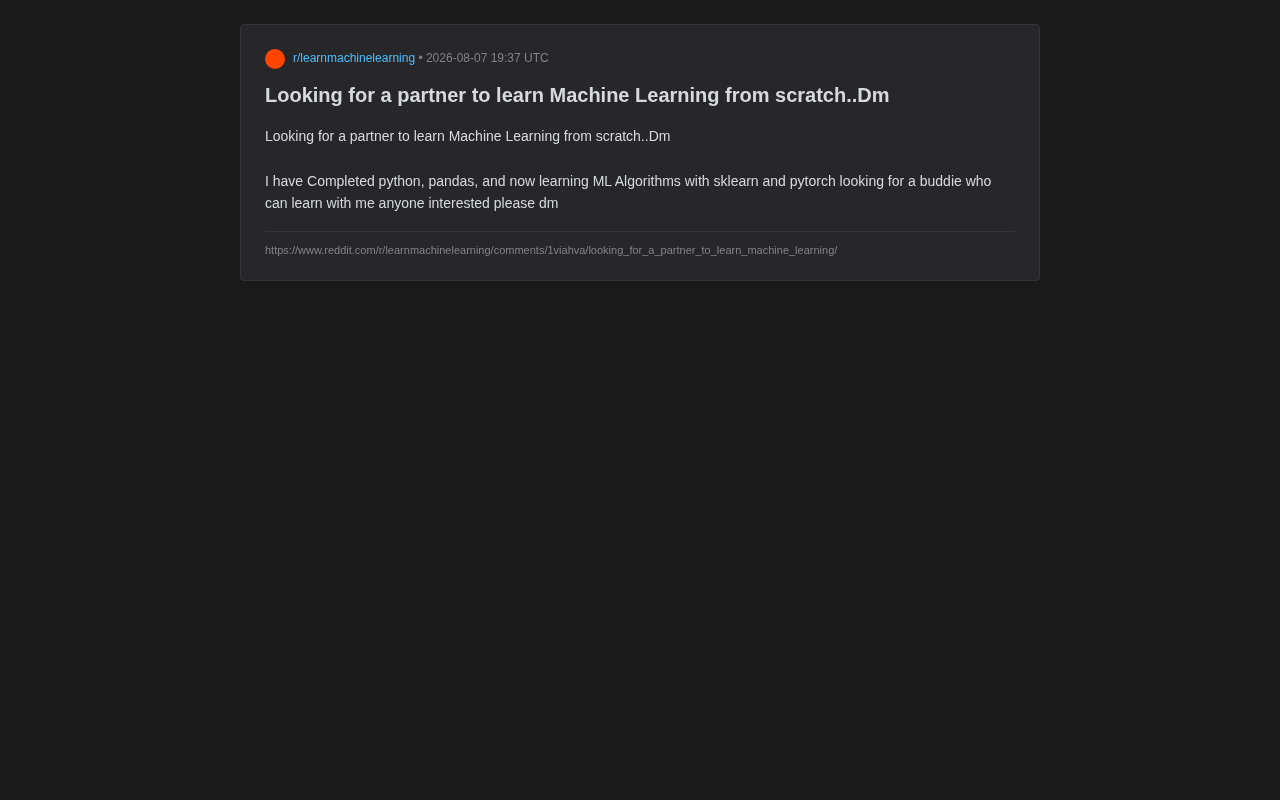
Though just a few lines long, this post reflects two core challenges that self-taught machine learning learners commonly face: how to plan a learning path from zero to advanced, and how to stay motivated throughout the long journey. This article will address both of these questions and provide actionable guidance for learners at a similar stage.
A Complete Learning Path for Machine Learning from Scratch
This learner's path is actually quite well-structured and worth emulating: first master Python programming fundamentals, then learn Pandas for data manipulation, move into traditional machine learning algorithms with scikit-learn, and finally transition to deep learning with the PyTorch framework. This progression aligns well with the widely recognized entry sequence in the field.
Phase 1: Python Programming and Data Processing Fundamentals
Python is the de facto lingua franca of machine learning, while Pandas and NumPy form the bedrock of data processing. NumPy is the core library for scientific computing in Python, providing high-performance multidimensional array objects and a rich collection of mathematical functions—virtually all higher-level ML frameworks are built on top of it. Pandas builds on NumPy by offering the DataFrame data structure, making tabular data reading, filtering, aggregation, and missing value handling extremely convenient—you can accomplish in a single line of code what would take dozens of clicks in Excel.
Many beginners rush to jump into "flashy" deep learning models while neglecting data cleaning and feature engineering—the "dirty work." Data cleaning involves handling missing values, removing duplicate records, correcting outliers, and standardizing data formats. Feature engineering is the process of extracting, transforming, and selecting the most valuable feature variables from raw data for model training. Andrew Ng once said "Applied machine learning is basically feature engineering," a statement that profoundly reveals its importance—it directly determines the upper bound of model performance.
In reality, data preparation often accounts for 60%–80% of the workload in real projects. This learner's decision to solidify Python and Pandas first is a wise choice.
Phase 2: scikit-learn and Traditional Machine Learning Algorithms
scikit-learn provides a unified interface for classic algorithms ranging from linear regression and decision trees to support vector machines and random forests. Its design follows consistency principles: all models implement unified APIs like fit(), predict(), and transform(), making algorithm switching extremely low-cost—you only need to change one line of instantiation code to switch from logistic regression to gradient boosting trees. This design allows learners to quickly compare the effectiveness of different algorithms.
The focus at this stage isn't just calling APIs—it's understanding the mathematical principles behind each algorithm. Gradient Descent is the most fundamental optimization algorithm in machine learning. Its core idea is to iteratively update parameters in the direction opposite to the gradient of the loss function, gradually approaching the optimal solution—like finding the lowest point of a valley while blindfolded by feeling the slope beneath your feet. Overfitting refers to when a model performs excellently on training data but generalizes poorly to new data, usually caused by excessive model complexity or insufficient training data—like a student who memorizes all exam answers but can't solve new problems. Underfitting is the opposite, where a model is too simple to capture patterns in the data. Cross-Validation divides data into K subsets that take turns serving as the validation set, providing more robust model performance evaluation than a single random split, effectively avoiding misjudgments caused by the randomness of data partitioning.
Mastering these "first principles" is what enables correct model selection when facing complex problems.
Phase 3: Getting Started with PyTorch Deep Learning Framework
PyTorch, developed by Meta (formerly Facebook) AI Research, is a deep learning framework widely adopted in both research and industry, known for its flexible syntax and active ecosystem. Its core feature is the Dynamic Computational Graph, which allows developers to build neural networks just like writing ordinary Python code, greatly facilitating debugging—you can set breakpoints and print intermediate variables anywhere, unlike early TensorFlow where you had to define the computation graph first and then execute it.
When transitioning from scikit-learn to PyTorch, learners need to build understanding of several core concepts: Tensors are the fundamental data structure in PyTorch, essentially GPU-accelerated multidimensional arrays; the Autograd mechanism automatically tracks all operations on tensors and computes gradients, eliminating the tedium of manually deriving backpropagation formulas; neural network layer structures are composed in a LEGO-brick fashion through the torch.nn module; and the training loop is the continuous iteration of the core process: forward pass → compute loss → backward pass → update parameters.
PyTorch's ecosystem is also extremely rich, including official sub-libraries like torchvision (computer vision), torchaudio (audio processing), and torchtext (natural language processing), as well as thriving third-party ecosystems like Hugging Face Transformers. This step represents a significant leap and is precisely where many self-learners tend to get "stuck."
Why Partnered Learning Is So Important for Machine Learning
This learner's proactive search for a study partner actually reveals a hidden pain point in the self-learning process: loneliness and procrastination.
Machine learning has a steep learning curve. From mathematical derivations to code debugging, you can encounter seemingly insurmountable obstacles at any time. When studying alone, it's easy to completely stall because of a single error message or an incomprehensible section of a paper. The value of a study partner lies in:
- Mutual accountability: Agreeing on progress and goals reduces the probability of giving up midway;
- Knowledge complementarity: Different people understand the same concept from different angles, and discussion often leads to "aha moments";
- Debugging assistance: When stuck on the same bug, a second pair of eyes can often spot the problem quickly;
- Emotional support: During learning slumps, a companion's presence effectively alleviates anxiety.
The effectiveness of paired learning is also supported by cognitive science research. Vygotsky's Zone of Proximal Development theory demonstrates that learners achieve the most effective cognitive development on tasks slightly above their current ability level when assisted by a capable peer. Explaining knowledge to others (the core of the Feynman Technique) forces learners to organize their thoughts and fill gaps in understanding—you think you understand something until you try to explain it to someone else and discover the holes. In software engineering, the pair programming practice in Extreme Programming (XP) has been proven to reduce defect rates by approximately 15% while improving team members' skill levels.
For a field like machine learning that requires both theoretical depth and extensive practice, the value of a partner mechanism is particularly pronounced.
How to Find and Maintain an Effective ML Study Partnership
Finding a partner is just the beginning. Making the relationship truly productive requires some methodology.
Define Shared Goals and Learning Pace
Before starting, both parties should reach consensus on learning objectives (whether it's getting started, job hunting, or research), weekly time commitment, and the sequence of learning content. Goal misalignment is the primary reason study partnerships break down—someone who wants to quickly blitz through courses for a job and someone who wants to deeply study theory will struggle to stay in sync.
Establish Regular Sync and Communication Mechanisms
You can schedule a weekly video discussion to share respective progress, challenges encountered, and solutions found. These "mini check-ins" serve both as accountability and as a knowledge consolidation process.
Drive Learning Through Hands-On Projects
Rather than each person grinding through tutorials independently, collaborate on a small project—such as an image classifier or a house price prediction model. Project-driven learning connects scattered knowledge points and gives collaboration a concrete anchor.
GitHub and Kaggle are ideal platforms for collaboration and hands-on practice. Kaggle is the world's largest data science competition platform with over 15 million registered users, offering not only competitions but also rich public datasets and shareable Notebooks coding environments. Beginners can start with "Getting Started" competitions (such as Titanic survival prediction or MNIST handwritten digit recognition), gaining instant feedback and sustained motivation through leaderboards. GitHub is the standard platform for code collaboration, where learners can review each other's code through Pull Requests and track learning task progress through Issues. This workflow itself is standard industry practice—developing team collaboration skills during the learning process kills two birds with one stone.
Leverage Machine Learning Community Resources
Beyond one-on-one partnerships, Reddit's r/MachineLearning, r/learnmachinelearning, Discord learning communities, and Kaggle competition teams are all great places to expand your learning network. Embedding your one-on-one relationship within a larger community provides richer feedback.
Conclusion: Turning a Solo Marathon into a Team Relay
This brief Reddit post deserves attention because it voices the shared sentiment of countless self-learners. The machine learning journey is long and arduous, but it doesn't have to be a lonely marathon.
Whether you're at the Python beginner stage or already training your first neural network in PyTorch, finding like-minded companions and joining active learning communities can help you go further and steadier on this journey. Technical ability certainly matters, but the motivation and methods for sustained learning are often what ultimately determine success or failure.
Related articles

oqoqo: A Developer Tool for Building Custom AI Evaluation Benchmarks with Real-World Tasks
oqoqo is a developer-focused AI evaluation tool for building private benchmarks, measuring Agent performance on real products, and optimizing model selection across GPT, Claude, and Gemini.

Prime Agent: An Open-Source Coding Agent That Can Improve Its Own Underlying Framework
Prime Agent is an open-source self-improving coding agent using Recursive Language Models and Continual Harness abstractions, achieving 95.5% on ARC-AGI-3.

Salesman AI: A Full-Cycle Sales AI Assistant from Pre-Meeting Rehearsal to Post-Meeting Follow-Up
Salesman AI is a full-cycle AI sales assistant covering pre-meeting buyer intelligence, adaptive rehearsal, post-meeting deal intelligence extraction, and follow-up management to turn every meeting into measurable pipeline progress.