Salesman AI: A Full-Cycle Sales AI Assistant from Pre-Meeting Rehearsal to Post-Meeting Follow-Up

Salesman AI is a full-cycle AI assistant turning sales meetings into measurable pipeline progress.
Salesman AI is a newly launched AI sales agent that spans the entire sales meeting lifecycle—from pre-meeting buyer intelligence compilation and adaptive rehearsal, to post-meeting deal intelligence extraction and follow-up management. By automating context assembly and converting conversations into structured insights and next actions, it aims to solve the common problems of inadequate preparation, poor improvisation, and broken follow-up chains that plague B2B sales teams.
When Sales Meetings Meet AI
In B2B sales, a high-quality customer meeting often determines the direction of a deal. In B2B (Business-to-Business) sales, deal cycles typically span months or even years, involving multiple decision-makers and complex procurement processes. According to Gartner research, a typical B2B purchasing decision involves an average of 6-10 stakeholders, each bringing different information sources and preferences. This means every customer meeting is not an isolated event, but a critical node in a long decision-making chain. Account Executives (AEs) need to simultaneously handle relationship management, needs discovery, objection handling, and value delivery during meetings.
However, in reality, many AEs lack adequate preparation before meetings, struggle to adapt on the fly during meetings, and neglect follow-up afterward—these broken links cause substantial potential revenue to slip away.
Recently launched on Product Hunt, Salesman AI targets precisely this pain point. Positioned as an "AI sales agent that turns meetings into revenue," it aims to connect the entire chain of sales meetings from preparation and execution to review. After launch, the product received 33 upvotes, ranking 11th for the day, and was categorized under Sales, Meetings, and Artificial Intelligence.
Salesman AI Core Capabilities: An Intelligent Sales Assistant Spanning the Entire Meeting Lifecycle
Unlike many sales tools that only address a single stage, Salesman AI's value proposition lies in "full-cycle coverage." According to official descriptions, its workflow can be broken down into three phases.
Pre-Meeting Preparation: Auto-Compiling Buyer Intelligence and Deal Context
Before each meeting begins, Salesman AI automatically collects and integrates buyer information and deal context. This means AEs no longer need to spend significant time manually searching through CRM records, email threads, and communication history—the system consolidates this scattered information into a structured pre-meeting brief.
It's worth elaborating on the limitations of CRM (Customer Relationship Management) systems here. Traditional CRMs like Salesforce and HubSpot are essentially structured databases for recording customer contact information, communication history, deal stages, and revenue forecasts. However, the core problem with CRM is that it's a "passive recording tool" rather than an "active enablement tool"—data entry relies on manual input from salespeople (which is one of the things AEs least want to do), and stored information often lacks timely contextualization. Research shows that salespeople spend an average of nearly 6 hours per week on CRM data entry, yet only a small fraction of this data gets converted into actionable guidance. This is precisely what Salesman AI aims to change.
Furthermore, it transforms this context into an "adaptive pre-meeting rehearsal." This feature is quite innovative: rather than just providing a static document, it allows salespeople to conduct a targeted simulation before facing the actual client, thereby improving their live performance.
The concept of adaptive rehearsal draws from "spaced repetition" and "situated learning" principles in education, combined with the role-playing capabilities of large language models. Unlike traditional sales training role-plays, AI-driven adaptive rehearsal can simulate realistic conversation scenarios based on the specific client's industry background, known pain points, and historical interaction records. It dynamically adjusts conversation difficulty and direction—for example, simulating a client raising price objections, competitor comparisons, or timeline delays. This personalized practice approach is theoretically more targeted than generic script training because it lets AEs "experience" potential key conversation moments in a low-risk environment first.
During and After Meetings: Turning Customer Conversations into Deal Intelligence
After each customer conversation, Salesman AI converts meeting content into actionable "deal intelligence" and "next actions." This effectively solves the pervasive "post-meeting follow-up gap" in sales teams—many valuable conversational signals are often lost because they aren't recorded and converted in a timely manner.
Deal Intelligence refers to structured insights extracted from unstructured conversation data, including but not limited to: customer budget signals, decision timelines, competitive evaluation status, and attitude shifts among key decision-makers. This information is typically hidden in the subtle phrasing of meeting conversations and easily missed by humans. Sales Pipeline is a core concept in sales management, referring to a visualized view of all in-progress potential deals arranged by stage. A healthy sales pipeline requires trackable and predictable conversion rates at each stage. Traditionally, pipeline progress assessment relies heavily on AEs' subjective reporting, while AI tools can provide more objective stage determination by analyzing actual conversation content.
This contextual information is then continuously retained in the AI Helper and deal dashboard, helping AEs drive meetings toward measurable pipeline progress.
Salesman AI's Product Design Logic
From a product strategy perspective, Salesman AI captures a key insight: sales is fundamentally about continuous context management. Traditional sales tools (like CRMs) excel at recording data but struggle to convert that data into actionable recommendations at the right moment. Salesman AI attempts to fill this gap with AI capabilities, creating a closed loop from "data to insight to action."
One noteworthy detail is its emphasis on "measurable." Sales management has long faced a challenge: how to quantify the contribution of a single meeting to the final close. By converting every conversation into structured intelligence and clear next steps, Salesman AI effectively provides trackable granularity for the sales process, which has practical significance for sales team reviews and optimization.
Competitive Landscape Analysis for AI Sales Assistants
The AI sales assistant space has become intensely competitive in recent years, ranging from meeting transcription tools (like Gong and Fireflies) to sales coaching assistants (like various AI Copilots), each with different focuses.
Representative companies in the meeting recording and conversation intelligence space include Gong (founded in 2015, having raised over $700 million), Chorus.ai (acquired by ZoomInfo for $575 million), and Fireflies.ai. Gong's core model is recording sales calls and video meetings, using NLP technology to analyze conversation patterns and identify key behavioral characteristics in successful deals—such as the frequency of questions successful AEs ask during discovery, pause duration when handling objections, and the depth of multi-threaded discussions. These tools primarily solve the "post-meeting analysis" problem—helping sales managers and AEs understand "what already happened." Salesman AI attempts to extend forward into "pre-meeting preparation" and "real-time assistance," forming more complete coverage. This trend from point solutions to full-cycle platforms also reflects how sales tech stacks are being reintegrated as AI capabilities mature.
Salesman AI's differentiation lies in its attempt to incorporate "pre-meeting rehearsal" into the product loop—an area that many similar tools rarely address.
However, as a product that just debuted on Product Hunt, it still needs to answer several critical questions:
- Context Quality: How accurate and complete is the auto-compiled buyer information? This directly determines the value of pre-meeting briefs and rehearsals.
- Real-World Effectiveness: Does "adaptive rehearsal" actually improve AEs' live performance, or is it merely a formality?
- System Integration: Whether it can seamlessly connect with enterprises' existing CRM and meeting tool ecosystems is a practical threshold that determines adoption by sales teams.
Based on the initial feedback of 33 upvotes, the market still shows interest in this type of "full-cycle sales AI," but the product's true value awaits validation from more real-world users.
Summary
Salesman AI represents a direction in AI sales tools evolving from "assisting at single points" to "spanning the entire cycle." It aims to address three common pain points in sales meetings—inadequate preparation, poor improvisation, and broken follow-up chains—while continuously accumulating context through the AI Helper and deal dashboard. For sales teams looking to improve meeting conversion rates and ensure every customer interaction genuinely advances pipeline progress, this is a new tool worth watching. Of course, its actual effectiveness still needs further validation in real sales scenarios.
Related articles
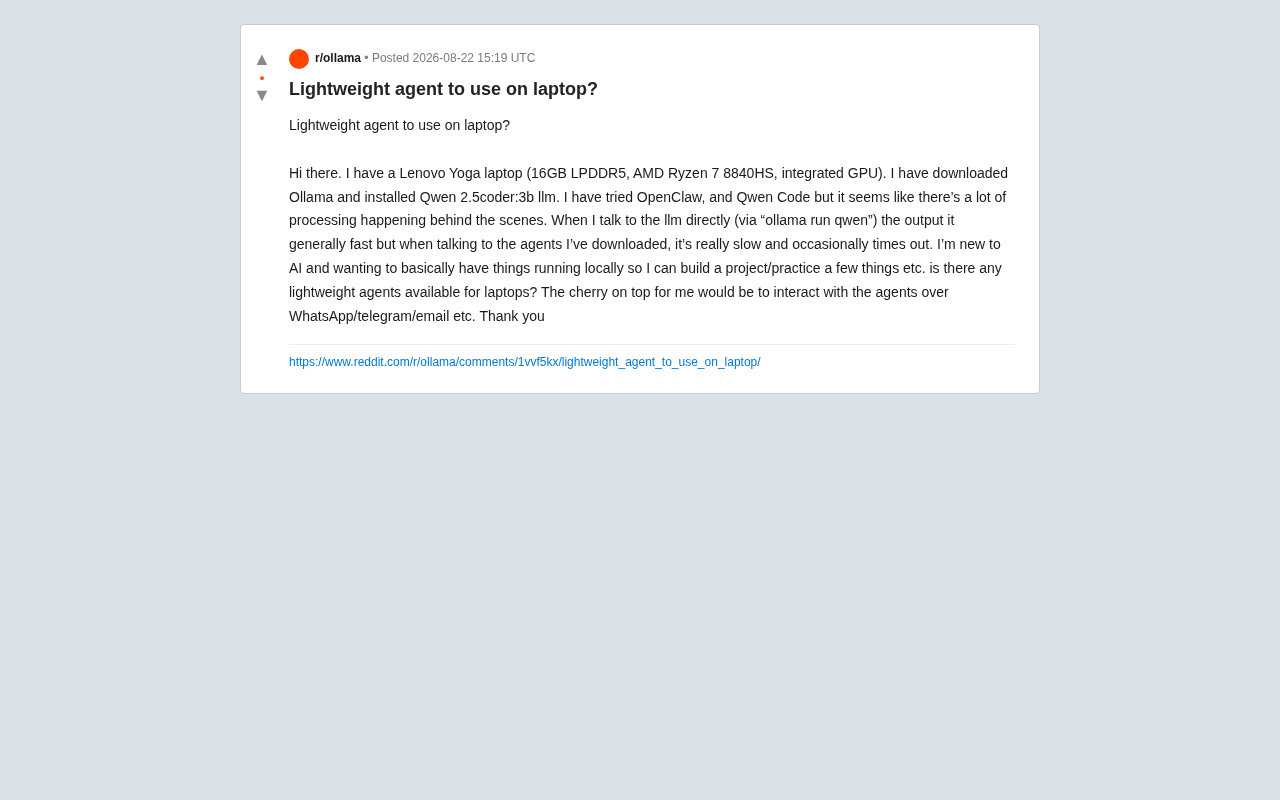
Local AI Agent Deployment Too Slow? A Lightweight Optimization Practical Guide
Local AI Agent deployment slow and timing out? This guide covers Agent framework overhead, hardware bottlenecks, and practical optimizations including context trimming, quantization, and Telegram Bot integration.

Choosing a Laptop for AI Studies: MacBook vs NVIDIA Laptop — An In-Depth Comparison Guide
In-depth analysis for AI students choosing laptops: MacBook Air M5 with remote GPU vs NVIDIA laptop, comparing CUDA support, portability, battery life, and value.

Self-Hosted LLM Tech Stack: A Complete Guide to Managing Your Local AI Cluster from the Terminal
A deep dive into self-hosting LLM tech stacks: inference engines, model management, vector databases, and how to manage your local AI cluster from the terminal.