Learning Python from Scratch: A Complete Guide to the Three-Stage Learning Path

A complete guide to learning Python from scratch through a three-stage path: basics, advanced, and practice.
This article outlines a systematic three-stage path for learning Python from scratch—basic syntax, advanced mastery, and hands-on practice. Paired with real projects in web crawling, automation, and data analysis, plus deep dives into topics like the GIL, bytecode, OOP, and Python's role in the AI era, it helps beginners build solid programming thinking.
Why It's Still Worth Starting Programming with Python Today
Among the many programming languages, Python has become one of the most widely used in the world. Python was first released in 1991 by Dutch programmer Guido van Rossum—in fact, the design work on the language began during the Christmas holidays of 1989, when Guido started brainstorming to pass the time. Its name doesn't come from the snake, but is a tribute to the British comedy troupe Monty Python. Python's design philosophy emphasizes code readability and simplicity, fully documented in the 19 aphorisms of "The Zen of Python" (PEP 20)—"Beautiful is better than ugly, explicit is better than implicit" is one of its core principles. You can view the full text anytime by typing import this into the Python interpreter. Driven by this philosophy, Python code is extremely readable and is often praised as "executable pseudocode."
It's worth adding that PEP (Python Enhancement Proposal) is the core governance mechanism of the Python community. Every language feature addition, modification, or deprecation must be submitted, discussed, and reviewed through the PEP process by the core developer committee. PEP 20 (The Zen of Python), PEP 8 (Style Guide for Python Code), and PEP 572 (the walrus operator) are all far-reaching milestone proposals. This open and transparent community-driven model is an important institutional guarantee for the healthy evolution of the Python ecosystem over more than thirty years, and it also embodies the best practices of open-source software governance.
According to the TIOBE Programming Community Index and Stack Overflow's annual Developer Survey, Python has consistently ranked as the world's most popular programming language since 2021. Its real competitiveness lies in its vast ecosystem: NumPy and Pandas power data processing, TensorFlow and PyTorch drive deep learning, and Django and FastAPI handle web development. This "one language, many uses" characteristic makes Python a versatile tool across domains. With the continued development of big data and artificial intelligence, Python appears more and more frequently in the tech stacks of all industries—whether it's data analysis, machine learning, automation scripts, or web development, you can see its presence everywhere.
For beginners looking to change careers or just getting started, programming often feels like an insurmountable mountain. Although there are abundant learning resources online, they generally suffer from two problems: first, the content is one-sided and fragmented, making it hard to form a coherent system; second, much of the material lacks practical examples, which is very unfriendly to self-learners starting from scratch.
Based on a systematic Python tutorial shared by a Bilibili content creator, this article outlines a clear path for learning Python from scratch. Its core philosophy is simple: pair every knowledge point with real-world program examples, making abstract syntax intuitive and tangible.
The Three-Stage Learning Path: From Fundamentals to Practice
This course breaks down Python learning into three progressive stages—basic syntax, advanced mastery, and hands-on practice. This layered design aligns with the cognitive patterns of beginners, avoiding being overwhelmed by complex concepts from the start.
Stage One: Basic Syntax—Laying a Solid Programming Foundation
The fundamentals section starts with environment setup, detailing the installation and configuration of the Python interpreter and the PyCharm development tool. This step seems simple, yet it's the first hurdle where many newcomers get stuck.
It's worth understanding that Python is an interpreted language—code doesn't need to be precompiled into machine code like C or Java, but is instead read line by line and executed in real time by the Python interpreter. Python's official standard implementation is CPython (written in C). It doesn't directly interpret source code, but first compiles it into bytecode (i.e., .pyc files), which is then interpreted and executed by a built-in virtual machine—this intermediate layer design balances development efficiency with cross-platform capability. Besides CPython, the ecosystem also includes Jython (targeting the JVM), IronPython (targeting .NET), and PyPy, which uses JIT (just-in-time) compilation technology and can perform several times faster than CPython in compute-intensive tasks.
Deeper Understanding: The Relationship Between Bytecode and the Virtual Machine
The process of CPython compiling source code into bytecode is highly similar in logic to Java compiling into .class files—both are intermediate representations targeting their respective virtual machines, rather than machine code targeting the physical CPU directly. The core value of this design lies in platform independence: the same bytecode can run identically on CPython virtual machines across Windows, macOS, and Linux without needing recompilation for different hardware architectures.
.pycfiles are usually stored in the__pycache__directory, and their filenames include the Python version number (e.g.,module.cpython-311.pyc) to avoid bytecode compatibility issues between different Python versions. When the source file hasn't been modified, Python directly loads the cached bytecode file, skipping the compilation step and thus speeding up program startup. Understanding this mechanism helps beginners explain common questions like "Why does a__pycache__folder appear in the directory after running a Python script for the first time?" It's worth mentioning that bytecode is not unreadable—thedismodule in Python's standard library can disassemble any function into a readable sequence of bytecode instructions, making it an excellent tool for deeply understanding Python's execution mechanism.
There's an important low-level concept worth understanding deeply here: the GIL (Global Interpreter Lock). To ensure thread safety in memory management, CPython introduced the GIL at the interpreter level—it ensures that only one thread can execute Python bytecode at any given moment. This means CPython's multithreading cannot achieve true parallelism on CPU-intensive tasks, and typically requires the multiprocessing module to bypass this limitation.
The historical roots of the GIL can be traced back to CPython's memory management mechanism: CPython uses reference counting as its primary garbage collection strategy—each object maintains a counter of how many times it's referenced, and memory is released immediately when the count reaches zero. In a multithreaded environment, multiple threads modifying the same object's reference count simultaneously would create race conditions, and the GIL was introduced in 1992 precisely to avoid such data corruption. It's worth noting that reference counting is not CPython's only garbage collection method—to handle circular references between objects (such as A referencing B and B referencing A, causing the reference count to never reach zero), CPython also comes with a generational garbage collector based on the "mark-and-sweep" algorithm as a supplement, periodically detecting and reclaiming circularly referenced objects. This dual-track mechanism makes Python's memory management efficient enough in most scenarios, but it's precisely this complexity that makes removing the GIL extremely difficult from an engineering standpoint.
The good news is that Python 3.13 has introduced an experimental "free-threaded" mode (PEP 703), allowing it to run with the GIL disabled, marking a historic step forward for Python in the field of high-performance concurrency. Note that the GIL has less impact on I/O-intensive tasks (such as network requests and file reads/writes)—during I/O waits, the GIL is actively released, allowing other threads to execute; what's truly limited are pure CPU computation scenarios. Understanding this mechanism helps beginners grasp why Python outperforms compiled languages in flexibility and development speed, while also maintaining a clear-eyed view of its performance boundaries. The interpreted nature makes debugging Python extremely convenient—you can run and view results immediately after modifying code, greatly lowering the barrier to entry.
PyCharm is a professional Python Integrated Development Environment (IDE) developed by JetBrains, offering features like intelligent code completion, real-time error hints, and a visual debugger, allowing beginners to focus their energy on learning syntax and logic rather than getting bogged down in the tedious details of command-line configuration. For complete beginners, there's an even lighter alternative: VS Code (Visual Studio Code) paired with the Python plugin also provides a complete development experience with lower resource usage. Both offer free versions, and beginners can choose according to personal preference. Additionally, for beginners who don't want to install any software locally, Jupyter Notebook (now more commonly used via the Anaconda distribution or Google Colab in the cloud) is also an excellent choice—it executes code interactively in "cells," with the output of each code segment displayed directly below the code, making it particularly suitable for data analysis and learning exploration scenarios.
Then comes the core syntax learning:
- Data types: integers, floats, strings, lists, dictionaries, etc.
- Basic logical structures: conditional statements (if), loops (for/while)
- Program design methods: how to translate real-world problems into code logic
Supplement: Python's Dynamic Type System
Python uses a dynamically strongly-typed system, a characteristic crucial for beginners to understand data types. "Dynamic" means variables don't need type declarations in advance—
x = 1andx = "hello"are both valid assignments, and Python automatically infers the type at runtime. "Strongly typed" means there's no implicit conversion between different types—"3" + 3will directly raise aTypeError, rather than quietly returning"33"or6like JavaScript. This design makes Python code extremely flexible to write, but it also requires developers to maintain clear awareness of data types. Type Hints introduced in Python 3.5 (such asdef add(x: int, y: int) -> int) are a complement to this flexibility—they don't affect runtime behavior, but can work with static checking tools likemypyto catch type errors early in the development phase, balancing the convenience of a dynamic language with the safety of static checking. This feature is especially important in large engineering projects and is a recommended practice in modern Python code standards. Furthermore, thematchstatement (structural pattern matching) introduced in Python 3.10 and the simplified generic syntax introduced in 3.12 both reflect the continued evolution of Python's type system toward engineering-oriented directions.
Each knowledge point comes with real-life program examples, and abundant tips and cautions are prepared for key difficulties to help beginners clear obstacles. Each lesson is also accompanied by exercises for timely checking of learning outcomes.
Stage Two: Advanced Mastery—Improving Code Quality
The advanced section focuses on three core concepts: functions, object-oriented programming (OOP), and file operations. These are the key leap from "being able to write code" to "writing good code."
Object-oriented programming is a cornerstone paradigm of modern software engineering, with origins tracing back to the Simula language of the 1960s, later popularized by Alan Kay in Smalltalk. The three core pillars of OOP are: encapsulation (binding data and operations within the "class" structure, hiding internal details from the outside), inheritance (subclasses can directly reuse the logic of parent classes, avoiding reinventing the wheel), and polymorphism (the same interface exhibits different behaviors across different objects). Python's OOP implementation is more flexible compared to strongly-typed languages like Java: Python supports multiple inheritance (one subclass can inherit from multiple parent classes simultaneously) and elegantly resolves the diamond problem in multiple inheritance through the MRO (Method Resolution Order, using the C3 linearization algorithm). The C3 linearization algorithm was proposed by Stefano Rossetti and others in 1996; its core idea is to linearly arrange all parent classes while preserving the internal inheritance order of each, ensuring that subclasses always appear before parent classes, thereby producing a unique and deterministic method lookup order. Developers can view the complete method resolution chain of any class through its __mro__ attribute or the ClassName.mro() method, which is very useful when debugging complex inheritance relationships. Even more noteworthy is Python's "duck typing" philosophy—"if it walks like a duck and quacks like a duck, then it's a duck"—which allows polymorphism to be achieved naturally without explicitly declaring interfaces. In Python, everything is an object—integers, strings, and even functions themselves are object instances.
Deeper Understanding: The Status of the Functional Programming Paradigm in Python
Although the advanced section focuses on OOP, Python also provides first-class support for functional programming, and the two paradigms can be freely mixed in Python. The core idea of functional programming is to treat computation as the evaluation of mathematical functions, emphasizing pure functions (the same input always produces the same output, with no side effects) and immutable data. Python provides higher-order functions like
map(),filter(), andreduce()for this, as well as thefunctoolsanditertoolsstandard library modules.lambdaexpressions can create anonymous functions and are extremely common when used with thekeyparameter ofsorted(). Understanding functional programming helps beginners write more concise and testable code, and it's also an important foundation for understanding the Pandas method-chaining style in subsequent data analysis. OOP excels at modeling "entities" (such as users, orders, products), while functional programming excels at describing "data transformation pipelines" (such as data cleaning pipelines). Being able to flexibly choose between the two paradigms based on the scenario is exactly a sign of a mature Python engineer. In fact, Python's built-in data structures also reflect traces of functional programming:tupleandfrozensetare immutable types, naturally fitting functional programming's preference for immutable data; whilecollections.namedtupleanddataclassesintroduced in Python 3.7 provide an elegant middle ground between OOP and functional style.
In the advanced stage, there are several unique Python language features worth beginners' attention: decorators are one of Python's "syntactic sugars," allowing functions to be dynamically extended without modifying their original code, widely used for cross-cutting concerns such as logging, permission validation, and caching; generators and the yield keyword implement lazy evaluation, significantly reducing memory usage when processing large-scale data; list comprehensions make data transformation operations more concise and elegant. Together, these features form the core of the "Pythonic" code style and are also essential foundations for reading the source code of mainstream open-source libraries. Especially worth mentioning are context managers and the with statement—the pattern with open('file.txt') as f: automatically manages resource acquisition and release through the __enter__ and __exit__ protocols, ensuring that resources such as file handles, database connections, and network sockets are correctly closed in any situation (including when exceptions occur), making it an important paradigm in engineered Python programming. Mastering OOP means developers can build reusable, maintainable code modules—it's a necessary path from writing "one-off scripts" to developing "engineering-grade projects," and a prerequisite for understanding the source code of mainstream open-source frameworks.
The course breaks things down step by step through concise, easy-to-understand cases, and additionally provides accompanying classroom case files and mind maps, allowing learners to focus on understanding the logic itself without being distracted by note-taking.
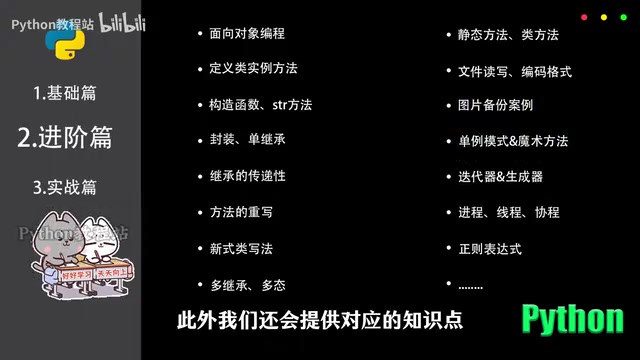
The mind maps are especially worth noting. The programming knowledge system is vast and complex, and presenting the knowledge structure visually helps beginners build an overall framework, effectively avoiding the predicament of "learning the later parts while forgetting the earlier ones."
Stage Three: Hands-On Practice—Truly Mastering Python Through Projects
It's hard to truly master programming by only learning syntax without hands-on practice. The practice section guides learners through real projects, including:
- Scraping images and videos: getting started with web crawling, understanding HTTP requests and data parsing
- Automatically sending emails: mastering practical skills for Python office automation
- Analyzing hotel room prices during the May Day holiday: combining data analysis to process real datasets
Take web crawling as an example. Its underlying principle is to simulate browser behavior, send HTTP/HTTPS requests to the target server, obtain response data in HTML or JSON format, and then use parsing libraries to extract the required information. Python's requests library is responsible for initiating network requests, while BeautifulSoup or lxml handle parsing the HTML document structure—this is the classic beginner combination. As skills advance, the Scrapy framework can provide engineering-grade solutions for asynchronous crawling, while Selenium and Playwright can drive real browsers to handle complex pages requiring JavaScript dynamic rendering.
Supplement: The Technical Battle Between Anti-Crawling Mechanisms and Countermeasures
Modern websites generally deploy multi-layered anti-crawling mechanisms, and understanding these mechanisms helps beginners build a complete picture of crawling knowledge. Common anti-crawling methods include: User-Agent detection (identifying non-browser request headers), rate limiting (returning 429 errors for high-frequency requests from the same IP), Cookie and Session validation (requiring the login state to be maintained), JavaScript rendering (key data is dynamically loaded via JS and cannot be obtained by pure HTTP requests), CAPTCHAs (human-machine verification, including image CAPTCHAs, slider verification, etc.), and more advanced behavioral fingerprinting (analyzing behavioral features such as mouse trajectories and click patterns). Under the premise of legal compliance, crawler engineers can deal with basic protections by setting random delays, rotating request headers, and using proxy IP pools; for JavaScript rendering issues, browser automation tools such as
SeleniumorPlaywrightneed to be introduced to execute JS in a real browser environment and obtain the rendered DOM. This process of technical competition is also an excellent practical scenario for deeply understanding the web technology stack (the HTTP protocol, browser rendering mechanisms, front-end/back-end interaction). It's worth mentioning that many large platforms (such as Twitter/X, Reddit, and weather data providers) offer official APIs, which are more stable and compliant than crawling—evaluating "whether you really need a crawler, or whether you can just use the official API" is itself an important engineering judgment skill.
In data analysis projects, you'll encounter the core toolchain of Python data science: Pandas provides Excel-like DataFrame data structures, supporting data cleaning, aggregation, and transformation; Matplotlib and Seaborn handle data visualization, transforming dull numbers into intuitive charts; NumPy provides high-performance array computation support at the lower level. This toolchain forms a complete loop for data analysis work and is a necessary foundation for further learning machine learning. Through analysis practice on real datasets (such as hotel price data), beginners can truly experience the complete process of "data telling a story"—from raw data collection, to cleaning and processing, to visually presenting the conclusions.
Extension: The Natural Path from Data Analysis to Machine Learning
After mastering the Pandas + Matplotlib data analysis toolchain, the path into the field of machine learning is surprisingly smooth. Scikit-learn is the standard entry-level library for Python machine learning, providing almost all classic algorithms from linear regression and decision trees to random forests and support vector machines, with a highly unified API design (
fit()for training,predict()for prediction,score()for evaluation) and a gentle learning curve. Taking hotel price analysis as an example, after completing descriptive statistical analysis, it can naturally extend into a price prediction model: feeding features such as holidays, geographic location, and star ratings into a linear regression or random forest model to predict the price range under specific conditions—this is precisely the complete paradigm of a data science project. Going further, TensorFlow and PyTorch are the mainstream frameworks for deep learning, suitable for handling complex tasks such as image recognition and natural language processing. This learning path from "data analysis → machine learning → deep learning" is precisely the most mainstream growth trajectory for AI engineers today, and Python is consistently the only language tool that runs through the entire journey.
It's worth noting that in crawling practice, you must comply with the target website's robots.txt protocol (this file specifies which paths are allowed to be crawled), pay attention to controlling request frequency to avoid putting pressure on the server, and understand the relevant legal boundaries of data usage. This practice helps beginners intuitively understand the underlying mechanisms of internet data flow—how clients and servers communicate, and how web data is structurally organized—which is also a foundational skill for data collection and analysis work.
These projects cover popular application directions such as crawling, automation, and data analysis. They're both interesting and practical, giving learners a genuine sense of accomplishment in realizing that "programming can solve real problems."
The Right Mindset for Learning Python: Take the First Step First
For beginners starting from scratch, the most important thing isn't to master some advanced technology in one leap, but to take the first step in programming first.
As emphasized in the tutorial: first stand at the foot of the mountain of programming, bravely take the first step, and then gradually climb upward. Many people feel they'll "never learn programming in their lifetime," often because they're intimidated by overly high expectations and complex materials, giving up before even starting.
There's another viewpoint worth noting: once you've mastered the syntax and logic of one language, the time to learn a second language is greatly reduced. There's a basis for this in cognitive science: the essence of programming is algorithmic thinking and problem decomposition ability, which academia formally calls "computational thinking"—a concept formally proposed by Carnegie Mellon University professor Jeannette Wing in 2006, covering four core dimensions: decomposition (breaking complex problems into subproblems), pattern recognition (discovering similar patterns between problems), abstraction (extracting essential features while ignoring irrelevant details), and algorithm design (formulating executable solution steps).
This transfer effect has a clear path to follow in practice. Starting from Python, moving toward data science naturally extends to R; entering the fields of systems programming or high-performance computing, C/C++ or Rust are advanced choices; web full-stack development leads to the JavaScript/TypeScript ecosystem; while mobile development corresponds to Swift (iOS) or Kotlin (Android). Although each language has different syntactic forms, core programming paradigms such as conditional branching, loop iteration, function abstraction, and modular organization are highly isomorphic. Research shows that after mastering their first language, programmers need on average only one-third to one-fifth of the time to learn a second language—because the differences mainly lie in syntactic sugar and runtime characteristics, rather than the mindset itself. Because its syntax is highly close to natural language (English) and its mandatory indentation standardizes code structure, Python is widely recommended by cognitive scientists and educators as the best entry-level tool for cultivating computational thinking—even if your future goal isn't Python, starting with it is still a wise choice.
Supplement: Python's Special Status in the AI Era—From Tool to Infrastructure
It's especially worth pointing out that Python plays a role far beyond that of a "programming language" in the current wave of large language models (LLMs) and generative AI. OpenAI's ChatGPT API, Anthropic's Claude API, Google's Gemini API—almost all mainstream AI service providers list the Python SDK as their preferred officially supported language. More importantly, the mainstream toolchains for prompt engineering and AI application development—LangChain, LlamaIndex, AutoGen—are all built with Python at their core. This means that for professionals hoping to stay competitive in the AI era, Python is no longer just a "useful skill," but the infrastructure layer for connecting to the entire AI ecosystem. Even if you don't plan to become an algorithm engineer, being able to use Python to call AI APIs and build automated workflows will create a significant capability gap in the job markets of almost all industries. The more profound impact is this: as AI-assisted programming tools (such as GitHub Copilot and Cursor) become widespread, the barrier to writing Python code is continuously lowering—AI can help you generate boilerplate code, but the ability to understand code logic, debug errors, and design architecture remains a core competitiveness. From this perspective, the timing for learning Python now holds more strategic value than at any historical period.
Who Is This Tutorial Suitable For
This Python beginner tutorial is mainly aimed at three groups:
- Professionals wanting to switch careers into IT or the data field
- Programming beginners with zero foundation
- Self-learners who need to systematically organize their Python knowledge
Its greatest value lies in being systematic and example-driven—replacing fragmented learning with a coherent three-stage path, and replacing dull text documents with real-life examples. Of course, any tutorial is only a guide; true growth comes from continuous hands-on practice and project work.
If you've always wanted to learn programming but kept hesitating to start, why not begin with environment setup and your first line of Hello World? The mountain of programming isn't as hard as you imagine—the key is to take the first step and keep going.
Key Takeaways
Related articles

Andrew Ng's New Company LearnVector: Achieving One-on-One Personalized Learning with AI
Andrew Ng launches LearnVector, using generative AI to deliver one-on-one personalized learning. Explore its core vision, potential capabilities, challenges, and how LLMs can solve education's scalability problem.

Truth Has No Direction: How the Tarski Paradox Challenges LLM Truth Probe Techniques
How a Tarski-style attack challenges LLM truth probes from the foundations of logic. Is the linear representation hypothesis valid, or is the "truth direction" in AI activations just a statistical illusion?

Andrew Ng's New Company LearnVector: Achieving One-on-One Personalized Learning with AI
Andrew Ng launches LearnVector, leveraging generative AI to create one-on-one personalized learning experiences. Explore its core vision, potential capabilities, challenges, and how LLMs could solve education's scalability problem.