Leash Bio Trains AI Chemists with DEL Data: Running the Lab Loop at Compute Speed

Leash Bio turns noisy DEL experiments into a Lab-in-the-Loop cycle to train chemistry AI with real feedback.
Leash Bio reframes DNA-encoded libraries (DEL) from a one-shot screening tool into a Lab-in-the-Loop cycle that continuously produces training data, compressing a high-noise experiment into compute speed. DEL data's broad coverage and real negatives expose cheating models that score well on benchmarks but generalize poorly. Training chemical AI agents requires hard experimental feedback, not literature imitation — making DEL a training infrastructure for reasoning trajectories.
An Experiment Everyone Dreads, Holding the Best Data for Training AI Chemists
DNA-encoded libraries (DEL) are widely recognized in pharma as a powerful high-throughput screening tool — and also one of the most dreaded types of experiments. In a recent talk, Leash Bio's Ian Quigley described it bluntly as an assay that "traumatizes everyone" — long operational chains, high noise, high failure rates. Many teams run one round and never want to do a second.
But Leash Bio took a different path: rather than avoiding DEL's complexity, they engineered it, scaled it, and ran a "Lab-in-the-Loop" iteration cycle at compute speed. More importantly, they found that this data isn't just for screening compounds — it can also test whether AI models are "cheating," and train AI agents with genuine chemical reasoning.
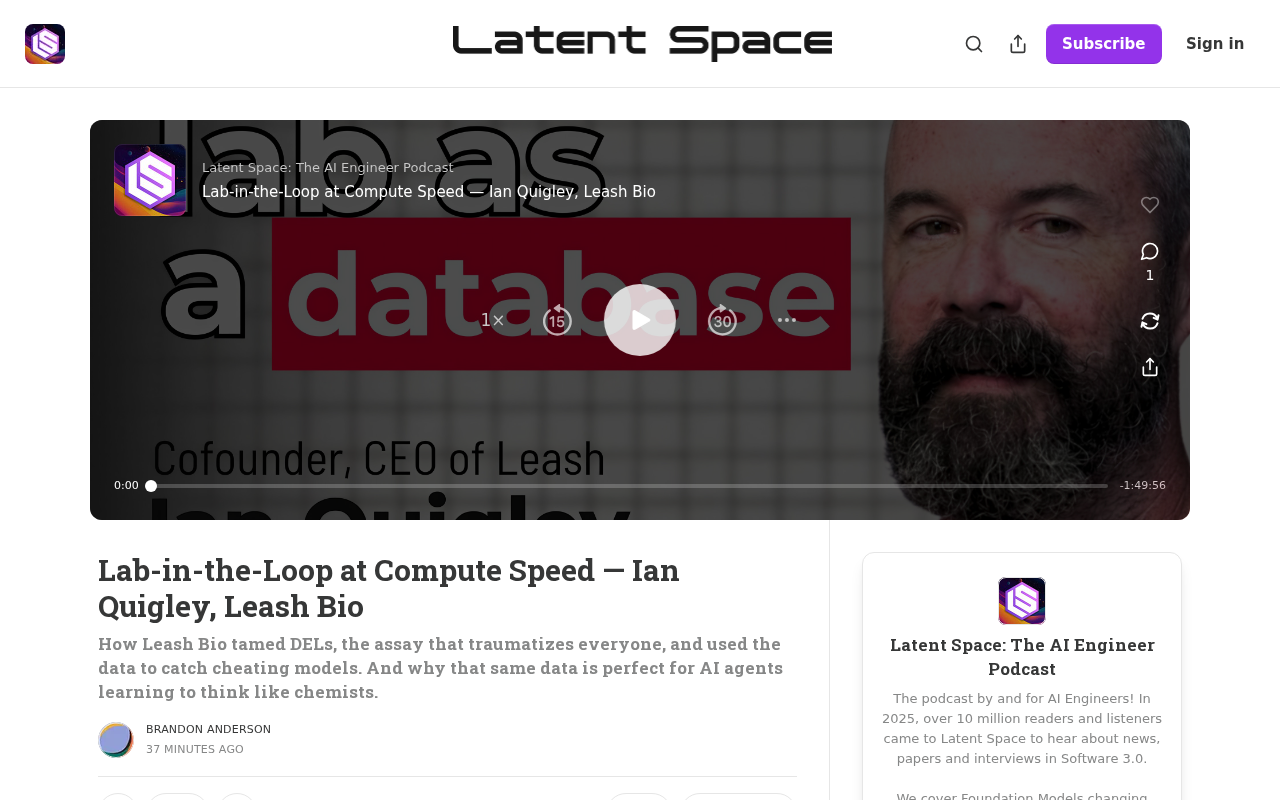
Why DEL Is Hard, and How Leash Bio Made It Simple
The Root of the Pain: Noise, Scale, and the Contradiction with Iteration Speed
The core idea of DEL is to encode massive numbers of compounds with DNA tags, run billions of binding experiments simultaneously in a single tube, then sequence to read out which compounds were "picked" by the target. Elegant in theory, but in practice problems pile up: library construction bias, non-specific adsorption across selection rounds, sequencing depth limits — all of which can drown the real signal in noise.
The traditional approach treats DEL as a one-shot screening tool: design the library, run a few selection rounds, sequence, pick candidates, then hand them to chemists for individual synthesis and validation. This pipeline is slow, and every failure wastes months.
DNA-Encoded Library (DEL) works like this: each compound to be tested is attached to a unique DNA sequence as a "barcode," and billions of compounds are incubated with the target protein in the same tube. Molecules that bind the target are captured, then PCR-amplified and read out via high-throughput sequencing of their DNA tags, revealing which compounds were enriched. This concept was pioneered by teams like Affinity Pharmaceuticals in the 2000s, and is now used to build libraries of billions of compounds — widely recognized in pharma as a high-throughput screening workhorse. It is often mentioned alongside mass-spectrometry or surface-plasmon-resonance methods such as ASMS and SPR — the latter typically cap out at tens of thousands of compounds, whereas DEL can cover tens of billions.
Lab-in-the-Loop: Let Experiments Iterate Quickly with the Model
Leash Bio's approach is to place DEL inside a continuously iterating loop. The model proposes the next round of compounds or conditions to test based on current data; the experimental side uses DEL to rapidly produce new data; data flows back to update the model. The key is "compute speed" — they aim to make the cycle as short as possible, with experimental design, data analysis, and the next-round decision all happening on the same rhythm.
In this mode, DEL is no longer a one-shot project but an engine that continuously produces training data. Every cycle accumulates real feedback for the model about "which molecules bind, and which don't."
Lab-in-the-Loop (LITL) traces its roots to active learning and Bayesian optimization, with mature applications in materials science and synthetic biology (e.g., Microsoft's MatterGen, A-Lab and other robotic experiment platforms). The core idea is for the model's next proposed experiment to be executed directly by robots or high-throughput assays, with results flowing back to update the model — maximizing information gain under a limited experimental budget. Unlike the traditional paradigm of "collect a big batch of data → train a model once," LITL pursues the shortest possible loop cycle — completing one iteration per month versus per week makes an order-of-magnitude difference in model performance. DEL suits LITL because a single round of experiments can produce massive labeled samples, naturally fitting this short-cycle, high-information cadence.
Using DEL Data to Catch "Cheating" Models
Quigley mentioned an interesting byproduct: the structural properties of DEL data make it naturally suited for detecting whether models are taking shortcuts.
A common trap in chemical data is that models learn dataset bias rather than chemical rules. For example, if certain scaffolds appear frequently in the training set, models tend to predict they're effective — rather than truly understanding functional-group–target interactions. DEL data's advantage is its broad coverage and the abundance of real negative samples, making it hard for a model to bluff its way through by memorization.
When Leash Bio uses this data for model evaluation, it can identify models that score beautifully on standard benchmarks but generalize poorly. In Quigley's words, these models "show their true colors" in the face of DEL data.
Why DEL Data Suits Training Thinking AI Agents
Chemical Reasoning Needs Real Feedback, Not Text Imitation
Much of today's "chemistry AI" is essentially a language model imitating phrasing from the literature — it can write plausible-looking synthetic routes, but without a closed loop with real experimental results. Leash Bio's view is that for an AI agent to think like a chemist, it must be exposed to the "hard feedback" of experiments — which designs actually bound, which failed, and what the failure patterns are.
DEL data happens to provide this feedback at scale and in structured form. Each round of selection results is a real test of the model's hypothesis, on which the agent can learn how to propose the next hypothesis.
Chemical agent refers to an AI system capable of autonomously running a "hypothesis → experiment design → result interpretation → new hypothesis" loop — similar to a chemistry version of the ReAct or Toolformer framework, except the tool calls are wet-lab experiments rather than APIs. Current mainstream chemistry LLMs (such as ChemCrow and Coscientist) rely mainly on literature pretraining and tool calls; their "reasoning" is essentially text pattern matching, lacking feedback signals from real molecule–target interactions. Leash Bio's view echoes the broader RLHF/RLVF (learning from verification feedback) trend in AI: in high-stakes domains, a model's reasoning must be anchored in verifiable physical feedback, otherwise it tends toward "literature hallucination" — writing plausible-looking plans that simply don't work in the lab.
From Screening Tool to Training Infrastructure
Reframing DEL as "AI training infrastructure" is the most noteworthy perspective shift in Leash Bio's talk. Traditionally DEL is treated as a tool for finding hits, with compound lists as output; under the Lab-in-the-Loop framework, it produces reasoning-trajectory data with experimentally validated labels.
For teams building chemical agents, this means the data strategy needs to change: not collect as many known molecule–target pairs as possible, but design experimental loops that continuously generate new feedback.
Benchmark overfitting / shortcut learning is a long-underestimated problem in chemistry AI evaluation. Commonly used datasets such as MoleculeNet and BindingDB have clear biases: positive samples tend to cluster in a small region of chemical space, so a model only needs to memorize these high-frequency scaffolds to score high — yet generalizes terribly to new chemical space. Recent community benchmarks like TDC (Therapeutics Data Commons) and Polaris attempt to mitigate this, but their negative samples are still mostly computationally generated rather than experimentally validated. DEL data's unique value is that negative samples come from real experimental non-binding results, cover a broad chemical space, and each selection round amounts to an actual test of the model's hypothesis — making it a far more realistic generalization test than synthetic benchmarks.
What This Means for the Industry
Leash Bio's practice points to a broader trend: the bottleneck for AI in science is shifting from model capability to data quality and iteration speed. Once a high-noise, high-barrier experiment like DEL is engineered to run "at compute speed," it turns from a burden into an asset.
For teams doing AI for Science, the question worth asking is not "which model do we use" but "how fast is our experimental loop, and how real is the feedback." DEL may not be the only answer, but it demonstrates a path to turning experimental pain into a model advantage.
One-line Summary
Leash Bio reframes noisy DEL experiments into a Lab-in-the-Loop cycle, training chemistry AI with real feedback and no room to cheat.
Paragraph Summary
Leash Bio reframes DNA-encoded libraries (DEL) from a one-shot screening tool into a Lab-in-the-Loop cycle that continuously produces training data, compressing a high-noise experiment that "traumatizes everyone" into compute speed. The article notes DEL data's broad coverage and real negative samples effectively expose "cheating" models that score well on standard benchmarks but generalize poorly. More importantly, training AI agents with chemical reasoning requires hard feedback from real experiments, not imitation of literature text. The author thus proposes a perspective shift: DEL's value is not just finding hits, but producing reasoning-trajectory data with experimentally validated labels, becoming AI training infrastructure. For AI for Science teams, the real bottleneck is shifting from model capability to data quality and experimental iteration speed.
Related articles

DeepCell: One-Click AI Generation of Documents, Spreadsheets, and Slides
DeepCell tops Product Hunt with one-click generation of documents, spreadsheets, and slides, using the .deepcell format for linked updates, designed for System 2 tasks like modeling and sales reviews.

Doneas: 15-Minute Daily Accountability Calls That Keep Indie Developers From Procrastinating
Doneas is a daily accountability tool for indie developers: plan tasks on Monday, join a 15-minute call with five builders each day, and log deliveries on a public progress page. This article analyzes its core mechanics, effectiveness, and potential issues around retention and matching.

Fastlane 2.0: Fully Automated AI Ad Campaigns, From Creative to Optimization
Fastlane 2.0 is an AI ad automation tool: enter your website and it learns your brand, generates video and image ads, and runs and optimizes them on Meta, TikTok, Instagram, and YouTube.