LedgerVault AI: A Zero-Cloud Receipt Organizer for Freelancers

LedgerVault AI is a zero-cloud invoice classification tool for freelancers that trades open source for trust.
LedgerVault AI is an open-source project published by developer Atharva Lawange on Dev.to, positioned as a private invoice and receipt classifier for freelancers, with a core proposition of "zero-cloud"—all files are processed locally and never uploaded to third-party servers. This approach earns data sovereignty and compliance advantages, at the cost of being constrained by local compute and having a ceiling on classification accuracy. Released as open source, it allows the "no cloud upload" promise to be verified through code review rather than resting on a declaration alone. The article notes it's a Hacktoberfest "Side Hustle" theme submission currently at an early stage, with key information such as technical implementation, supported formats, and classification performance not yet public; those interested are advised to try it on a small batch first before deciding whether to incorporate it into their workflow.
One of the most tedious chores freelancers face is archiving and organizing invoices and receipts. Storing them in the cloud risks leaking client information; keeping them local means sorting everything by hand. LedgerVault AI, an open-source project published by developer Atharva Lawange on Dev.to, attempts to solve both the privacy and efficiency problems at once with a "zero-cloud" approach.
What Problem Does It Actually Solve
LedgerVault AI's positioning is very clear: build a private, no-cloud-upload invoice and receipt classifier for freelancers.
Freelancers' financial documents have a few distinctive characteristics. The volume isn't huge, but the sources are scattered—different clients, different platforms, different formats. At the same time, sensitivity is high: invoices often carry client names, amounts, and banking details, and a leak can have serious consequences. The common approach is to use a cloud-based bookkeeping tool that automatically recognizes invoice contents—convenient, yes, but at the cost of handing those files over to a third-party server.
LedgerVault AI takes a different path: all processing happens locally, and files never leave the user's device. The project's subtitle uses the words "Private, Zero-Cloud," making the core proposition immediately clear.
The project was published as a submission for the second week's "Side Hustle" theme of the Hacktoberfest Open Source AI Challenge, which the author explicitly notes in the article.
Why "Zero-Cloud" Deserves to Be Called Out on Its Own
Making "no cloud upload" a selling point reflects a clear set of technical trade-offs.
The advantage of cloud solutions is that they can call on more powerful models, save local compute, and leave maintenance to the service provider. But the cost is a transfer of data sovereignty. For a tool that handles financial documents, this is not something that can be brushed aside. Privacy regulations in many countries and regions place explicit restrictions on cross-border transfers of personal financial data, and freelancers serving enterprise clients often have to promise in contracts that data won't leave the premises.
Local processing means: no network requests, no third-party server retention, and no vague clauses like "we need to upload this to improve our service." Users have complete control over their own data. The downsides are equally obvious—constrained by local device compute, the scale of models that can run is limited, and classification accuracy may not match large cloud models.
LedgerVault AI is betting that: invoice and receipt classification is a relatively standardized task that doesn't require top-tier large models—local capability is enough to handle it.
Local LLM is the technical foundation that makes the "zero-cloud" approach viable. In recent years, open-source models represented by Meta's Llama series, Mistral, and Microsoft's Phi can run on consumer-grade GPUs or even CPUs. Combined with quantization formats such as GGUF and inference frameworks like Ollama and llama.cpp, a 7-billion-parameter model quantized to 4-bit can have its VRAM footprint compressed to around 4GB, runnable on an ordinary laptop. This changes the old default assumption that "AI must depend on the cloud": for tasks with a high degree of structure, such as text classification and information extraction, small local models already perform adequately—and invoice field recognition (client name, amount, date) falls exactly into this category. The cost is that local inference is slower than cloud APIs and requires users to have a certain hardware threshold.
What Open Source Means Here
The project is released as open source, which is especially important for its target user group.
Trust in a privacy tool cannot rest on promises—only on verification. For a closed-source piece of software claiming it "doesn't upload to the cloud," users have no way to confirm whether it's secretly sending data anyway. Once it's open source, anyone can review the code and confirm there are no hidden network requests. For a scenario like handling financial documents, this is a necessary condition for building trust, not a bonus.
Second, open source lets freelancers adjust classification rules to match their own file formats and client habits. Freelance businesses vary enormously—a photographer's and a programmer's invoice structures are completely different—and one-size-fits-all commercial software struggles to cover every case.
From the perspective of the Hacktoberfest challenge, the topic fits well too. The "Side Hustle" theme encourages developers to build tools that help people earn extra income or manage side business affairs, and receipt organization happens to be an unavoidable part of freelancing.
Hacktoberfest is a contribution event held every October since 2014 by DigitalOcean together with GitHub and others, encouraging developers to submit pull requests to open-source repositories. Participants who complete a certain number of qualifying PRs receive official rewards (such as T-shirts or digital badges). This mechanism brings exposure and initial contributors to a large number of individual developers and small projects, and it's also a window during which many new projects quickly accumulate their first batch of stars and issues. The "second week Side Hustle theme" mentioned in the article is a themed challenge within the event, typically organized by the host or community around a specific direction, with participants submitting weekly entries to compete. Understanding this context explains why LedgerVault AI's release rhythm and promotional style resemble an event submission more than the formal launch of a mature product.
The Boundaries of Available Information
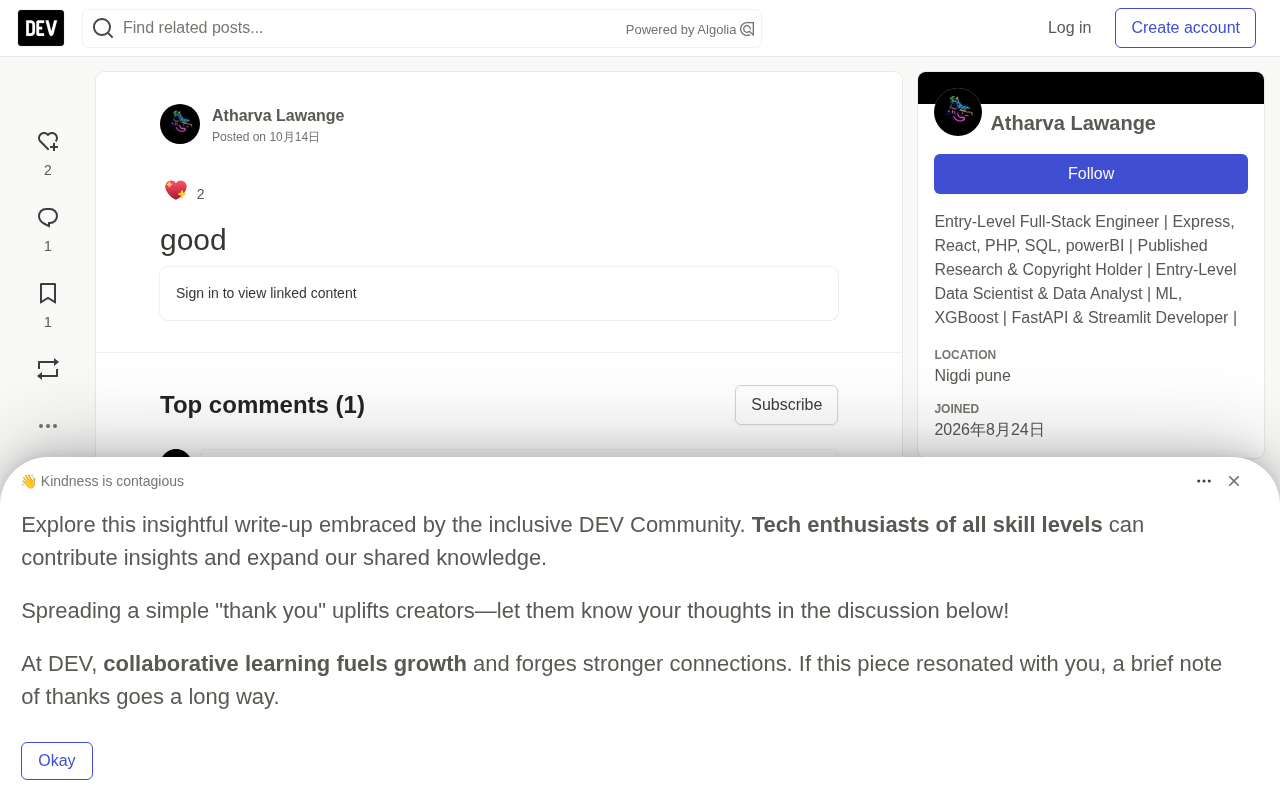
It should be noted that the publicly available information currently obtainable remains largely at the level of project positioning and release background. As for specific technical implementation—which local model is used, which file formats are supported, how accurate the classification is, what the interface looks like—the original content does not elaborate. The screenshot is also only the project's introduction card on Dev.to, with no actual product interface captured.
The project's engagement data currently stands at 1 reaction, 1 comment, and a 4-minute read time, indicating it's still a relatively new post and community feedback is still accumulating.
If you're a freelancer looking for a receipt organization solution that doesn't upload to the cloud, this project is worth following. But before confirming its actual classification performance and format compatibility, it's advisable to try it on a small batch of files first before deciding whether to incorporate it into your daily workflow.
Judging whether a local receipt classifier is usable usually comes down to a few quantifiable metrics: field recognition accuracy (the correct extraction rate of key fields such as client name, tax amount, and date), supported file formats (PDF, scanned images, phone photos, email attachments, etc.), OCR dependency (scanned documents require optical character recognition preprocessing, which significantly affects the final result), and export and bookkeeping software integration (such as exporting CSV/OFX for use with QuickBooks, Wave, etc.). None of these dimensions are currently disclosed in the public information, so it's impossible to draw conclusions about its actual usability. For projects you plan to follow, it's advisable to prioritize whether the author supplements the model selection, supported formats, and test samples—these are what determine whether it can truly enter a daily workflow.
One-line Summary
LedgerVault AI is a zero-cloud invoice classification tool for freelancers that trades open source for trust.
Paragraph Summary
LedgerVault AI is an open-source project published by developer Atharva Lawange on Dev.to, positioned as a private invoice and receipt classifier for freelancers, with a core proposition of "zero-cloud"—all files are processed locally and never uploaded to third-party servers. This approach earns data sovereignty and compliance advantages, at the cost of being constrained by local compute and having a ceiling on classification accuracy. The project is released as open source, allowing the "no cloud upload" promise to be verified through code review rather than resting on a declaration alone. The article notes that the project is a Hacktoberfest "Side Hustle" theme submission and is currently at an early stage, with key information such as technical implementation, supported formats, and classification performance not yet public; those interested are advised to try it on a small batch first before deciding whether to incorporate it into their workflow.
Related articles

FastAPI: A High-Performance Python Framework and a Production-Ready API Development Powerhouse
FastAPI is a high-performance web framework based on Python type hints, supporting async and automatic OpenAPI docs. With over 100k GitHub stars, this article analyzes its core strengths, production readiness, and selection advice.

Tesla Optimus Begins Mass Production: Can the Goal of 20,000 Units Per Week Be Achieved?
Tesla Optimus officially begins mass production as Musk sets a target of 20,000 units per week. This article analyzes the supply chain challenges behind mass production, the real gap in capacity ramp-up, and the competitive landscape for humanoid robots.

PCL: A Minecraft Launcher with 8.5k Stars — Why Was It Written in VB.NET?
An in-depth analysis of PCL, the GitHub Minecraft launcher with 8,500+ stars: why it chose VB.NET, its features and China network advantages, and the limits of Windows-only.