Legendary OSINT: The Viral Open-Source Intelligence Tool Collection on GitHub

A curated GitHub OSINT resource list goes viral, serving fraud investigators and CTI analysts alike.
Legendary_OSINT is a rapidly growing GitHub repository curating open-source intelligence tools and resources for anti-fraud investigators, threat intelligence analysts, and KYC/AML compliance professionals. With over 1,600 Stars, it organizes tools by investigation target and function, covering people search, corporate investigation, domain analysis, and geolocation. The article explores its classification logic, the importance of OSINT across industries, and critical legal and ethical considerations for practitioners.
A Viral OSINT Resource Repository
In the fields of cybersecurity and intelligence investigation, Open-Source Intelligence (OSINT) is playing an increasingly critical role. Recently, a GitHub repository called Legendary_OSINT (maintained by user K2SOsint) has rapidly gained traction, adding 109 stars in a single day and accumulating over 1,622 Stars and 204 Forks. This project is essentially a carefully curated list of OSINT tools and resources, targeting professionals including anti-fraud investigators, Cyber Threat Intelligence (CTI) analysts, and KYC (Know Your Customer) & AML (Anti-Money Laundering) compliance practitioners.
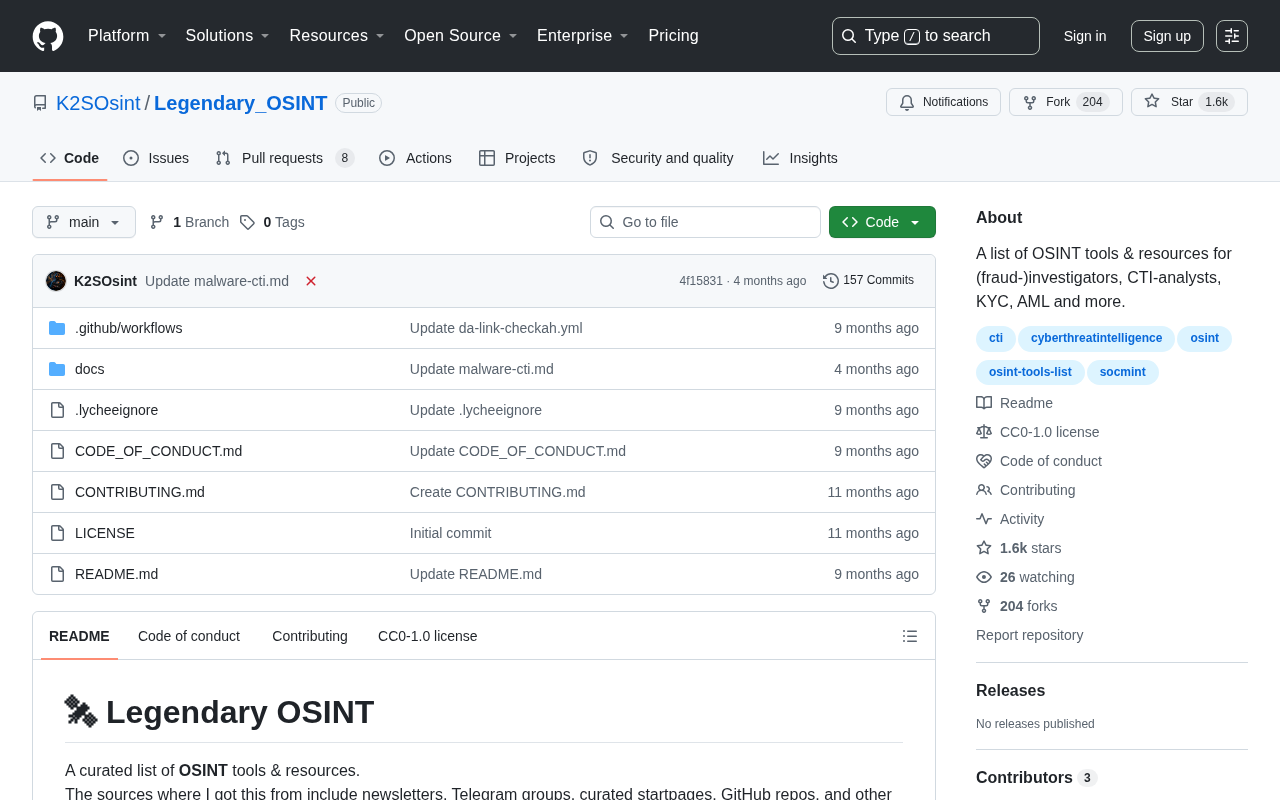
Unlike complex software systems, these "Awesome List" style projects continue to attract developers and security practitioners precisely because of their practical aggregation value — they bring together investigative tools, databases, tutorials, and methodologies scattered across the internet into a quickly searchable map, dramatically lowering the barrier to information gathering.
What is OSINT and Why Does It Matter
Open-source intelligence refers to the practice of collecting, analyzing, and interpreting data through publicly accessible information sources. These sources include social media, public databases, corporate registration records, domain registration data, image metadata, satellite imagery, and more. Unlike intelligence gathering that relies on internal systems or illegal means, OSINT's defining characteristic is that it is legal, transparent, and reproducible.
The Historical Evolution of OSINT
As a branch of intelligence studies, OSINT's history traces back to World War II, when intelligence agencies from various nations had already begun systematically collecting and analyzing public publications, radio signals, and press information. During the Cold War, the U.S. Foreign Broadcast Information Service (FBIS) and BBC Monitoring were quintessential OSINT practitioners. With the advent of the internet age, OSINT's information sources expanded dramatically from traditional media to social networks, dark web forums, code repositories, satellite imagery, and other digital channels, with data volumes growing exponentially. In 2005, the U.S. Office of the Director of National Intelligence (ODNI) formally established the Open Source Center, marking OSINT's institutional recognition within the national security apparatus. Today, OSINT is not only a tool for government intelligence agencies but has also deeply penetrated civilian domains including corporate security, investigative journalism, and academic research.
Core Application Scenarios for OSINT
From the project's positioning, we can see that OSINT's value spans multiple professional fields:
- Anti-fraud investigation: Tracking real identities and associated networks behind suspicious transactions;
- Cyber Threat Intelligence (CTI): Analyzing attackers' infrastructure and TTPs (Tactics, Techniques, and Procedures);
- KYC/AML compliance: Financial institutions verifying identities and screening sanctions lists during customer due diligence;
- Journalists and researchers: Conducting fact-checking and in-depth investigative reporting.
Precisely because of this broad coverage, a high-quality tool list can simultaneously serve these overlapping communities, which is the core reason Legendary_OSINT has been able to rapidly accumulate attention.
Deep Dive into the TTPs Framework
In the threat intelligence domain, TTPs — Tactics, Techniques, and Procedures — represent the most essential conceptual framework for analyzing attacker behavior. The ATT&CK framework developed by MITRE is the industry's most widely used TTPs knowledge base, decomposing attacker behavior into 14 tactical stages (from Initial Access to Exfiltration), with hundreds of specific techniques and sub-techniques under each stage. TTPs are considered the behavioral characteristics most difficult for attackers to change — IP addresses and malware hashes can be easily swapped, but an attacker's behavioral patterns and operational habits remain relatively stable. Therefore, TTPs-based threat intelligence holds extremely high value for predicting and defending against Advanced Persistent Threats (APTs). OSINT analysts frequently need to extract and synthesize attacker TTPs from public security reports, malware sample analyses, dark web forum intelligence, and other sources.
The Deep Integration of KYC/AML Compliance Systems with OSINT
KYC and AML are two cornerstones of the global financial regulatory system. KYC requires financial institutions to verify customer identities, understand their funding sources and transaction purposes before establishing business relationships; AML requires institutions to build transaction monitoring systems to identify suspicious money laundering activities. The Financial Action Task Force (FATF), as the global standard-setting body for anti-money laundering, has had its recommendations adopted by more than 190 countries and jurisdictions. In practice, compliance teams need to perform Customer Due Diligence (CDD) and Enhanced Due Diligence (EDD), which includes screening sanctions lists (such as the OFAC SDN List, UN Sanctions Lists), Politically Exposed Persons (PEP) databases, and adverse media information. OSINT tools play a critical role in this process — they can efficiently extract beneficial ownership information from public corporate registration databases, court records, and equity penetration platforms, helping identify shell companies and complex multi-layered holding structures.
Repository Organization Logic and Tool Classification

These aggregation-style repositories are typically organized by investigation target or data type, helping users quickly locate the tools they need. Typical classification dimensions include:
By Investigation Subject
- People investigation: Username searches, email tracing, phone number lookup tools;
- Corporate investigation: Company registration information, ownership structures, business relationship networks;
- Domains and networks: WHOIS lookups, DNS records, SSL Certificate Transparency logs;
- Geolocation: Image geoinformation extraction, street view comparison, satellite imagery analysis;
- Social media: Cross-platform account correlation, content archiving, and timeline reconstruction.
SSL Certificate Transparency Logs — An Underestimated Investigation Tool
Certificate Transparency (CT) is a public audit framework promoted by Google since 2013, requiring all Certificate Authorities (CAs) to log issued SSL/TLS certificates in publicly queryable log servers. This mechanism was originally designed to detect and prevent CAs from erroneously or maliciously issuing certificates, but it provides an unexpected gold mine for OSINT investigators: by querying CT logs (using tools like crt.sh, Censys, etc.), investigators can discover all domains and subdomains owned by a specific organization or individual, including infrastructure that hasn't officially launched or has been deliberately hidden. SSL certificates requested by attackers when deploying phishing sites or C2 servers are also recorded in CT logs, enabling threat intelligence analysts to discover suspicious infrastructure before an attack is launched. Combined with historical WHOIS records, passive DNS data, and IP geolocation, investigators can construct complete network infrastructure correlation graphs.
By Functional Attributes
Beyond tools themselves, quality OSINT lists often also include methodology documents, investigation frameworks, training resources, and legal compliance guides. This is particularly important for newcomers — tools are merely means; knowing how to conduct investigations in a compliant, systematic manner is the core of professional competence.
Why the "Awesome List" Model Endures
Legendary_OSINT's viral success is not an isolated case. GitHub hosts numerous similar curated list projects that create extremely high community value at minimal maintenance cost. This model's success depends on several factors:
Continuous updates ensure timeliness. The OSINT tool ecosystem changes rapidly, with many online services becoming defunct due to policy changes, funding issues, or anti-scraping mechanisms. Only a list that can promptly remove dead links and add new tools maintains long-term utility.
Community collaboration expands coverage. Through the Pull Request mechanism, practitioners worldwide can contribute quality resources they've discovered, extending the list's coverage far beyond any single maintainer's capacity. The 204 Forks also reflect the community's enthusiasm for participation.
Selection criteria ensure quality. Facing a sea of tools, the "Legendary" naming itself conveys a selection standard — what's included should be verified, genuinely useful resources rather than simple accumulation.
The Ecosystem Origin and Governance of Awesome Lists
Awesome Lists are a unique form of knowledge organization on GitHub, pioneered by the awesome project initiated by Sindre Sorhus in 2014. These projects are essentially a form of community-driven Knowledge Curation, organizing links and descriptions in Markdown format through README.md files to form resource indexes for specific domains. GitHub's collaboration mechanisms — Issues for discussion and suggestions, Pull Requests for submitting new resources, Stars for measuring community recognition — are naturally suited to this crowdsourced knowledge management approach. High-quality Awesome Lists typically establish clear contribution guidelines (CONTRIBUTING.md), setting inclusion criteria such as: tools must still be actively maintained, must have clear documentation, and cannot be purely commercial promotions. This decentralized knowledge aggregation approach fills the gaps left by traditional Wikis' update lag and search engines' excessive noise in results.
Legal and Ethical Boundaries of Using OSINT Tools
Although OSINT emphasizes legality and openness, tool usage still exists in ethical and legal gray areas. Investigators must pay close attention in practice to:
- Privacy compliance: Data protection regulations like GDPR and CCPA impose strict restrictions on the collection and processing of personal information;
- Data authorization: Some databases may be "accessible," but commercial use may violate their terms of service;
- Investigation ethics: Even when technically feasible, deep profiling of individuals should have clear, legitimate purposes.
The Specific Impact of GDPR and CCPA on OSINT Practice
The EU's General Data Protection Regulation (GDPR, effective 2018) and the U.S. California Consumer Privacy Act (CCPA, effective 2020) have had profound impacts on OSINT practice. GDPR Article 6 stipulates six lawful bases for data processing, among which "legitimate interest" is frequently invoked by investigative organizations, but must be demonstrated through a Legitimate Interest Assessment (LIA) that the investigation purpose outweighs the data subject's rights. GDPR's implementation directly led to the mass anonymization of registrant information in WHOIS databases — ICANN introduced a temporary specification in 2018 allowing registrars to redact personal registrants' contact information, creating significant obstacles for domain investigations. CCPA grants California residents the right to know what personal information businesses have collected, to request deletion, and to opt out of sales. For OSINT practitioners using people-search services provided by data brokers, these regulations mean they must establish clear legal basis documentation, recording the purpose, scope, and retention period of each data collection, or face substantial fines.
For KYC and AML practitioners, compliant use of tools directly relates to financial institutions' regulatory risk, which is why professional training and legal guides are equally indispensable components of the OSINT knowledge system.
Conclusion
The rapid rise of Legendary_OSINT reflects the sustained demand in the open-source intelligence field for high-quality, systematized tool resources. In an era where digital investigation, cybersecurity, and compliance review are increasingly important, these aggregation-style repositories provide practitioners with an efficient starting point. For anyone looking to enter the OSINT field, rather than blindly searching through an ocean of information, it's better to start from a community-verified map like this one — but always remember: tools grant capability, while compliance and ethics define boundaries.
Related articles

Chain of Thought Isn't Just for AI: How Humans Can Use CoT to Improve Thinking Quality
Chain of Thought isn't just a prompt trick for large models. Starting from a Hacker News discussion, this article analyzes why CoT works for human thinking too, breaks down actionable ways to transfer it, and highlights the key differences between human CoT and machine CoT.
Cloudflare Teams Up with OpenAI: Closi…
Cloudflare Teams Up with OpenAI: Closing the Loop from Vulnerability Discovery to Defense with AI
Cloudflare uses OpenAI Daybreak to investigate security vulnerabilities and generate reviewable remediation plans, while developers use Codex to boost coding efficiency and quality.

Orca Multi-Agent Orchestration in Practice: A Guide to Parallel Collaboration with Claude and Codex
Orca is Stable AI's free open-source agent workbench supporting 34 agents like Claude Code and Codex in parallel. Learn its Git worktree isolation, multi-model orchestration, and mobile management.