Lenovo Yoga Slim 7X Review: The Best Windows Ultrabook You Can Buy for $1,000

The Lenovo Yoga Slim 7X delivers a premium Snapdragon X2 Elite and 2K OLED combo at an exceptional $1,000 value.
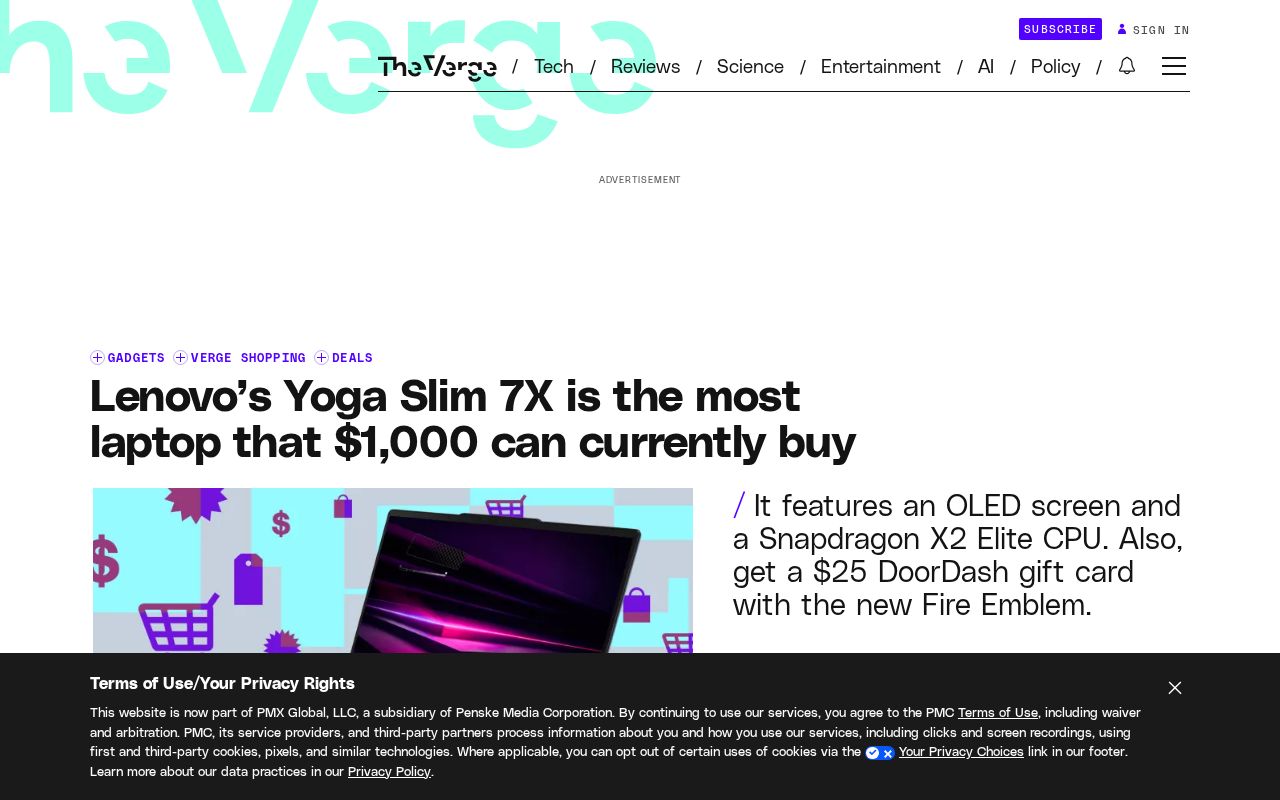
The Lenovo Yoga Slim 7X is a 14-inch ARM-based Windows ultrabook whose core appeal lies in bringing a premium 2K 16:10 OLED touchscreen and Qualcomm Snapdragon X2 Elite processor down to the $1,000 price range via a limited-time Best Buy promotion. It stands out in its segment for display quality, power efficiency, and slim build. Users should note some ARM compatibility limitations for x86 professional software, but for students and business users whose workflows center on mainstream apps, it's an excellent choice with virtually no significant drawbacks at this price.
For consumers with a budget around $1,000 looking to pick up a Windows ultrabook, the Lenovo Yoga Slim 7X is one of the most compelling options on the market right now. This 14-inch machine combines premium specs with a limited-time promotional price, making it a standout value in its price segment.
Key Specs at a Glance
The Yoga Slim 7X sports a 14-inch form factor built around portability and slim design. The display is a 2K resolution, 16:10 OLED touchscreen — a spec combination that's uncommon at this price point. OLED panels deliver exceptional contrast, true blacks, and vibrant colors that typically appear only on higher-end machines.
Under the hood, the laptop runs on the Qualcomm Snapdragon X2 Elite, a high-performance ARM-based mobile platform. The biggest advantage of this chip family is power efficiency — it tends to deliver excellent battery life along with a fanless or near-silent user experience, while handling everyday tasks like office work, web browsing, and video playback with ease.
The Snapdragon X2 Elite (model X1E-80-100) is Qualcomm's flagship mobile processor for the PC market, introduced in 2024. Built on TSMC's 4nm process, it uses a 12-core Oryon CPU architecture. Compared to the previous Snapdragon X Elite, the X2 Elite improves multi-core performance and AI compute, and integrates an Adreno GPU alongside Qualcomm's NPU, which is rated at 45 TOPS — meeting Microsoft's requirements for Copilot+ PC certification. This means the laptop can natively run Windows 11's AI features, including live caption translation and image super-resolution, placing it firmly among the top-tier ARM PC platforms available today.
Why This Price Point Matters
At the $1,000 budget tier, consumers typically have to make tradeoffs between display quality, processing power, and build quality. The Yoga Slim 7X sidesteps those compromises through a limited-time promotion, bringing the premium combination of an OLED touchscreen and Snapdragon X2 Elite down to the four-figure price point — which is precisely why it's been called "the best laptop you can buy for $1,000."
According to the original coverage, this deal is available through Best Buy and is explicitly time-limited. For anyone on the fence, these kinds of temporary price drops are often the best opportunity to get a premium ultrabook at an accessible price.
Considerations for ARM-Based Windows Laptops
One thing worth keeping in mind is the ARM architecture underlying the Snapdragon chip. Compared to traditional x86 processors, ARM-based Windows laptops have a natural advantage in battery life and power efficiency — but software compatibility is worth thinking about. Some older or specialized applications may need to run through an emulation layer, which can carry a performance penalty. For users whose workflow centers on browsers, office suites, and streaming, this impact is generally negligible. Those who rely heavily on specific professional software should verify compatibility beforehand.
Software compatibility for Windows on ARM has improved significantly in recent years. Starting with Windows 11, Microsoft ships the built-in Prism emulation layer, which automatically translates x86/x64 instructions to ARM. Most mainstream applications — including Chrome, Office, and the Adobe suite — now have native ARM builds that perform on par with x86 machines. The performance hit from emulation is most noticeable with large x64 professional applications, such as some CAD tools, legacy engineering simulation software, or outdated 32-bit apps. Kernel-level software like certain enterprise VPN clients and security tools has historically posed compatibility issues, though vendors have been steadily releasing ARM-compatible drivers. The most straightforward way to check whether ARM is right for you is to look up your essential applications on Microsoft's app compatibility page or Qualcomm's official compatibility list.
Who Should Buy This
This laptop is aimed at users who prioritize portability, display quality, and battery endurance. Students, business professionals, and anyone who needs a capable on-the-go primary machine will find this configuration delivers a strong experience. If your core needs are long battery life, a quality OLED display, and a slim, lightweight chassis — and your daily software stack consists of mainstream applications — the Yoga Slim 7X has very few weaknesses at its current price.
On the other hand, if you need to run demanding games or rely on x86-specific professional software, you should evaluate ARM platform compatibility more carefully before committing.
Verdict
The Lenovo Yoga Slim 7X sets a high benchmark in the $1,000 price segment with its 2K OLED touchscreen, Snapdragon X2 Elite processor, and slim, lightweight build. For consumers searching for a well-rounded, premium Windows ultrabook, catching it on a limited-time sale is a smart move.
Related articles

Workbuddy for Absolute Beginners: How a Desktop AI Agent Fits Into Real Workflows
A beginner's guide to the Workbuddy desktop AI agent: installation, claiming credits, file management, and building automated workflows—compared with CodeX for fit and cost, helping professionals shift from AI question-askers to AI managers.

OpenAI's New Agent Stack: Computer Use, Decisions API, and Ultra-Fast Workflows
OpenAI Dev Day unveiled a new agent stack: Computer Use outperforms humans, Decisions API delivers ultra-low-latency classification via Luna, Agents API opens the same Computer Use capabilities, and GPT-6.1 Sol costs only one-seventh of Astra. Core updates, benchmark data, and developer insights.

Liang Wenfeng Open-Sources DeepInfo Inference Framework, Takes On U.S. Ban
DeepSeek open-sources its DeepInfo inference framework after its models, featuring GPU/CPU cross-pipelining, small-model prediction with large-model verification, and full Huawei Ascend and NVIDIA chip support—facing the U.S. federal ban head-on. This article analyzes its significance for AI deployment and open-source strategy.