lepoly: A Unified Management Platform for 3D Assets

lepoly is an in-browser digital asset management platform built for 3D assets, integrating hosting, organization, review, and sharing.
lepoly is a digital asset management platform for 3D content creation teams, designed to solve the problems of scattered files and version chaos for models, textures, and more. It offers cloud hosting in the browser, tag and collection organization, 3D model previews, online review, and permission-controlled sharing, integrating storage and collaboration workflows. Compared with general-purpose DAM tools, lepoly is optimized at the底层 level for 3D file formats and previews; unlike display-oriented platforms such as Sketchfab, it focuses more on internal team asset management efficiency. The product received 79 votes on Product Hunt, ranking 13th in the 3D Modeling category, and is led by Cedric Pinson. As an early-stage product, its integration with mainstream creation software such as Blender and Maya will determine its future value. It is suitable for teams in games, film and television, architectural visualization, and other fields that need to manage large numbers of 3D assets.
The Pain Points of 3D Asset Management and lepoly's Positioning
In the field of 3D content creation, asset management has always been a thorny problem. Files such as models, textures, materials, and animations are scattered across local hard drives, cloud storage, and various collaboration tools, resulting in version chaos, difficulty finding files, and inconvenient sharing. lepoly was born precisely to solve this pain point. It is a digital asset management platform built specifically for 3D assets, with the tagline "One place for all your 3D assets," allowing users to host, organize, review, and share directly in the browser.
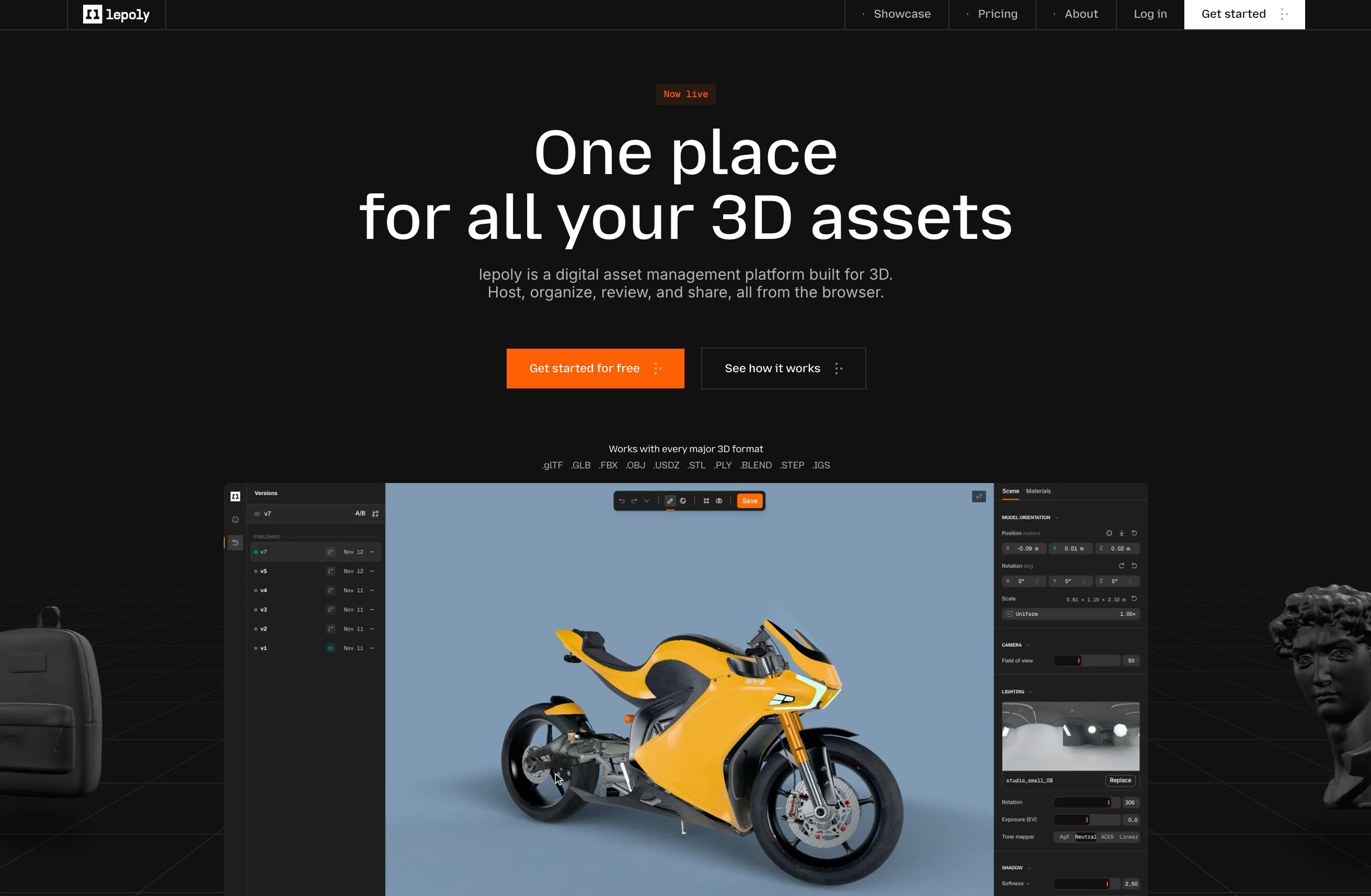
Unlike general-purpose digital asset management (DAM) tools, lepoly is optimized from the ground up for 3D file formats and collaboration workflows. It is more than just a storage bucket—it also provides a lightweight workflow for review and sharing, so teams don't need to switch between multiple tools.
Core Features: Full-Process Management in the Browser
Hosting and Organization
lepoly allows users to upload 3D assets to the cloud and organize them through tags, collections, search, and more. The platform supports previewing 3D models without downloading, which greatly improves asset retrieval efficiency. For teams with large model libraries, a visual management interface is far more intuitive than traditional folder structures.
Review and Sharing
Review is a key part of 3D collaboration. lepoly offers online review capabilities, allowing team members to view assets directly in the browser and leave feedback, avoiding the hassle of sending file versions back and forth. For sharing, users can generate links and control access permissions, making it easy to share specific assets with clients or external partners.
3D file formats refer to file specifications used to store three-dimensional geometry, materials, animations, and other data. Common formats include FBX, OBJ, GLTF/GLB, STL, USD, and more. Different formats vary significantly in compatibility, compression efficiency, and animation support. For example, GLTF is called "the JPEG of 3D" and is well-suited for web transmission; USD was developed by Pixar and supports complex scene descriptions. Previewing 3D models in the browser typically relies on WebGL or WebGPU technology, parsing formats and rendering without installing local software. This places high demands on the file parsing capabilities of asset management platforms and is one of their technical barriers.
Product Positioning from Multiple Perspectives
According to information on Product Hunt, lepoly received 79 votes, ranking 13th for the day in the 3D Modeling category. Although the number of comments is low (only 1), the vote count indicates that the concept has attracted some attention. The makers include Cedric Pinson, who has a relevant background in the 3D field.
Judging from the official website and product description, lepoly emphasizes an "in-browser" experience, which aligns with the current trend toward lightweight SaaS tools. Compared with traditional desktop asset management software, it reduces deployment and maintenance costs, making it especially suitable for distributed teams.
Differentiation from Competitors
There are already some 3D asset management tools on the market, such as Sketchfab (focused on display and sharing) and Google Poly (now shut down). lepoly's differentiation lies in integrating hosting, organization, review, and sharing into a single platform, with a focus on team collaboration workflows. It does not aim to become a massive 3D community but rather to solve internal asset management efficiency problems.
However, as an early-stage product, lepoly's ecosystem and integration capabilities remain to be seen. Whether it can deeply integrate with mainstream 3D creation software (such as Blender and Maya) will determine its value in real-world workflows.
Sketchfab is an online platform centered on 3D model display and sharing. Users can upload models and preview them in real time via WebGL, and it also offers embedding and purchasing features, but its community orientation is stronger than its team asset management. Google Poly was a 3D model library launched by Google, mainly aimed at VR/AR content creators, offering free model browsing and downloading, but it was shut down in 2021. Its closure reflects the business model challenges of general-purpose 3D asset libraries. General-purpose DAM tools such as Bynder and Brandfolder mainly handle two-dimensional assets like images, videos, and documents. Although they support custom metadata and permissions, they lack native parsing and preview capabilities for 3D file formats. lepoly's positioning sits between professional 3D display platforms and general-purpose DAM, with a stronger emphasis on internal team collaboration workflows.
Use Cases and Future Outlook
lepoly is suitable for teams in game development, film and television production, architectural visualization, e-commerce product display, and other areas that need to manage large numbers of 3D assets. For independent creators, it can also provide a convenient solution for organizing and sharing assets.
As demand for 3D content grows, asset management tools focused on vertical domains will find opportunities. If lepoly can continue to iterate on file format support, version control, and automated workflows, it has the potential to become one of the infrastructure tools for 3D teams. The product is still in its early stages, and teams that are interested are advised to learn more and try it out through the official website.
Related articles

Prompt Engineering for Beginners: From Writing Prompts to Engineering Thinking
Starting from the essence and four functions of prompts, this article systematically explains the six-step process, four success criteria, learning value, and practical limitations of prompt engineering to help you build a complete understanding.

Anthropic Launches Nasdaq IPO: AI Giant's Listing and Risk Disclosures
Anthropic officially launches its Nasdaq IPO under ticker ANT, with market valuation expected to potentially exceed SpaceX's record. The prospectus devotes nearly 100 pages to AI risks, while first-half revenue grew over 14x but net losses widened sharply, reigniting the AI bubble debate.

Rust cURL Clone Uses 4,832 unsafe Blocks—Is the Memory Safety Myth Broken?
A Rust cURL clone uses 4,832 unsafe keywords, challenging Rust's memory safety narrative. We analyze what unsafe really means, compare Fil-C, and examine rewrite motives.