Lerim CLI: A Long-Term Memory Solution for AI Coding Assistants
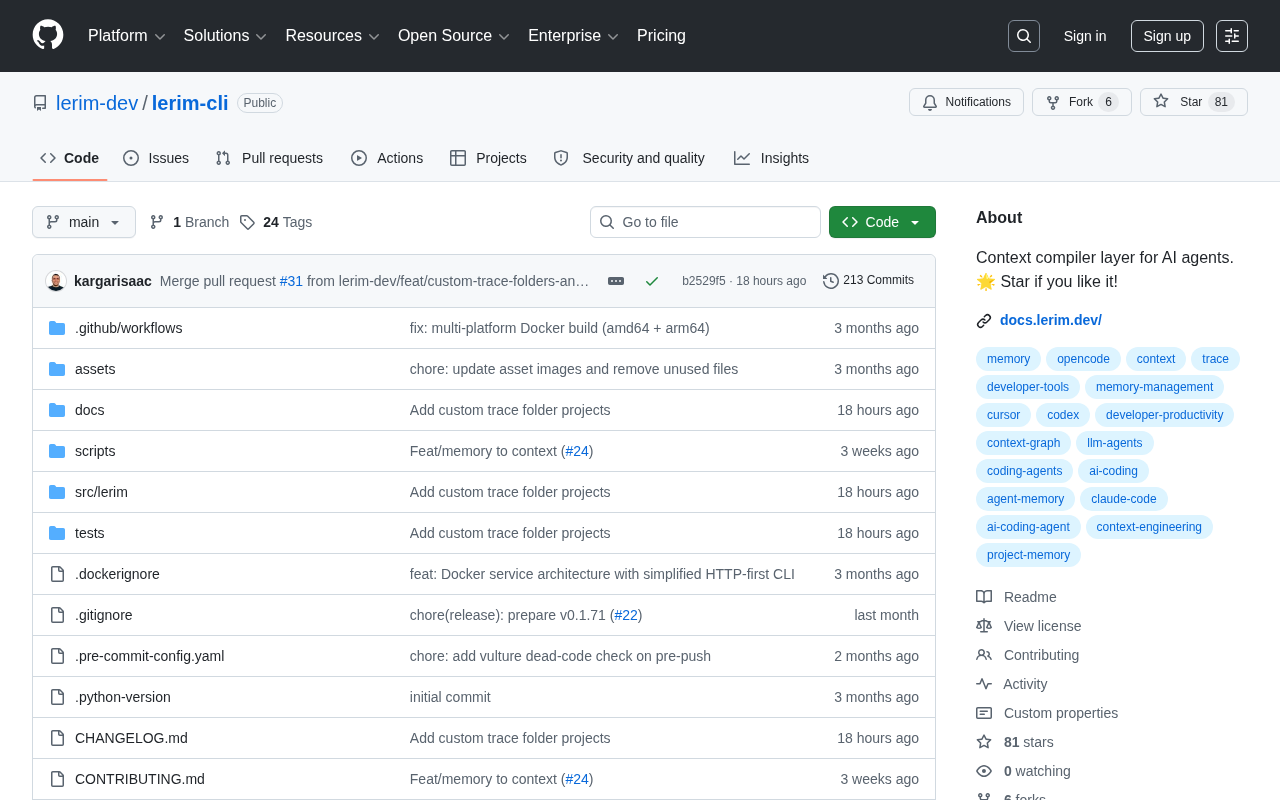
Lerim CLI: an open-source background agent that auto-extracts and reuses project memory from AI coding sessions
Lerim CLI is an open-source background memory agent built in Python, designed to solve the lack of cross-session memory in AI coding assistants. It non-intrusively monitors coding agent sessions, automatically extracting, structuring, and reusing valuable project knowledge — eliminating the burden of manual documentation. Compared to static approaches like Cursor's .cursorrules, Lerim offers automatic extraction, dynamic evolution, and tool-agnosticism, reflecting the industry trend of AI coding tools moving from one-off interactions to continuous collaboration.
Project Overview
AI-assisted programming is becoming increasingly prevalent. Developers generate vast amounts of valuable contextual information when interacting with coding agents, but this information typically dissipates once a session ends. Lerim CLI is an open-source tool built precisely to address this pain point — it's a background memory agent that automatically extracts reusable project memories from coding agent sessions.
Coding agents refer to AI systems with autonomous planning and execution capabilities. They don't just generate code snippets — they understand task intent, decompose complex problems, invoke tool chains, and iteratively verify results. Unlike traditional code completion tools, coding agents are typically built on Large Language Models (LLMs), combined with reasoning frameworks like ReAct (Reasoning + Acting), enabling them to complete the full workflow from requirements analysis to code implementation across multiple interaction rounds. Current mainstream coding agents include Devin, OpenHands, Claude Code, and others, representing the evolution of AI-assisted programming from "suggestive" to "autonomous" approaches.
Project repository: lerim-dev/lerim-cli, currently with 79 Stars, developed in Python.
Why AI Coding Assistants Need Long-Term Memory
Current Pain Points
Mainstream AI coding assistants (such as GitHub Copilot, Cursor, Claude, etc.) perform excellently within a single session but generally lack cross-session memory capabilities. This manifests as:
- Every new session requires re-establishing project context
- Previously solved problem patterns cannot be automatically reused
- Project-specific conventions and preferences need to be repeatedly explained
- Team-accumulated coding knowledge is difficult to systematically preserve
The root cause of these issues lies in the context window limitations of large language models. The context window refers to the maximum number of tokens a model can process in a single inference pass. Even though the latest models have expanded this to 128K or longer, project-level knowledge accumulation far exceeds single-window capacity. More critically, the context window is essentially "short-term memory" — it's cleared when the session ends. This has created demand for external memory systems. Common industry solutions include RAG (Retrieval-Augmented Generation), vector database storage, and structured knowledge graphs. Lerim CLI builds upon these technologies with purpose-built abstractions and automation specifically for coding scenarios.
Lerim CLI's Approach
As a background memory agent, Lerim CLI's core workflow consists of four steps:
- Monitor: Continuously observe coding agent sessions running in the background
- Extract: Automatically identify and extract information fragments with reuse value
- Structure: Organize extracted information into structured project memories
- Reuse: Automatically inject relevant historical context in subsequent sessions
This design effectively builds a "project knowledge base" for AI coding assistants, allowing them to remember project conventions, architectural decisions, and best practices — much like an experienced team member would.
Core Technical Features of Lerim CLI
Automated Knowledge Extraction
Unlike solutions that require manually maintaining documentation or rule files, Lerim CLI emphasizes "automatic extraction." Developers don't need to deliberately organize knowledge — the tool intelligently identifies in the background which information is worth retaining as long-term memory, significantly reducing the cognitive burden of knowledge management.
In knowledge management theory, this involves the externalization of tacit knowledge. Tacit knowledge refers to experiential knowledge that's difficult to express directly in language or text, such as "why this architectural pattern was chosen" or "the conventions for handling this edge case." Traditional documentation approaches (like READMEs and Wikis) can only capture explicit knowledge, while vast amounts of tacit knowledge exist within developers' daily conversations and decision-making processes. AI coding sessions are natural carriers of tacit knowledge — when developers discuss problems with AI, they naturally express project conventions, design preferences, and problem-solving patterns. Lerim CLI's value lies in automatically distilling this tacit knowledge scattered across sessions into reusable structured memories.
Non-Intrusive Background Operation
Lerim adopts a background agent architecture that doesn't interrupt the developer's normal workflow. It silently observes, learns, and accumulates, providing memory support only when needed. This non-intrusive design keeps the development experience smooth.
Non-intrusive architecture has a deep tradition in developer tooling. From Unix daemons to the modern Language Server Protocol (LSP), excellent development tools often pursue "zero-friction" integration. Lerim CLI's background agent model is similar to the design philosophy of APM (Application Performance Monitoring) tools — collecting information through observation rather than intervention. The technical challenge of this architecture lies in accurately capturing session content and performing semantic understanding without modifying the host application (i.e., the coding agent). Common implementation approaches include file system monitoring, log parsing, API hooks, and more.
Built on the Python Ecosystem
The project is developed in Python, making it easy to integrate with existing AI/ML toolchains while also lowering the barrier for community contributions. Python's dominant position in the AI field means Lerim can directly leverage mature LLM application frameworks like LangChain and LlamaIndex, as well as vector retrieval libraries like FAISS and ChromaDB for efficient memory storage and recall.
Practical Use Cases
Multi-Project Management for Individual Developers
For independent developers maintaining multiple projects simultaneously, Lerim can help quickly restore context when switching between projects, reducing the time cost of "getting back into the zone."
Team Collaboration and Knowledge Transfer
In team environments, the project memories accumulated by Lerim can serve as carriers of tacit knowledge, helping new members understand project conventions more quickly and ensuring that AI assistant suggestions align with team standards.
The Memory-Enhanced Trend in AI Coding Tools
The emergence of Lerim CLI reflects an important trend in the AI coding tools space: moving from one-off interactions to continuous collaboration. As AI agent capabilities grow stronger, "memory" and "context management" are becoming key dimensions of competitive differentiation.
Similar concepts are already embodied in product features like Cursor's .cursorrules and Claude's Project Knowledge, but Lerim turns this into an independent, universal open-source solution with better flexibility and composability.
Specifically, Cursor's .cursorrules file is a static rule definition approach where developers manually write project-level instructions (such as code style preferences, tech stack constraints, etc.), which the AI references when generating code. Claude's Project Knowledge allows users to upload documents as persistent context. The common limitation of both approaches is that they rely on manual maintenance and are tied to specific products. Lerim CLI differentiates itself in three ways: first, automatic extraction rather than manual writing; second, dynamic evolution rather than static configuration; third, tool-agnosticism — it can work with any coding agent without being constrained by a single product ecosystem.
From a broader perspective, this trend aligns with the "Memory-Augmented" research direction in the AI Agent field. Both academia and industry are exploring how to build human-like long-term memory systems for AI agents, including different layers such as Episodic Memory, Semantic Memory, and Procedural Memory. Lerim CLI can be seen as a concrete implementation of this research direction in the software engineering domain.
Conclusion
While Lerim CLI is still in its early stages, the direction it represents — building a persistent project memory layer for AI coding workflows — has clear practical value. For developers who heavily use AI coding assistants, this is a tool worth watching and trying out.
Key Takeaways
- Lerim CLI is a background memory agent that automatically extracts reusable project memories from AI coding agent sessions
- It solves the core pain point of AI coding assistants lacking cross-session memory, without requiring manual knowledge documentation
- It adopts a non-intrusive background operation mode, automatically monitoring, extracting, structuring, and reusing historical context
- Developed in Python for easy integration with existing AI toolchains, currently with 79 Stars
- Reflects the industry trend of AI coding tools evolving from one-off interactions to continuous collaboration
Related articles
 Product Reviews
The Programmer's Desk Setup Guide: Building a Workspace That Feels Like Home
Discover how programmers build productive, comfortable workspaces. From multi-monitor setups to ergonomic design, explore the desk philosophy that drives focus and flow.
 Product Reviews
Qoder vs Cursor Real-World Comparison: Which $20/Month AI IDE Is Better?
Hands-on comparison of Qoder vs Cursor AI IDEs: Agent autonomy, human interaction count, and architecture decisions. Qoder needed only 2 interactions vs Cursor's 8.
 Product Reviews
Cursor Cloud Agent Demo: Eliminating Bottlenecks Across the Entire Software Development Lifecycle
Deep analysis of Cursor's Cloud Agent demo showing how cloud VMs, automated test artifacts, and a full-chain control plane systematically eliminate human bottlenecks across the software development lifecycle.