Letter Visitors: Identify Visitors and AI Agents Directly on Your Website

Letter Visitors lets you see visitor identity, company, and AI agents directly on your website, with session replay support.
Letter Visitors is the #1 Product Hunt launch that displays visitor information directly on your website page—including individual identity, company affiliation, and AI agents crawling your pages—with session replay support. It moves visitor data out of third-party dashboards and onto the site itself, helping marketing teams assess lead quality, developers observe AI scraping behavior, and product teams pinpoint user friction. It treats AI agents as a separate visitor category, unlike most tools that filter all crawlers uniformly. Its differentiation lies in interaction model rather than underlying data capability, and long-term value depends on identification accuracy and privacy compliance.
Website analytics tools typically lock visitor data inside a third-party dashboard, but Letter Visitors—the new product that topped Product Hunt—proposes a different approach: see who your visitors are directly on your website, including their company and even the AI agents crawling your pages, with session replay support.
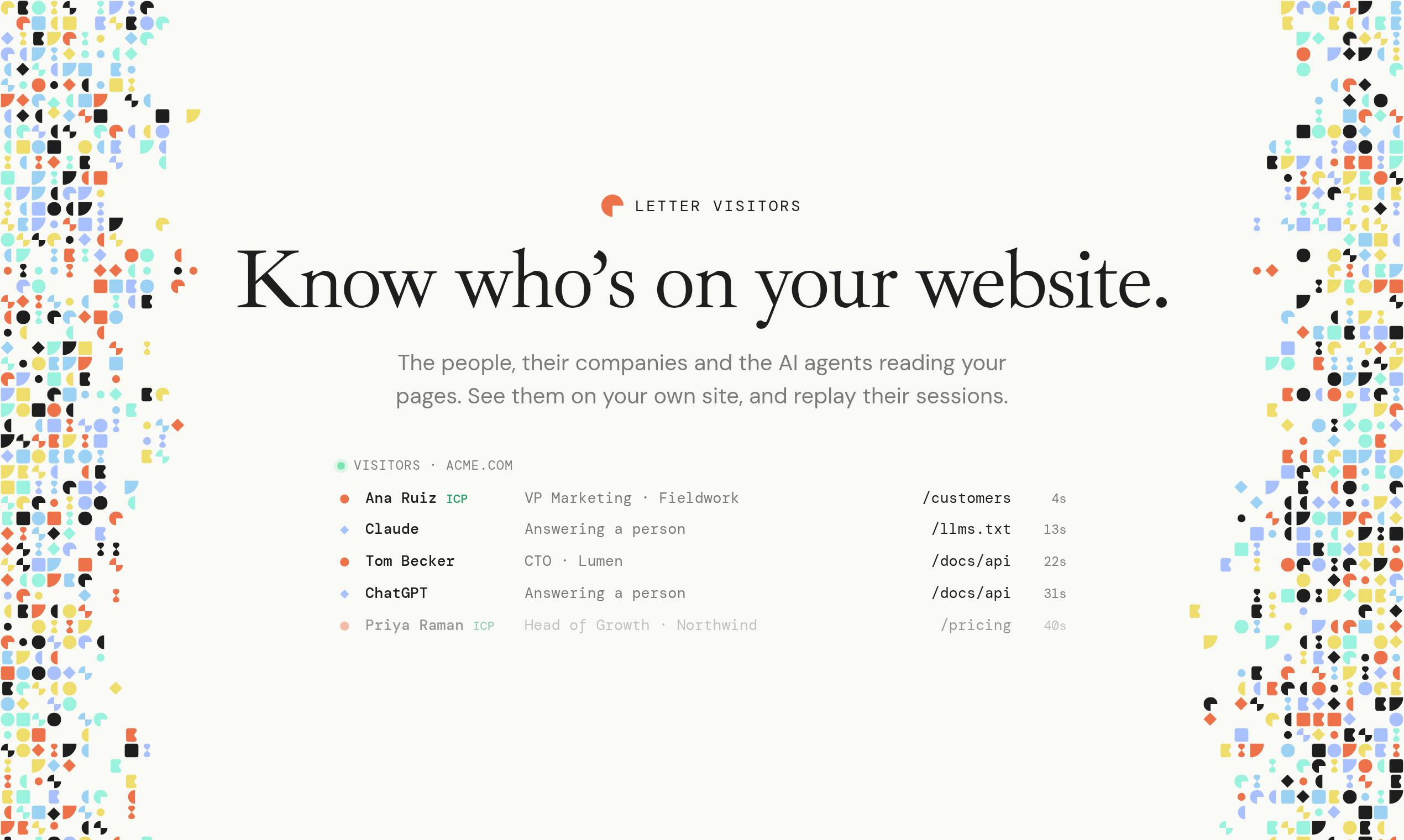
Core Feature: From "Anonymous Traffic" to "Identifiable Visitors"
Traditional analytics tools tell you "how many people came." Letter Visitors tries to answer "who came." According to the product description, it displays visitor information directly on the website page, including individual identity, company affiliation, and AI agents reading the page. This means marketing and development teams can understand visitor behavior in the context of the actual page without switching to a separate dashboard.
The product received 164 votes and 26 comments on Product Hunt, ranking first for the day in the Marketing and Developer Tools categories. This cross-category positioning indicates it targets both growth teams—who care about conversions and leads—and developers—who care about page performance and crawler behavior.
AI Agent Identification: An Overlooked Visitor Segment
The product description specifically highlights "AI agents reading your pages." As LLM-powered scraping tools and automated agents proliferate, website visitors are no longer just humans. Being able to identify which traffic comes from AI agents has practical implications for content strategy and server resource allocation: content teams can determine whether their pages are being cited by AI products, and technical teams can distinguish real user requests from machine scraping.
This capability is uncommon among existing analytics tools. Most tools lump crawlers into "bot traffic" and filter them out together, while Letter Visitors chooses to surface them separately—a choice that aligns with the rapid penetration of AI applications today.
An AI Agent typically refers to a software program driven by a large language model that can autonomously execute tasks (such as web scraping, information extraction, and automated operations), as distinct from traditional crawlers that run on fixed rules. Because they often mimic human browsing behavior (e.g., executing JavaScript, carrying common User-Agents), traditional identification methods based on User-Agent or robots.txt tend to fail, requiring behavioral features, request fingerprints, or dedicated detection models to distinguish them. For websites, AI agent traffic may represent content being cited by AI products (positive value) or bring bandwidth consumption and the risk of data being scraped in bulk, so identifying and categorizing it separately has real operational significance.
Session Replay: Reconstruct Visits on Your Own Website
Beyond real-time identification, Letter Visitors also offers session replay. Users can replay a visitor's browsing journey on their own site, combining "who came" with "what they did." For developer tool products, this capability is commonly used to diagnose where users get stuck; for marketing sites, it helps assess lead quality.
Interestingly, both company identification and session replay involve privacy and compliance concerns. The product page does not explain data sources or compliance strategies in the provided materials, so in practice you'll need to pay attention to how visitor data is collected and what disclosure obligations apply.
Session Replay is a technology that records and replays a user's interactions on a webpage, typically by capturing events such as mouse movements, clicks, scrolling, and form inputs (sometimes combined with DOM snapshots) to reconstruct the visit. It helps teams visually identify where users get stuck or abandon, but because it may touch personal data, it constitutes processing that requires explicit disclosure and consent under regulations like GDPR and CCPA. Common practices include masking input content, blocking sensitive fields, and describing the scope of collection in the privacy policy—an unavoidable compliance dimension when evaluating such tools.
Market Positioning and Competitive Landscape
Letter Visitors operates in a space with established players, spanning traditional web analytics to visitor identification and intent data platforms. Its differentiation lies in the interaction model of "seeing it directly on the website" and in including AI agents in the visitor category. Its #1 ranking on Product Hunt that day shows market interest in "identifiable visitors," but whether that translates into long-term adoption depends on identification accuracy and the maturity of its privacy approach.
For small teams that want to understand visitor composition without leaving their website, tools like this lower the barrier to entry; for large enterprises, data governance and integration capabilities will be the more critical evaluation criteria.
Visitor Identification and Intent Data are mature categories in B2B marketing technology. The typical approach is to reverse-resolve a visitor's company from their IP address, then combine behavioral data to assess purchase intent—representative vendors include Clearbit, 6sense, and Demandbase. These solutions mostly rely on third-party database matching, so accuracy is affected by IP allocation, proxies, and mobile networks, and person-level identification is strictly limited under privacy regulations. Letter Visitors presents identification results directly on the website page—a difference in interaction model rather than a fundamental breakthrough in underlying data capability.
Who Should Use It
- Growth and marketing teams: identify visiting companies and assess lead quality
- Developers: observe AI agent scraping behavior and optimize pages and resource allocation
- Product teams: locate user friction points through session replay
Letter Visitors is currently launched via Product Hunt, created by Mathew Pregasen and Deepak. Its core value proposition is clear: move visitor identity and session data from the back office onto the website itself, making "who's watching" visible.
Related articles

From 0 to 1: Vibe Coding an AI Knowledge Base — A Practical Retrospective and Tech Stack Breakdown
A retrospective on building the AI knowledge base OilBook from scratch with Vibe Coding: Next.js+Neon stack, Oil Dev Skill workflow, Stripe paywall security, interview-style writing, AI-flavor control, and Vercel deployment.

GLM-5.4 Hands-On: Native Vision Meets a New Vibe Coding Workflow
Hands-on with Zhipu GLM-5.4: native vision tested across a 3D product demo, pure-code video generation, and remote-control Vibe Coding, compared with GPT-6.2 and Gemini Neon.

AI and Humans Claim to Prove the Riemann Hypothesis: Machine-Verified, Yet Nobody Can Understand It
Anthropic mathematician and AI Claude claim to prove the Riemann Hypothesis with 17 million lines of Lean code, machine-verified but unreadable by humans. This article analyzes the event, the zero proportion record from 41.6% to 67.2%, and the gap between machine verification and human understanding.