Letting AI Agents Learn While Idle: deeplearning.ai Launches Adaptive Agents Course
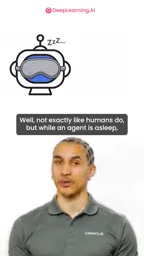
Adaptive agents use idle time to replay experiences and turn work traces into reusable skills.
The article introduces the core mechanism of adaptive AI agents: during idle time, they review historical work traces through a "dreaming"-style learning loop, abstract them into reusable skills, and thereby avoid repeated mistakes and improve long-term efficiency. It also mentions deeplearning.ai's short course "Building Adaptive Agents," which teaches how to design agents with idle-time learning capabilities.
Introduction: When AI Agents Learn to "Dream"
After a traditional AI agent completes a task, the experience often dissipates. Adaptive AI Agents propose a new idea: let the agent review its history while idle, learn from mistakes, and turn work traces into reusable skills. The latest short course from deeplearning.ai is built around exactly this concept.
Core Mechanism: The Idle-Time Learning Loop
According to the video, when an agent is in a "sleep" state (i.e., not handling requests), it can review past experiences and turn yesterday's work traces into reusable skills. This process is figuratively described as "dreaming," but it is not a dream in the human sense—rather, it is a learning mechanism based on experience replay.
The key to this learning loop is that the agent not only executes tasks but also self-optimizes between tasks. The video gives an example: a coding agent may need 10 minutes today to figure out how to fix a certain bug, but by the next day it has already memorized the solution and avoids repeating the same mistake.
Experience Replay is a classic technique in reinforcement learning, referring to an agent storing past interaction data (states, actions, rewards) and resampling these historical experiences during training to break data correlation and improve sample efficiency. When an adaptive agent reviews its history while idle, it is essentially a variant of this mechanism: it does not rely on real-time feedback but extracts patterns from stored "work traces." Similar to memory consolidation during human sleep, this offline learning allows the agent to optimize its policy without disrupting online service—a key design for improving long-term performance.
From Work Traces to Reusable Skills
So-called "work traces" refer to the interaction records, intermediate steps, and result feedback generated by the agent during task execution. By analyzing these traces, the agent can abstract general problem-solving patterns and solidify them into callable skills. This process means the agent no longer starts from scratch every time but enters new tasks with accumulated experience.
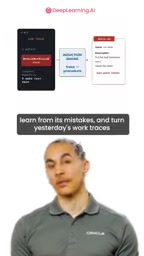
The video emphasizes that this capability is one of the important characteristics of adaptive AI agents: they not only work, but get better with every job.
Skill Extraction generally refers to abstracting reusable behavior modules or policy fragments from an agent's execution trajectories. In adaptive agents, this involves pattern recognition, abstraction, and encapsulation of work traces to form a callable "skill library." Unlike traditional end-to-end models, skill extraction emphasizes modularity and composability, enabling the agent to decompose complex tasks into reusable subroutines and thereby accelerate learning on new tasks. This process often relies on techniques such as program synthesis or hierarchical reinforcement learning to transform raw interaction records into higher-level abstract actions.
Practical Value: Avoiding Repeated Mistakes
For developers, the most direct benefit is improved efficiency. Coding agents no longer repeatedly make the same mistakes but can quickly reuse past successful fixes. The scenario described in the video—"tomorrow, it remembers the solution and avoids making the same mistake again"—is a direct manifestation of this learning capability.
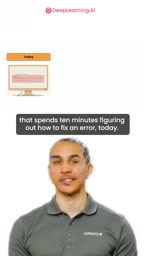
Behind this is the combination of memory mechanisms and skill extraction, enabling the agent to continuously accumulate "experience capital" over long-term operation.
Memory Mechanism in AI agents is usually divided into short-term memory (such as the context window) and long-term memory (such as vector databases or external storage). Adaptive agents need long-term memory to persist work traces and learned skills and to support efficient retrieval and updating. Common implementations include embedding-based similarity retrieval, knowledge graphs, or structured logs. The design of the memory mechanism directly affects whether the agent can recall past experience at the right time, avoid repeating mistakes, and support continuous learning without forgetting old knowledge (i.e., mitigating catastrophic forgetting).
Course Information and Learning Path
The short course launched by deeplearning.ai is titled "Building Adaptive Agents" and aims to teach how to design AI agents with idle-time learning capabilities. The course covers the core concepts described above and is suitable for developers who want to improve the long-term performance of agents.
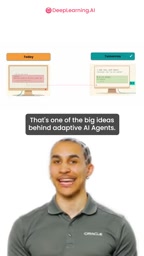
From an industry trend perspective, enabling agents to continuously evolve after deployment is a key direction for reducing maintenance costs and improving automation reliability. This course provides an entry point for this direction.
Conclusion
The core of adaptive agents lies in using idle time for experience replay and skill consolidation, allowing the agent to self-improve with every job. deeplearning.ai's short course systematically introduces this concept and provides a practical guide for developers. For teams focused on the long-term effectiveness of AI agents, this is a learning resource worth paying attention to.
One-line Summary
Adaptive agents use idle time to replay experiences and turn work traces into reusable skills.
Paragraph Summary
The article introduces the core mechanism of adaptive AI agents: during idle time, they review historical work traces through a "dreaming"-style learning loop, abstract them into reusable skills, and thereby avoid repeating mistakes and improve long-term efficiency. Using a coding agent as an example, a bug that takes 10 minutes to solve today can be quickly addressed tomorrow by reusing the solution. The article also mentions deeplearning.ai's short course "Building Adaptive Agents," which aims to teach how to design agents with idle-time learning capabilities, and notes that this direction is significant for reducing maintenance costs and improving automation reliability.
Related articles

When Gen Z Tries to Be Clever: Law Enforcement Technology and Human Nature Through Pursuit Videos
From a viral YouTube police pursuit video, we analyze the law enforcement tech, psychological dynamics, and legal consequences behind Gen Z flight behavior—and how body cameras and radio dispatch shape modern policing.

Are "Responsible" Seafood Labels Trustworthy? The Truth Behind Aquaculture Certification
Over half of global seafood is farmed, yet labels like "responsibly farmed" and "sustainable" are vaguely defined. Investigations show mainstream certifications are industry-run with low standards—consumers should be wary of marketing rhetoric.
What to Do If You Eat Moldy Food? A Full Scientific Breakdown of Mold
What happens if you eat moldy food? From mold biology, this article explains how mycelium penetrates food, why cutting off mold is still unsafe, the difference between spoilage molds and mycotoxins, and how human taste evolution relates to fermented foods.