Letting AI Run a Startup for a Week: Test Results and Reflections

Founder lets AI run his startup for a week, finding AI excels at process execution but struggles with complex decisions.
A founder conducted a one-week experiment delegating partial company operations to an LLM-based AI system covering customer communication, task management, and content generation. AI proved more efficient at standardized replies and drafting, but frequently erred in cross-departmental coordination and stakeholder trade-offs—misjudging urgent complaints as routine, lacking contextual intuition, and over-executing vague instructions. The takeaway: AI suits rule-based execution, while humans should handle exceptions.
As AI tools increasingly permeate every industry, a bold question has emerged: what would happen if you handed your startup's daily operations over to AI? Recently, a founder conducted an experiment titled "I let an AI run my startup for a week," attempting to delegate partial operational decision-making authority to an AI system over the course of one week. This experiment sparked extensive discussion in tech communities like Hacker News, touching on multiple dimensions including AI decision-making capabilities, startup management automation, and the boundaries of human-AI collaboration.
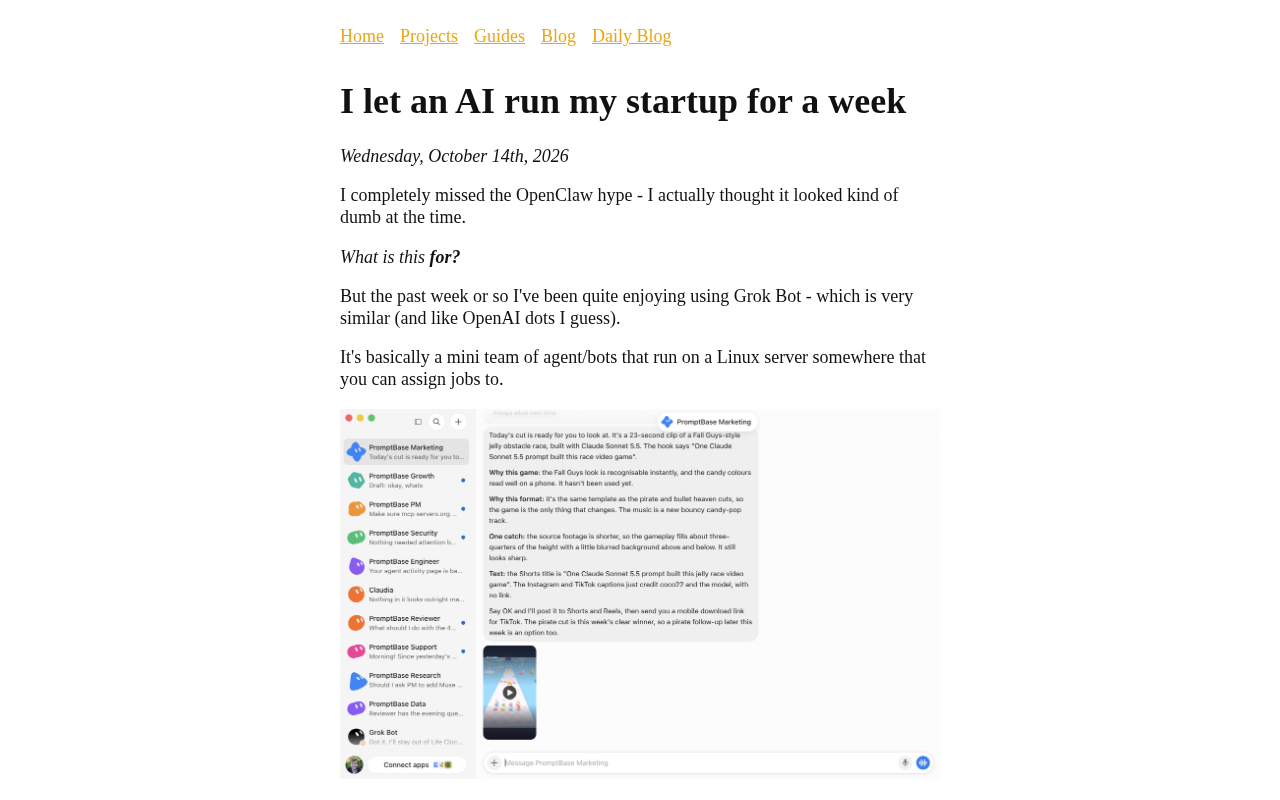
Experiment Background: Why Hand Your Company to AI?
A startup's daily operations involve a massive volume of repetitive decisions—replying to customer emails, scheduling meetings, assigning tasks, following up on project progress, writing weekly reports, and more. These tasks consume enormous amounts of the founder's energy, yet are difficult to fully outsource to a human assistant. As large language model capabilities improve, more and more entrepreneurs are asking: can AI handle these administrative tasks?
This founder's experiment was built precisely around this pain point. He set up an AI-based operations system, attempting to let AI take over some management functions, including automatically replying to common customer inquiries, generating daily task lists, and allocating resources based on preset rules. The experiment ran for one week, during which he recorded every AI decision and compared it with how he would typically handle things himself.
Large Language Models (LLMs) are the core technological foundation supporting this type of experiment. Through pre-training on massive text datasets, an LLM learns the statistical patterns of language and world knowledge, thereby gaining the ability to understand instructions, generate text, and perform reasoning. Unlike traditional rule engines or classification models, LLMs can handle open-ended, unstructured tasks—such as understanding the tone and intent of a customer email, or drafting a document based on vague requirements. But they also have clear limitations: they lack long-term memory of a specific organization's internal context, cannot truly "understand" interpersonal relationships and power structures, and are prone to "hallucinations" or over-execution when faced with ambiguous instructions. It is precisely these characteristics that determine why AI can efficiently handle standardized tasks in startup operations while exposing its shortcomings in complex decision-making scenarios.
What Work Did AI Actually Take Over?
According to the experiment description, AI was primarily assigned three types of tasks. The first was customer communication: the AI system would automatically categorize incoming emails, provide standardized replies to common inquiries, and flag complex issues for the founder to handle manually. The second was task management: AI would automatically generate daily to-do items and assign them to the appropriate team members based on project deadlines and team workload. The third was content generation: including writing social media updates, organizing meeting notes, and drafting simple business documents.
Based on the results, AI performed reliably in standardized replies and content generation, with efficiency noticeably higher than human work. But when it came to cross-departmental coordination and decisions requiring balancing multiple stakeholders' interests, AI frequently went off track—for example, simply categorizing an urgent customer complaint as a routine inquiry, leading to delayed response.
Key Problems Exposed
After a week of experimentation, the author summarized several core pain points. The most prominent was that AI lacks "contextual intuition"—it cannot perceive interpersonal dynamics within the team, legacy issues, or unspoken priorities. For instance, AI might assign additional tasks to an employee dealing with a family emergency, because it only sees "free time" on the calendar.
Another problem was accountability. When AI makes a wrong decision (such as sending inappropriate promotional information to a customer), who should bear the responsibility? The experimenter found that he himself had to spend extra time reviewing AI's external communications, which actually increased his workload. Additionally, AI tends to "over-execute" when facing ambiguous instructions—for example, when asked to "optimize meeting scheduling," it automatically canceled all weekly meetings it deemed "low priority," triggering team dissatisfaction.
"Contextual intuition" is typically called "tacit knowledge" in cognitive science and organizational management—the kind of experiential judgment that is difficult to express explicitly through words or rules, yet is crucial to decision-making. For example, knowing that a certain employee has been in a bad state recently, that a customer who complains aggressively is actually a long-term major client, or that a weekly meeting appearing low-priority is actually key to team cohesion. Human managers accumulate this intuition through long-term observation, informal communication, and empathy, while current AI systems can only make judgments based on explicit data and preset rules, unable to capture soft information like office politics, emotional atmosphere, and historical grievances. This is the fundamental reason why AI excels at standardized tasks but frequently fails in coordination scenarios that require "reading the room."
Implications for AI Startup Tools
This experiment provides valuable reference for the development of AI management tools. First, current AI is better suited as an "execution assistant" rather than a "decision-maker"—handling repetitive tasks under clear rules is where its strengths lie. Second, human-AI collaboration requires designing a clear "escalation mechanism"—when AI encounters uncertain situations, it should proactively request human intervention rather than guessing on its own. Finally, entrepreneurs need to establish audit logs of AI decisions to trace problem sources and continuously optimize prompts and rules.
Judging from the tech community's response, most commenters agree that "AI can save time, but cannot replace judgment." Some developers pointed out that similar AI operations experiments may work in small teams, but as the company scales, AI's shortcomings in understanding complex contexts will become increasingly apparent. For entrepreneurs considering introducing AI management tools, the conclusion of this experiment can perhaps be summed up in one sentence: let AI handle processes, let humans handle exceptions.
"Escalation mechanism" in human-AI collaboration systems refers to the process design where AI proactively returns decision-making authority to humans when encountering situations beyond its capability boundaries or with low confidence. An effective escalation mechanism typically contains three elements: clear trigger conditions (such as confidence below threshold, involving sensitive topics, requiring cross-departmental resource allocation), a clear handoff path (who to notify, in what form to present background information), and a timely feedback loop (how human decisions are fed back to AI to optimize subsequent judgments). Systems lacking an escalation mechanism easily fall into two extremes: either AI makes decisions unilaterally and causes errors, or it escalates every trivial matter to humans,反而增加负担. The case of AI automatically canceling weekly meetings in the experiment is a typical manifestation of missing the "ask first when uncertain" step.
One-line Summary
Founder lets AI run his startup for a week, finding AI excels at process execution but struggles with complex decisions.
Paragraph Summary
A founder conducted a one-week experiment delegating partial company operational decision-making to an LLM-based AI system, with tasks covering customer communication, task management, and content generation. Results showed AI was more efficient than humans in standardized replies and document drafting, but frequently made errors in cross-departmental coordination and multi-stakeholder trade-offs—such as misjudging urgent complaints as routine inquiries. Core problems included AI's lack of contextual intuition, inability to perceive implicit team priorities, unclear accountability for decisions, and over-execution under ambiguous instructions. The experiment's conclusion: current AI is better suited as an execution assistant under clear rules; human-AI collaboration requires designing escalation mechanisms, letting AI handle processes and humans handle exceptions, and establishing decision audit logs.
Related articles

Chain of Thought Isn't Just for AI: How Humans Can Use CoT to Improve Thinking Quality
Chain of Thought isn't just a prompt trick for large models. Starting from a Hacker News discussion, this article analyzes why CoT works for human thinking too, breaks down actionable ways to transfer it, and highlights the key differences between human CoT and machine CoT.
Cloudflare Teams Up with OpenAI: Closi…
Cloudflare Teams Up with OpenAI: Closing the Loop from Vulnerability Discovery to Defense with AI
Cloudflare uses OpenAI Daybreak to investigate security vulnerabilities and generate reviewable remediation plans, while developers use Codex to boost coding efficiency and quality.

Orca Multi-Agent Orchestration in Practice: A Guide to Parallel Collaboration with Claude and Codex
Orca is Stable AI's free open-source agent workbench supporting 34 agents like Claude Code and Codex in parallel. Learn its Git worktree isolation, multi-model orchestration, and mobile management.