LexLattice: Reshaping Multilingual Legal Summarization with Neural Cellular Automata

LexLattice beats billion-parameter LLMs on multilingual legal summarization using just 1.8M parameters via neural cellular automata.
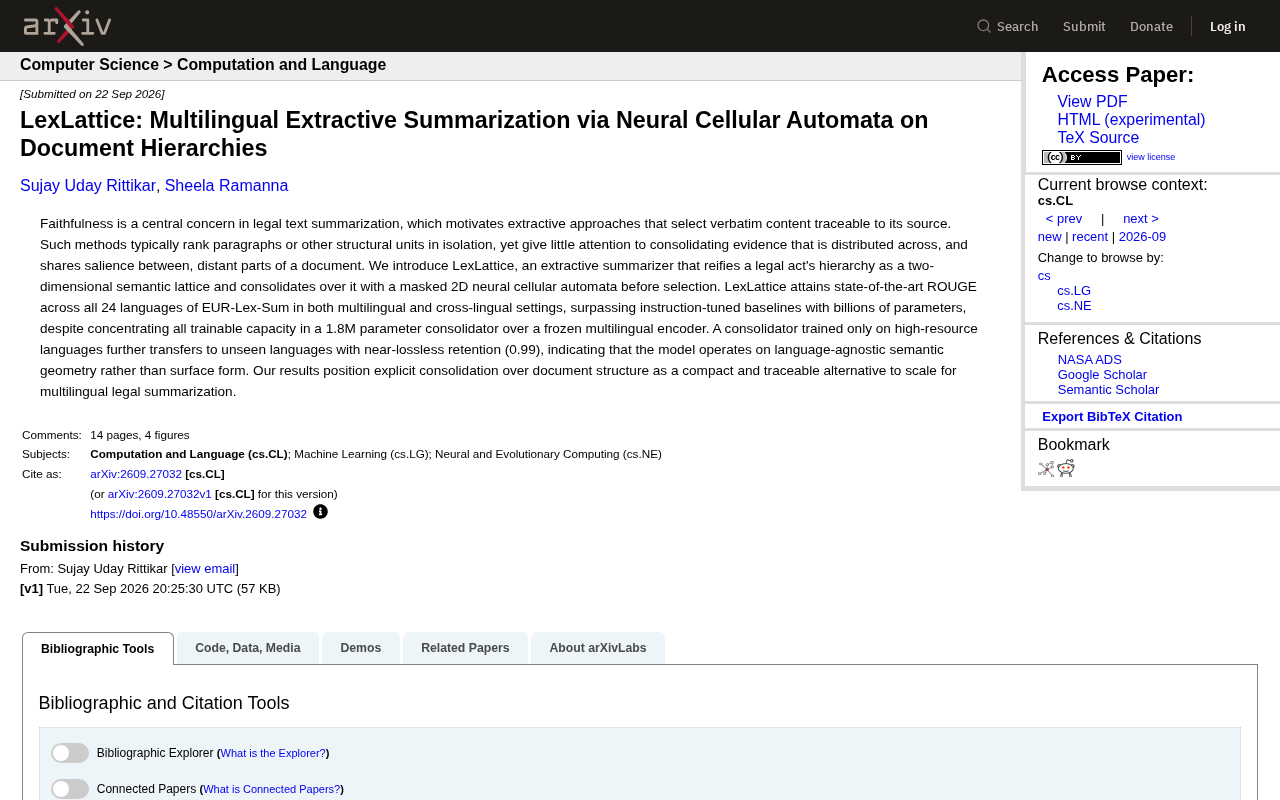
LexLattice is a new paper on multilingual extractive legal summarization that models a legal document's hierarchy (articles, clauses, subparagraphs) as a 2D semantic lattice and applies masked Neural Cellular Automata to iteratively propagate and consolidate semantics across the lattice before selecting summary sentences. With only 1.8M trainable parameters, it achieves state-of-the-art ROUGE scores across all 24 languages of EUR-Lex-Sum, outperforming instruction-tuned models with billions of parameters. The consolidator also transfers near-losslessly (retention rate 0.99) to unseen languages, suggesting it operates on language-agnostic semantic geometry — offering a compact, traceable alternative to model scaling for high-stakes legal and compliance applications.
Why Legal Summarization Stays Committed to Extractive Methods
Legal text summarization has one non-negotiable core requirement: faithfulness. In judicial and compliance contexts, summaries cannot "fabricate" content — every conclusion must be traceable back to the source document. This is precisely why extractive summarization has long dominated the legal domain: it selects verbatim content directly from the original text, ensuring every statement can be pinpointed in the source.
But existing extractive methods have a clear weakness: they typically score and rank paragraphs or structural units in isolation, rarely accounting for cases where evidence is distributed across a document. In a legal document, key arguments often span multiple clauses separated by considerable distance, sharing semantic salience with one another. Scoring each section independently misses this cross-structural evidence integration.
A new paper on arXiv, LexLattice: Multilingual Extractive Summarization via Neural Cellular Automata on Document Hierarchies, proposes a solution to exactly this problem.
Extractive summarization and abstractive summarization represent the two main approaches in automatic summarization. Abstractive methods allow models to freely paraphrase and synthesize meaning, producing more fluent and natural summaries — but at the cost of potentially introducing hallucinations, where the model fabricates content not present in the original text. This is tolerable in general-purpose settings, but in high-stakes domains like law, medicine, and compliance, any statement that cannot be traced to the original document can have serious consequences. Extractive methods mitigate this risk by directly copying text spans from the source, giving every summary item a verifiable textual origin. ROUGE (Recall-Oriented Understudy for Gisting Evaluation) is the most widely used metric suite for evaluating summarization quality, quantifying the overlap of n-grams between system-generated and reference summaries. ROUGE-1, ROUGE-2, and ROUGE-L measure unigram, bigram, and longest common subsequence overlaps, respectively.
LexLattice's Core Idea: Turning Document Structure into a 2D Semantic Lattice
LexLattice's key innovation lies in how it models the hierarchical structure of legal documents. It reifies a legal document's hierarchy (articles, paragraphs, subparagraphs, etc.) into a two-dimensional semantic lattice, then performs consolidation on this lattice before selecting summary sentences.
The tool used for consolidation is the most compelling part of the paper: a masked 2D Neural Cellular Automaton. Neural Cellular Automata are most commonly associated with image generation and morphogenesis simulation, where each "cell" iteratively updates based on its neighbors' states. LexLattice transplants this mechanism onto document structure: semantic information propagates and aggregates iteratively between adjacent cells in the lattice, explicitly integrating evidence scattered throughout the document before the final sentence selection step.
This approach of "explicit structural consolidation" stands in sharp contrast to the prevailing trend of simply scaling up parameters and model size.
Neural Cellular Automata (NCA) are variants of classical cellular automata in which the hand-crafted update rules are replaced by learned neural networks. In classical cellular automata (such as Conway's Game of Life), each cell updates its state at discrete time steps based on fixed rules derived from its neighbors. NCA replaces those update rules with trainable neural networks, allowing the evolution of cell states to be learned from data. NCA were previously best known for image generation and morphogenesis simulation — Google Brain famously used them to demonstrate how cells can "self-organize" into global shapes through purely local communication. LexLattice transfers this mechanism to document understanding: it maps hierarchical nodes of a legal document (articles, clauses, subparagraphs) to lattice cells, and uses NCA's iterative neighborhood propagation in place of manually defined cross-paragraph attention mechanisms, allowing semantic information to diffuse naturally along document structure without needing to explicitly model long-range dependencies. The "masked" aspect means propagation respects the document's hierarchical structural constraints, only passing information between semantically adjacent or same-level nodes, preventing interference from unrelated sections.
Beating Billion-Parameter Models with Just 1.8M Parameters
LexLattice's most striking achievement is that it attains state-of-the-art ROUGE scores across all 24 languages in the EUR-Lex-Sum dataset, under both multilingual and cross-lingual settings.
Even more striking is the efficiency comparison: it outperforms instruction-tuned baseline models with billions of parameters, while its entire set of trainable parameters amounts to just 1.8 million (1.8M) — all concentrated in a consolidator module built on top of a frozen multilingual encoder.
In other words, LexLattice does not fine-tune a massive encoder. Instead, it only trains a tiny module responsible for "consolidating semantics over document structure." This validates an important point: for tasks like legal summarization, explicit structural modeling can substitute for blind scaling, delivering better and more traceable results at a fraction of the computational cost.
Cross-Lingual Transfer: The Model Captures "Semantic Geometry," Not Surface Form
The paper also reports a particularly illuminating finding. When the researchers trained the consolidator only on high-resource languages and transferred it to languages unseen during training, the retention rate reached 0.99 — virtually lossless.
This near-lossless cross-lingual transfer suggests that LexLattice's consolidator operates on language-agnostic semantic geometry rather than the surface forms of any particular language. Because the consolidation process occurs at the level of the lattice's abstract structure, it generalizes across languages naturally. This has direct practical value for scenarios requiring coverage of multilingual legal systems, such as the EU's 24 official languages.
EUR-Lex-Sum is a benchmark dataset built specifically for multilingual legal summarization research, covering all 24 official EU languages, with content sourced from legal act summaries on EUR-Lex, the EU's legal database. Each sample includes a full EU legal act and its corresponding official human-written summary, with the same regulation aligned in parallel across all language versions — making it naturally suited for multilingual and cross-lingual evaluation. The dataset's challenges include: highly imbalanced training sample counts across languages (with low-resource languages like Irish and Maltese having very limited annotated data), and the strict hierarchical structure of EU legal texts (nested chapters, articles, and paragraphs), which places high demands on structural modeling capabilities. LexLattice's performance on this dataset — especially its near-lossless transfer to low-resource languages — is the core proof of its structured consolidation strategy's value.
Significance: A Compact, Traceable Alternative to Scaling
Taken together, LexLattice's central message is clear: in multilingual legal summarization, explicitly consolidating over document structure is a compact and traceable path that can serve as an alternative to simply scaling up model size.
- From a faithfulness standpoint, the extractive approach inherently ensures content traceability;
- From an efficiency standpoint, a 1.8M-parameter consolidator is far more economical than billion-parameter large models;
- From a generalization standpoint, operating at the level of semantic geometry enables near-lossless cross-lingual transfer.
For fields like legal tech and compliance review — where accuracy and interpretability demands are extremely high — this kind of "small but precise" structured approach may be a better fit for real-world needs than chasing ever-larger general-purpose models. That said, as a newly published preprint, its conclusions still await broader reproduction and real-world deployment validation.
Related articles

Chain of Thought Isn't Just for AI: How Humans Can Use CoT to Improve Thinking Quality
Chain of Thought isn't just a prompt trick for large models. Starting from a Hacker News discussion, this article analyzes why CoT works for human thinking too, breaks down actionable ways to transfer it, and highlights the key differences between human CoT and machine CoT.
Cloudflare Teams Up with OpenAI: Closi…
Cloudflare Teams Up with OpenAI: Closing the Loop from Vulnerability Discovery to Defense with AI
Cloudflare uses OpenAI Daybreak to investigate security vulnerabilities and generate reviewable remediation plans, while developers use Codex to boost coding efficiency and quality.

Orca Multi-Agent Orchestration in Practice: A Guide to Parallel Collaboration with Claude and Codex
Orca is Stable AI's free open-source agent workbench supporting 34 agents like Claude Code and Codex in parallel. Learn its Git worktree isolation, multi-model orchestration, and mobile management.