LFM2.5-24B-A2B Hands-On: Holding Up Under Heavy Load in Pi Agent

Reddit user finds LiquidAI's new LFM2.5-24B-A2B impressive in Pi Agent workflow, stable and reliable on mechanical tasks.
A Reddit user who long used Ornith 1.5-35B swapped LiquidAI's newly released LFM2.5-24B-A2B into his Pi Agent workflow for testing. On an AMD W7900 via llama.cpp+ROCm, the model achieved ~95 tps sustained inference speed, with Q8 quantization using 30GB VRAM and supporting full 128k context. On mechanical and long-running recursive tasks, it performed stably and reliably, positioned as a "small" model running in parallel with a large model, suited for dual-GPU division of labor. However, the author candidly noted that insight capability in AI-Council mode still needs longer-term verification, promising to report back. Overall, this real-workflow controlled experiment provides preliminary corroboration for LiquidAI's official performance claims.
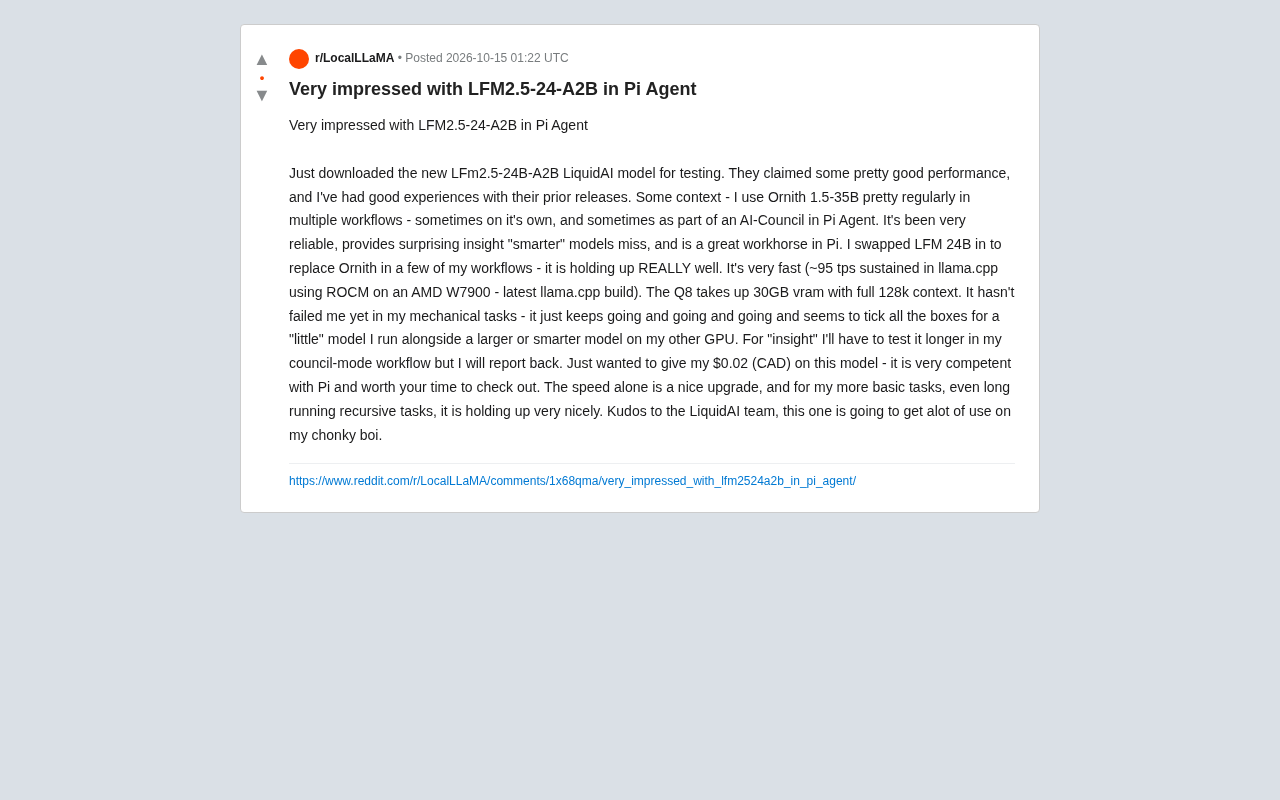
In the local large model deployment community, a solid hands-on report often carries more weight than official benchmark scores. Recently, a Reddit user's post sparked considerable discussion: he had just downloaded LiquidAI's newly released LFM2.5-24B-A2B model and ran replacement tests across multiple scenarios in his Pi Agent workflow, concluding it was "very impressive."
1. Why This Test Is Worth Paying Attention To
This user isn't the type to run a quick demo and post about it. From his description, he had long relied on Ornith 1.5-35B as his primary model, using it across multiple workflows—sometimes standalone, sometimes as a member of the "AI-Council" mode within Pi Agent. His assessment of Ornith: extremely reliable, capable of delivering insights that "smarter" larger models tend to overlook, a true workhorse in Pi.
Precisely because he had a stable baseline for comparison, he decided to swap in LFM2.5-24B-A2B to see whether this smaller model could hold its ground. The result, in his own words—"holding up REALLY well." On mechanical tasks, it never let him down, "it just keeps going and going," fulfilling almost all his expectations for a "small model."
2. Speed and VRAM: Key Metrics for Local Deployment
For local deployment users, beyond model capability, speed and VRAM usage are the top concerns. The post provides quite specific data:
- Inference speed: On an AMD W7900 GPU, using llama.cpp with the ROCm backend, the latest build sustains approximately 95 tps (tokens per second)
- VRAM usage: The Q8 quantized version occupies about 30GB VRAM, and supports the full 128k context
These two numbers are meaningful when viewed together. A sustained output speed of 95 tps is quite smooth for a 24B-class model, especially achieved on a consumer/workstation-grade AMD GPU via ROCm. And 30GB VRAM at Q8 quantization for full 128k context means users with a single large-VRAM card (like the W7900's 48GB) can easily accommodate it while leaving headroom for other tasks.
About llama.cpp and ROCm
llama.cpp is an open-source LLM inference engine written in C/C++, with core advantages in highly optimized quantization support and cross-platform compatibility. It supports GGUF format models and can run on multiple backends including CPU, CUDA, Metal, and ROCm. ROCm (Radeon Open Compute) is AMD's open-source GPU computing platform, positioned against NVIDIA's CUDA. For a long time, ROCm's ecosystem maturity on consumer and workstation AMD GPUs lagged behind CUDA, but iteration speed has accelerated noticeably in the past two years. Achieving 95 tps on a W7900 in this review shows that the llama.cpp + ROCm combination has reached practical-grade stability—a positive signal for users unwilling to be locked into the NVIDIA ecosystem.
About Q8 Quantization
Quantization is the technique of compressing model weights from high-precision floating point (like FP16) to lower-bit integers, aimed at reducing VRAM usage and improving inference speed. Q8 means each weight is stored as an 8-bit integer, representing a "near-lossless" quantization level—compared to more aggressive compression schemes like Q4, Q8 has minimal precision loss but higher VRAM usage. A 24B model at Q8 occupying about 30GB VRAM means a GPU with at least 32GB VRAM is needed for full loading, and the W7900's 48GB leaves ample headroom. Understanding the trade-offs between quantization levels, VRAM usage, and precision is core homework for local deployment selection.
3. The Dual-GPU Collaboration Approach: Small Model + Large Model
This user's deployment architecture deserves separate discussion. He explicitly mentioned positioning LFM2.5-24B-A2B as a "small" model "running on another GPU, in parallel with a large model or smarter model."
This is an increasingly common local deployment strategy: use one GPU to run a large model for complex reasoning and planning, and another GPU to run a small, fast model for mechanical, repetitive, long-chain execution tasks. The core logic of this division of labor is—not all tasks require the largest model. Many mechanical tasks and recursive long-pipeline tasks are actually more cost-effective with a small, fast model, because it won't slow down the entire pipeline.
The post author specifically emphasized that even for "long running recursive tasks," LFM2.5 performed very steadily. This is especially important for Agent-type workflows, because Agents often require models to repeatedly call tools, process intermediate results, and maintain long contexts—once a model errs or slows down in a long chain, the entire process gets stuck.
About AI Agents and Tool Calling
Agent workflows refer to the pattern of letting large models autonomously plan steps, call external tools (like search engines, code executors, APIs), process intermediate results, and iterate until goals are completed. Unlike single-turn Q&A, Agent scenarios demand more "long-chain stability" from models: they need to consistently follow instruction formats, correctly parse tool returns, and maintain context consistency across dozens or even hundreds of iterations. Once any step produces a format error or hallucination, the entire chain may break. Therefore, using a small, fast model specifically for execution-type subtasks while a large model handles top-level planning has become a common architectural choice for reducing cost and latency. Pi Agent's "AI-Council" mode goes further, letting multiple models provide judgments in parallel before synthesizing—essentially trading model diversity for decision quality.
4. What Remains Unverified: Insight Capability
The author was also candid about drawing boundaries. He noted that at the "insight" level—the AI-Council mode usage where multiple models each provide judgments that are then synthesized—he would need longer testing before drawing conclusions.
This distinction is critical. Mechanical tasks test stability, speed, and instruction following; Council mode tests a model's judgment quality, uniqueness of perspective, and "whether it can say something other models haven't." LFM2.5 has passed the preliminary test on the former; the latter needs more time. The author said he would report back later—this cautious attitude actually makes the earlier praise more credible.
This also gives a heads-up to users considering following suit: if you mainly use models for process execution, tool calling, and batch processing, LFM2.5-24B-A2B might be immediately usable; but if you're counting on it to provide high-quality insights in multi-model collaboration, it's best to run your own tests first.
What Is Model "Insight"
In community context, "insight" typically refers to whether a model can provide non-obvious judgments with unique perspectives, rather than restating common conclusions from training data. It relates to model scale, training data diversity, and post-training strategies. Small models can approach large model performance on mechanical tasks through instruction fine-tuning, but on tasks requiring cross-domain association, identifying the essence of problems, and proposing counterintuitive solutions, they often fall short due to limitations in parameter capacity and knowledge density. This is precisely why the author evaluates "mechanical tasks" and "Council mode insight" separately—the former tests execution, the latter tests judgment, and the two require different dimensions of model capability.
5. Significance for LiquidAI and the Local Model Ecosystem
The post concludes with "Kudos to the LiquidAI team," and a prediction that this model will see heavy use on his "chonky boi" (big rig).
From a community feedback perspective, the value of this share lies in providing a controlled experiment within a real workflow, rather than isolated benchmarks. LiquidAI's performance claims at launch received preliminary validation in this user's mechanical task scenarios, with speed performance directly called "a nice upgrade." For users looking for open-source models at the 24B level, supporting long contexts, and running efficiently on AMD platforms, LFM2.5-24B-A2B deserves a spot on the candidate list.
Of course, a single user's experience cannot replace systematic evaluation. The model's insight capability in Council mode and generalization across broader task types still need more community testing to supplement. But at least from this "$0.02 (CAD)" feedback, it's a promising start for a release.
One-line Summary
Reddit user finds LiquidAI's new LFM2.5-24B-A2B impressive in Pi Agent workflow, stable and reliable on mechanical tasks.
Paragraph Summary
A Reddit user who long used Ornith 1.5-35B swapped LiquidAI's newly released LFM2.5-24B-A2B into his Pi Agent workflow for testing. On an AMD W7900 via llama.cpp+ROCm, the model achieved ~95 tps sustained inference speed, with Q8 quantization using 30GB VRAM and supporting full 128k context. On mechanical and long-running recursive tasks, it performed stably and reliably, positioned as a "small" model running in parallel with a large model, suited for dual-GPU division of labor. However, the author candidly noted that insight capability in AI-Council mode still needs longer-term verification, promising to report back. Overall, this real-workflow controlled experiment provides preliminary corroboration for LiquidAI's official performance claims.
Related articles

Chain of Thought Isn't Just for AI: How Humans Can Use CoT to Improve Thinking Quality
Chain of Thought isn't just a prompt trick for large models. Starting from a Hacker News discussion, this article analyzes why CoT works for human thinking too, breaks down actionable ways to transfer it, and highlights the key differences between human CoT and machine CoT.
Cloudflare Teams Up with OpenAI: Closi…
Cloudflare Teams Up with OpenAI: Closing the Loop from Vulnerability Discovery to Defense with AI
Cloudflare uses OpenAI Daybreak to investigate security vulnerabilities and generate reviewable remediation plans, while developers use Codex to boost coding efficiency and quality.

Orca Multi-Agent Orchestration in Practice: A Guide to Parallel Collaboration with Claude and Codex
Orca is Stable AI's free open-source agent workbench supporting 34 agents like Claude Code and Codex in parallel. Learn its Git worktree isolation, multi-model orchestration, and mobile management.