LFM2.5 Released: How a 2.6B Small Model Rivals Models 4x Its Size

Liquid AI's 2.6B LFM2.5 model matches models 4x its size through liquid neural network architecture innovation.
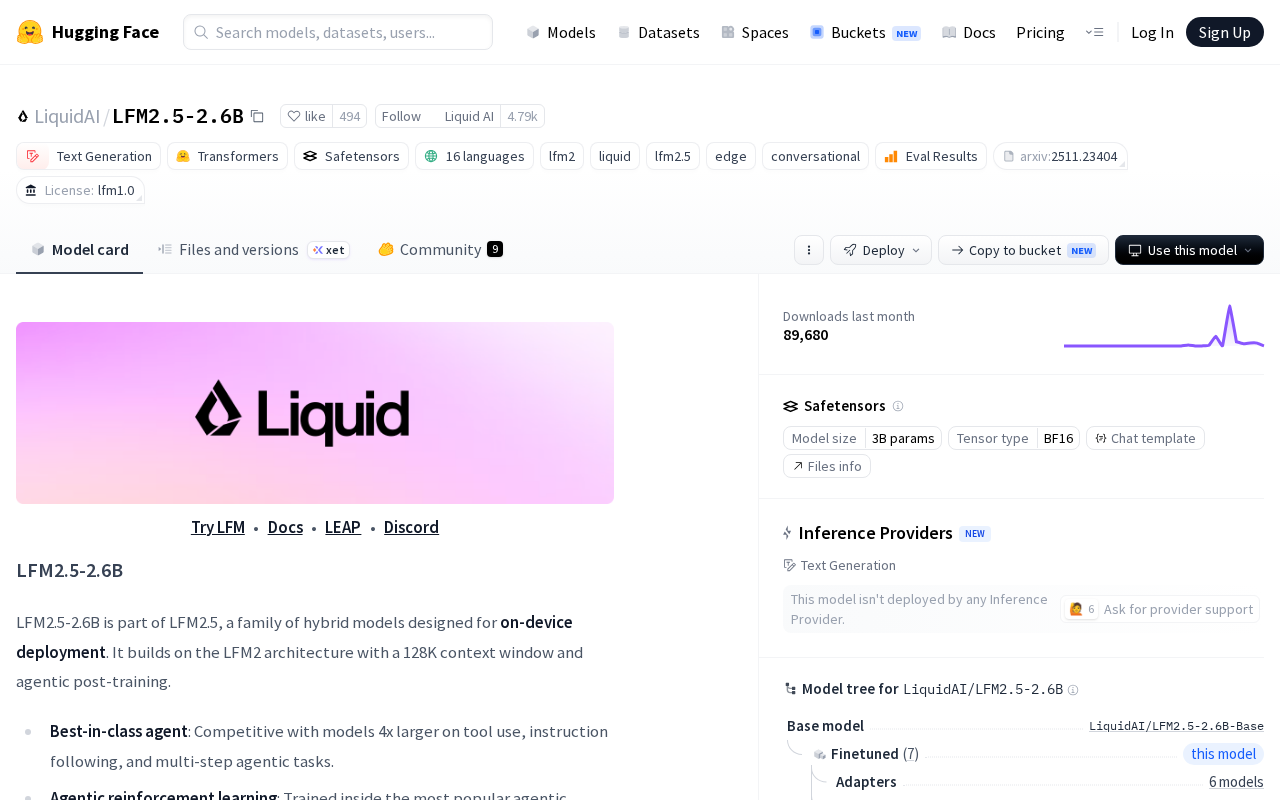
Liquid AI's LFM2.5 demonstrates that a 2.6B parameter model can rival 10B-class models on multiple benchmarks, leveraging liquid neural network architecture, high-quality data curation, and advanced training strategies. This breakthrough signals that efficiency optimization is becoming as critical as scale in AI development, enabling deployment on edge devices and lowering barriers for developers.
A Big Breakthrough for Small Models
In the large language model space, parameter count has long been considered a key measure of capability. This perception largely stems from OpenAI's "Scaling Laws" proposed in 2020—research showing that model performance has a predictable power-law relationship with parameter count, training data volume, and compute, which directly fueled the arms race of ultra-large models like GPT-3 (175B) and PaLM (540B). However, Liquid AI's newly released LFM2.5 model once again challenges this established belief—this model with only 2.6 billion (2.6B) parameters demonstrates competitive performance comparable to models 4 times its size across multiple benchmarks.
This means a model with roughly one-quarter the parameters can achieve performance that approaches or even matches larger models on practical tasks. For the entire industry, this represents not just a technical advancement but signals that efficiency optimization is becoming a competitive dimension equally important as scaling up. The scaling laws themselves hint at this possibility: if breakthroughs can be achieved in data quality and training strategies, small models can absolutely approach the performance curves of larger ones.
Why Small Yet Powerful Models Matter So Much
Dramatically Improved Deployment Costs and Inference Efficiency
Model parameter count directly affects memory usage, computational overhead, and response latency during inference. A 2.6B model compared to a 10B-class model can run with significantly lower hardware requirements, potentially enabling deployment on edge devices, consumer-grade GPUs, and even mobile scenarios.
Specifically, a 2.6B parameter model occupies approximately 5.2GB of VRAM at FP16 precision and can be compressed to roughly 1.3GB after INT4 quantization, making it feasible to run in real-time on high-end smartphones or lightweight edge servers. Edge devices typically face multiple constraints including limited memory (4-16GB RAM), restricted compute (no dedicated GPU or only low-power NPUs), and power sensitivity. In contrast, even with aggressive quantization, 10B-class models still require over 5GB of memory, essentially ruling out deployment on consumer mobile devices.
This holds enormous appeal for enterprises and developers looking to control costs. When a small model can deliver quality approaching that of large models, users don't need to pay for additional compute to achieve usable results. LFM2.5 represents precisely this kind of "value-for-performance" technical approach.
Efficiency Optimization Becomes a Mainstream Technical Trend
The emergence of LFM2.5 is not an isolated case but a continuation of the recent "small model uprising" trend. From Mistral 7B to various carefully trained small-parameter models, the industry increasingly recognizes that high-quality training data, superior architecture design, and refined training strategies often deliver more substantial improvements than simply stacking parameters.
Since 2023, this trend has formed a clear trajectory: Mistral 7B first demonstrated that a carefully trained 7B model could rival early 13B or even 30B models; Meta's Llama 3.2 series introduced lightweight 1B and 3B versions; Microsoft's Phi series surpassed competitors many times its size on multiple benchmarks with just 2.7B parameters. The common pattern behind these successes includes: high-quality data curation (including synthetic data augmentation, strict deduplication, and toxicity filtering), training token counts far exceeding traditionally optimal ratios, and the application of advanced post-training alignment techniques like DPO.
Liquid AI itself is known for its distinctive "Liquid Neural Networks" philosophy, emphasizing more flexible and efficient model structures. Liquid Neural Networks were originally proposed by Ramin Hasani and colleagues at MIT in 2020, inspired by the dynamic properties of the C. elegans (roundworm) nervous system. Unlike traditional neural networks where weights are fixed after training, the connection strengths between nodes in liquid neural networks dynamically adjust based on input—essentially a form of continuous-time recurrent neural network (CT-RNN). The core advantage of this architecture lies in achieving complex temporal reasoning with extremely few neurons while offering stronger interpretability and robustness to out-of-distribution data. The LFM series represents the practical application of this philosophy to large language models, and this 2.5 version iteration further validates the value of architectural innovation.
Where Does LFM2.5's Competitiveness Come From?
Meticulous Data and Training Refinement
The key to making a small model reach large model performance lies in training process optimization. This typically includes: using rigorously curated and deduplicated high-quality corpora, adopting longer training schedules, and incorporating more advanced alignment and fine-tuning techniques.
Smaller parameter count means the model's "knowledge capacity" is limited, so every parameter must be utilized efficiently. This requires the training team to make precise trade-offs in data mixing ratios, learning rate scheduling, and loss function design, ultimately maximizing the effectiveness of limited parameters. Notably, recent research has found that training data quality and diversity have a particularly significant impact on small models—at the same parameter count, models trained on carefully curated high-quality data can outperform those trained on unprocessed web-crawled data by tens of percentage points.
Architectural Innovation from Liquid Neural Networks
Liquid AI's technical heritage gives it an architectural approach distinct from the mainstream pure Transformer paradigm. Since its introduction in 2017, the Transformer architecture has dominated the LLM field through its self-attention mechanism, but its O(n²) attention computation complexity makes long-sequence processing costly, and its fixed feed-forward network structure exhibits some inefficiency in parameter utilization. In recent years, multiple alternative or hybrid architectures have emerged: Mamba introduces State Space Models (SSM) for linear complexity; RWKV combines RNN inference efficiency with Transformer training parallelism; Mixture of Experts (MoE) improves parameter utilization through sparse activation.
Liquid AI's approach draws from dynamical systems theory, potentially combining the advantages of continuous-time dynamics with discrete attention mechanisms. By introducing more efficient computational units and information flow mechanisms, the model can maintain strong expressiveness and generalization performance while keeping a relatively small scale.
This architectural differentiation is precisely what gives LFM2.5 the confidence to challenge larger models.
A Rational View of What "Rivaling" Means
You might not have noticed, but the claim of "comparable competitiveness to models 4x larger" is typically based on specific benchmark test sets. Common LLM benchmarks include MMLU (Massive Multitask Language Understanding), HellaSwag (commonsense reasoning), HumanEval (code generation), GSM8K (mathematical reasoning), and others. While these tests provide a standardized comparison framework, they have known limitations: data contamination risks (training sets may inadvertently include test questions), disconnect from real-world application scenarios, and inability to measure nuances in long-text coherence and instruction following. The industry increasingly favors human preference evaluations like Chatbot Arena, or domain-specific vertical assessments to supplement benchmark scores.
In practical applications, model performance may vary across different tasks and domains. In complex scenarios requiring deep reasoning, long-context processing, or specialized knowledge, larger models often still hold advantages.
Therefore, the rational approach for developers and enterprises is to evaluate based on their specific use cases rather than simply judging by benchmark scores alone. The value of small models is better reflected in the "good enough and efficient" balance point—delivering sufficiently good quality for a large volume of everyday tasks while dramatically reducing deployment and operating costs.
LFM2.5's Implications for the AI Industry
The release of LFM2.5 reinforces a signal: in the second half of the large model era, efficiency will become the core battleground. As the marginal returns of parameter scaling gradually diminish, how to achieve stronger capabilities with fewer resources will determine who wins in cost-sensitive commercial competition.
For small teams and individual developers, the proliferation of such efficient small models means lower barriers to entry and broader application possibilities. Whether for local deployment, privacy-sensitive scenarios, or resource-constrained edge computing environments, small yet powerful models will play an increasingly important role.
As teams like Liquid AI continue to advance architectural innovation, we have reason to expect more "punching above their weight" models to emerge, driving the entire AI ecosystem toward a more inclusive and sustainable direction. This also means the democratization of AI is no longer just a slogan—when a highly capable model can run smoothly on a laptop, the barrier to innovation has truly been lowered to every developer with an idea.
Key Takeaways
Related articles

Chain of Thought Isn't Just for AI: How Humans Can Use CoT to Improve Thinking Quality
Chain of Thought isn't just a prompt trick for large models. Starting from a Hacker News discussion, this article analyzes why CoT works for human thinking too, breaks down actionable ways to transfer it, and highlights the key differences between human CoT and machine CoT.
Cloudflare Teams Up with OpenAI: Closi…
Cloudflare Teams Up with OpenAI: Closing the Loop from Vulnerability Discovery to Defense with AI
Cloudflare uses OpenAI Daybreak to investigate security vulnerabilities and generate reviewable remediation plans, while developers use Codex to boost coding efficiency and quality.

Orca Multi-Agent Orchestration in Practice: A Guide to Parallel Collaboration with Claude and Codex
Orca is Stable AI's free open-source agent workbench supporting 34 agents like Claude Code and Codex in parallel. Learn its Git worktree isolation, multi-model orchestration, and mobile management.