LG Immersion Cooling Agreement: Why the AI Data Center Test Bed Matters More Than Deployment Promises

LG signed an immersion cooling development agreement with GS E&C and GRC—test bed scope, not deployment slogans, is the key to success.
LG Electronics, GS E&C, and GRC signed a development agreement on October 13 to validate immersion cooling applicability and reliability and develop integrated solutions and reference designs for AI data centers. This is a development agreement, not a deployment contract—no test bed results or measured energy savings data were announced. The article argues the real bottleneck isn't thermal performance but test bed scope design: test beds must lock in deployable configurations, certify equipment/coolant/tanks/procedures as a system, incorporate building-side loads, piping, service access, and heat rejection boundaries into experimental design, and validate service cycles and abnormal responses. Reference design value depends on the test conditions and measurement boundaries it carries.
The Immersion Cooling Agreement That Puts Engineering Before Marketing
The heat dissipation challenge in AI data centers is pushing immersion cooling from a niche topic to the engineering forefront. The development agreement signed by LG Electronics, GS E&C, and Green Revolution Cooling (GRC) may look like just another partnership announcement on the surface, but it actually exposes the real bottleneck for immersion cooling deployment: the scope design of the test bed matters far more than deployment slogans when it comes to project success.
According to LG's Korean newsroom announcement, the three parties signed the agreement on October 13, planning to validate the applicability and reliability of immersion cooling and to develop integrated solutions and reference designs for AI data centers. LG provides cooling technology and operational data, GS E&C handles building reference design and the concept-proof test bed (covering equipment layout, structural loads, piping, and electrical connections), and GRC supplies immersion tanks and control technology along with installation and O&M data.
This is not a deployment contract, and the announcement provides no results from a completed test bed or measured energy savings data. For infrastructure buyers, the real question worth asking is: what kind of reproducible certification record will this agreement produce?
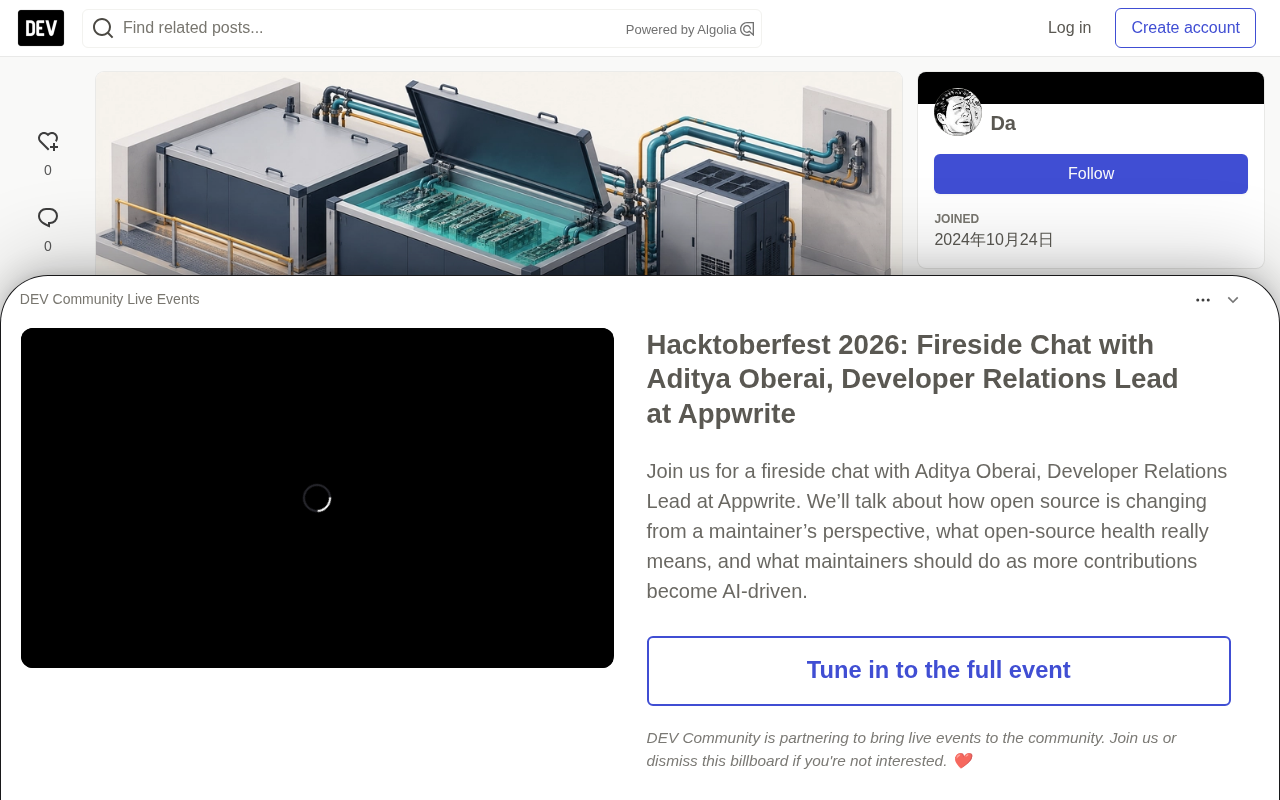
The Test Bed's First Priority: Certifying Real Equipment and Coolant Combinations
Immersion cooling changes the relationship between servers and their surrounding environment. Equipment, coolant, tanks, and maintenance procedures must be certified as a complete system. This means the test bed must lock in deployable configurations from the start, rather than first building a demo environment that merely runs.
Specifically, test records should include server components, firmware versions, coolant specifications, and tank configurations. It should also clarify which vendors support the combination and under what conditions. A successful run must come with clear boundaries—swapping components or coolant may introduce questions the original test didn't answer. Which changes require additional review and who approves them should be agreed upon before testing begins.
Maintenance procedures also fall within the certification scope. Service teams need to know how equipment is disassembled, transported, and restored to operation. Cleaning, inspection, and coolant management steps should be incorporated into actual operating procedures during testing, not patched in at the handover stage.
Immersion cooling is primarily divided into single-phase and two-phase categories, depending on whether the coolant is conductive and whether phase change occurs. In single-phase solutions, servers are directly immersed in non-conductive hydrocarbon or fluorinated liquids, with the liquid pumped externally through heat exchangers to remove heat—the liquid itself doesn't boil. Two-phase solutions use low-boiling-point fluorinated liquids that absorb heat and boil into vapor on server surfaces, then condense back through a condenser. The two differ significantly in coolant specifications, tank sealing requirements, and maintenance procedures: two-phase coolants are highly volatile, demand higher tank sealing and leak detection standards, and face more prominent supply chain risks due to regulations restricting perfluorinated compounds. Clarifying whether a given test bed targets single-phase or two-phase is a prerequisite for evaluating equipment compatibility lists, coolant replenishment costs, and long-term operational burden.
Putting Building-Side Issues into the Experimental Design
Immersion cooling projects often fail not because of thermal performance, but because of building compatibility. The test bed should capture the physical constraints that determine whether a design can fit a real site, with responsible engineers evaluating equipment layout, load conditions, and service access.
Delivery routes and service corridors should be reviewed alongside final positioning. The equipment needed to lift or move components, and the space required for safe operations, should all be confirmed within the test scope. Results should demonstrate that O&M teams can maintain the facility without working around a cramped floor plan.
Heat rejection boundaries must be explicit. What requirements the tank system places on the facility, and how those requirements vary with workload and operating conditions, need to be documented. This information lets buyers evaluate building retrofit costs separately from equipment procurement—which is precisely the gray area where most immersion cooling budgets overrun.
Immersion tanks are not standalone equipment; they impose a set of requirements on the facility that differ from air cooling. When filled with coolant and servers, a single tank can weigh over a ton, and the distributed floor load and localized concentrated loads often exceed the design margins of conventional data centers, requiring structural reinforcement assessments. The heat rejection path also differs: air cooling relies on CRAC units to expel heat outdoors, while immersion cooling transfers heat through internal tank heat exchangers to a secondary water system, then rejects it via cooling towers or dry coolers. This requires the facility to have appropriate supply/return water temperature windows, flow rates, and redundancy configurations. Additionally, coolant replenishment, filtration, and possible leak handling require reserved space for chemical storage and operations. These constraints are especially pronounced when retrofitting existing data centers, and they represent the most commonly underestimated part of immersion cooling project budgets.
Service Cycles Must Be Tested Alongside Workloads
Thermal performance at steady state is only part of the infrastructure decision. Test teams should demonstrate a planned service intervention using documented procedures and role assignments expected in a production environment.
The entire sequence—from identifying components needing attention to restoring the system—should be recorded: which adjacent equipment can continue running, which must be isolated, and how the team confirms readiness before restoring workloads. The test scope should also include responses to abnormal conditions, where operators can identify affected equipment, understand available actions, and follow escalation paths.
These are recommended evaluation steps, not assertions that the partners' designs have specific flaws. But an immersion cooling solution lacking service cycle validation essentially leaves operational risk to the customer site.
Operations in an immersion environment are fundamentally different from air cooling. After servers are removed from tanks, coolant may remain on surfaces and internally, requiring dedicated drainage, cleaning, and drying processes—otherwise direct transport causes dripping and secondary contamination. Maintenance often involves draining coolant, disconnecting quick-connect fittings, using specialized lifting equipment to hoist servers from tanks, then moving through drainage areas to standard maintenance stations—a process requiring longer downtime windows and stricter safety protocols. Therefore, service cycle testing must answer not just thermal performance questions but also: how many people and how much time a planned maintenance requires, whether backup tanks are needed to hold removed equipment, and how to complete these operations without disrupting adjacent workloads. This data directly determines O&M costs and availability commitments.
The Value of a Reference Design Depends on the Assumptions It Carries
A useful reference design must come with its own assumptions. Any efficiency result should be accompanied by the test workload, environmental conditions, system configuration, and measurement boundaries.
If energy consumption is to be compared with another solution, the comparison conditions must be visible: what auxiliary cooling and pumping equipment is included in each case, and what service the servers delivered. Percentages without this context are nearly useless for buyers estimating performance at another site. The same applies to reliability claims—state what was tested, for how long, and which operating scenarios remain uncovered, and carry these limitations through from the test bed to customer proposals.
The collaboration announced by LG, GS E&C, and GRC explicitly includes building integration and operational evidence, which is uncommon in the immersion cooling space. But its value doesn't depend on press release wording—it depends on whether the test records can clearly define the supported system and the work required to sustain its operation.
One-line Summary
LG signed an immersion cooling development agreement with GS E&C and GRC—test bed scope, not deployment slogans, is the key to success.
Paragraph Summary
LG Electronics, GS E&C, and GRC signed a development agreement on October 13 to validate immersion cooling applicability and reliability, and to develop integrated solutions and reference designs for AI data centers. This is a development agreement, not a deployment contract—the announcement provides no test bed results or measured energy savings data. The article argues that the real bottleneck for immersion cooling isn't thermal performance but test bed scope design. Test beds must lock in deployable configurations, systematically certify equipment, coolant, tanks, and operational procedures; incorporate building-side loads, piping, service access, and heat rejection boundaries into the experimental design; and validate service cycles and abnormal condition responses. The value of a reference design depends on the test conditions, measurement boundaries, and uncovered scenarios it carries—all of which determine whether buyers can evaluate equipment costs and building retrofit costs separately.
Related articles

Workbuddy for Absolute Beginners: How a Desktop AI Agent Fits Into Real Workflows
A beginner's guide to the Workbuddy desktop AI agent: installation, claiming credits, file management, and building automated workflows—compared with CodeX for fit and cost, helping professionals shift from AI question-askers to AI managers.

OpenAI's New Agent Stack: Computer Use, Decisions API, and Ultra-Fast Workflows
OpenAI Dev Day unveiled a new agent stack: Computer Use outperforms humans, Decisions API delivers ultra-low-latency classification via Luna, Agents API opens the same Computer Use capabilities, and GPT-6.1 Sol costs only one-seventh of Astra. Core updates, benchmark data, and developer insights.

Liang Wenfeng Open-Sources DeepInfo Inference Framework, Takes On U.S. Ban
DeepSeek open-sources its DeepInfo inference framework after its models, featuring GPU/CPU cross-pipelining, small-model prediction with large-model verification, and full Huawei Ascend and NVIDIA chip support—facing the U.S. federal ban head-on. This article analyzes its significance for AI deployment and open-source strategy.