Li Hongyi's Introduction to Generative AI: The Right Path to LLMs for Complete Beginners

Breaking down NTU Li Hongyi's "Introduction to Generative AI": course positioning, content, and self-study methods.
This article breaks down NTU Li Hongyi's "Introduction to Generative Artificial Intelligence," pointing out that the course doesn't teach ChatGPT usage but rather the principles and full picture of generative AI. It's divided into three modules — fundamentals, advanced, and hands-on — covering Transformer, pre-training, SFT, RLHF, as well as RAG, Agent, and fine-tuning deployment. Assignments deliberately preserve the negative experiences of training time and non-reproducible results. The article also uses the GPT-2 and Frieren analogy to illustrate rapid technological iteration and offers three self-study tips: distinguish using from understanding, treat assignments as experiences, and don't be misled by "hand-holding guide."
On Bilibili, there's an LLM introductory course that keeps getting recommended — National Taiwan University's Li Hongyi's "Introduction to Generative Artificial Intelligence." But the promotion around it often goes off track: the title says "beginner-friendly, hand-holding guide," while the course intro piles on practical buzzwords like RAG, Agent, and LangChain. What does this course actually cover, who is it for, and how should you study it? Drawing on the original course content and Bilibili creators' consolidated versions, this article breaks it down.
This course doesn't teach "how to use ChatGPT"
Right at the start, Li Hongyi proactively clears up a common misunderstanding: this is not a course on how to use ChatGPT. ChatGPT is merely the most representative example of generative AI; what the course covers is the full picture of generative AI — where these models come from, how they're trained, why they're so impressive today, and what possibilities lie ahead.
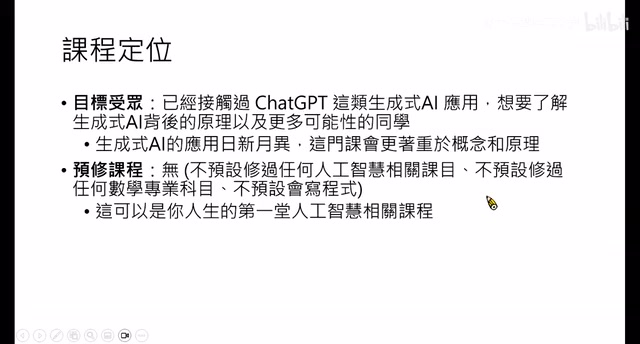
His reasoning is straightforward: the interfaces and capabilities of applications like ChatGPT change rapidly — they can look completely different in a few months or even weeks — so any specific operational trick taught in class will quickly become outdated. A university course should teach things you'll use for years or even a lifetime, namely the underlying concepts and principles. The same logic holds for self-learners — chasing tool tutorials means you're forever catching up; once you understand foundational concepts like Transformer, pre-training, SFT, and RLHF, you can quickly get up to speed with any new tool.
The course explicitly has no prerequisites: no prior AI courses, no math or programming background required. It can serve as your first AI course in life.
Course content: from principles to hands-on training
According to Bilibili creators' consolidated version, the course is divided into three major modules. The fundamentals section covers a quick Python introduction, setting up an AI development environment, prompt engineering, and the core principles of large models — key concepts like Transformer, pre-training, SFT, and RLHF. The advanced section moves into practical techniques like RAG, Agent, and LangChain, as well as LLM fine-tuning and private deployment, covering base model selection, dataset processing, and fine-tuning implementation in real enterprise scenarios. The hands-on section features enterprise-level projects such as medical Q&A systems, intelligent e-commerce customer service, digital humans, and educational smart teaching assistants.
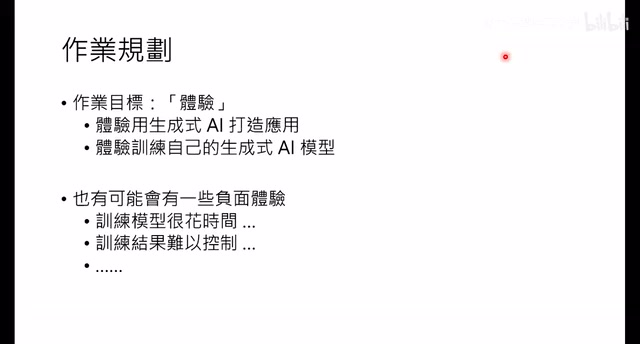
It should be noted that the Bilibili version is a secondary consolidation and expansion of Li Hongyi's original course; Li's own assignments are more focused on experiencing the principles. According to his introduction, the course has 10 assignments, most requiring writing code or even training models, with Colab or Kaggle as the execution environment — no need to own a GPU.

Assignment difficulty is marked with triangles: one triangle is basically a freebie, two triangles require time to get full marks, and three triangles involve training models and take at least several hours. Li Hongyi also deliberately preserves a "negative experience" — training models takes time and results aren't fully reproducible. He compares this experience to a vaccine: it lets you know that training models can be time-consuming and hard to predict, so you'll be mentally prepared for bigger challenges ahead.
Transformer is a neural network architecture proposed by Google in the 2017 paper "Attention Is All You Need." Its core is the self-attention mechanism, which lets the model process relationships between any two positions in a sequence in parallel, rather than recursing step by step like an RNN. This design greatly improves training efficiency and has become the backbone of almost all modern large language models, including GPT and BERT. Understanding Transformer is the starting point for understanding "why large models work."
Pre-training refers to training a model on massive amounts of unlabeled text through self-supervised objectives (such as predicting the next word), enabling it to acquire general language patterns and world knowledge. The model after pre-training is called a base model; it has strong completion capabilities but doesn't yet "obediently" follow instructions.
SFT (Supervised Fine-Tuning) involves continuing to train the base model on a small amount of high-quality "instruction-answer" paired data so it learns to respond in the format and style humans expect. RLHF (Reinforcement Learning from Human Feedback) goes further: first training a reward model to simulate human preferences, then using reinforcement learning (such as PPO) to optimize the language model so its outputs better align with human values. SFT + RLHF is the key step in "aligning" products like ChatGPT, and the course will cover its principles and limitations.
RAG (Retrieval-Augmented Generation) is a technique that lets large models retrieve relevant documents from an external knowledge base before generating answers, then feeds the retrieved results as context into the model. It can inject private or real-time knowledge without retraining the model, and is commonly used in enterprise knowledge Q&A, customer service, and similar scenarios. It's a mainstream solution for mitigating large models' "hallucinations" and outdated knowledge.
Agent refers to a system that uses a large model as its "brain," capable of autonomously planning, invoking tools (search, calculation, APIs), and executing multi-step tasks to achieve goals. Unlike single-turn Q&A, Agents emphasize iterative decision-making and interaction with the environment.
LangChain is an open-source development framework that provides components like chained calls, tool integration, memory management, and Agent orchestration to simplify LLM-based application development. The course's advanced section introduces these to help learners quickly build usable prototype systems after understanding the principles.
A memorable analogy: GPT-2 and Frieren
The most viral segment of the course is Li Hongyi's analogy using "Frieren: Beyond Journey's End." Eighty years ago, the demon king's subordinate Qual invented a killing spell that no one could stop; eighty years later, when the seal weakened and Qual revived, Frieren blocked it by simply having her apprentice cast an ordinary defensive barrier — because humans had spent eighty years thoroughly researching that spell.
Mapping this to AI: the model to be fine-tuned in the assignment has 7 billion parameters, which sounds large, but it can run on free compute, so it's not especially impressive. Yet if you traveled back a few years, GPT-2's largest version had only 1.5 billion parameters, and it was called "the most powerful NLP model in history" at the time. Today's assignment model is several times the size of that "world-destroying" model from back then.
This analogy points to a pragmatic conclusion: generative AI technology changes extremely fast — don't judge today's technology level by the standards of five years ago, and don't assume a model is strong just because it has "many parameters." Parameter count is just one indicator of model capability; many other factors affect it.
Parameter count refers to the total number of learnable weights in a neural network, usually measured in "hundreds of millions" or "billions (B)." More parameters mean greater model capacity, theoretically able to fit more complex patterns, but it doesn't determine capability linearly: data quality, training strategy, architecture optimization, and post-training alignment are equally critical. GPT-2's largest version had 1.5 billion parameters, while today's 7B (7 billion) models can be fine-tuned on free compute — a direct reflection of the combined effect of compute efficiency and algorithmic progress. Li Hongyi's analogy is precisely a reminder: parameter scale is a historical marker, not an absolute label of strength.
Using AI for homework? Teachers use AI to grade too
The course's attitude toward AI tools is quite open. Can students use ChatGPT to write assignments? Li Hongyi's answer is "yes" — in a course on generative AI, of course you should be able to use generative AI for homework. He also notes that assignments that can be graded by LLMs will be graded by LLMs, and thanks the Dabinchi team at NTK for providing the platform and compute support. According to the course introduction, this team will also come to class to share industry experience using generative AI and the journey of developing their own large language model.
This closed loop of "using AI to learn AI, using AI to teach AI" itself illustrates the real position of generative AI in today's education landscape better than any tool tutorial.
How to study this course: three tips for self-learners
First, distinguish between "knowing how to use" and "understanding." If you just want to quickly build a small application for article classification or customer service Q&A, calling existing APIs is enough — no need to spend a semester on principles. But if you want to judge when to develop your own model versus when to use existing solutions, the value of a principles course becomes clear.
Second, treat assignments as experiences, not assessments. Training models takes a long time and results are random — these "negative experiences" are precisely the shortest path to understanding the engineering reality of large models.
Third, don't be misled by the phrase "hand-holding guide." This is a two-credit introductory course with limited class hours, so many technologies can only be touched on briefly. Li Hongyi's own positioning: this course walks you through performing a few magic tricks, but it's not enough to turn you into a magician. It's a starting point, not an endpoint — the papers cited in class (mostly from arXiv) point the way for deeper study.
For complete beginners, the real value of this course isn't teaching you how to use a particular framework, but helping you build a coordinate system for judging technology levels and choosing tools. In an era where model capabilities change every few months, that's more durable than any crash-course technique.
One-line Summary
Breaking down NTU Li Hongyi's "Introduction to Generative AI": course positioning, content, and self-study methods.
Paragraph Summary
This article breaks down NTU Li Hongyi's "Introduction to Generative Artificial Intelligence," pointing out that the course doesn't teach ChatGPT usage but rather the principles and full picture of generative AI. It's divided into three modules — fundamentals, advanced, and hands-on — covering Transformer, pre-training, SFT, RLHF, as well as RAG, Agent, and fine-tuning deployment. Assignments deliberately preserve the negative experiences of training time and non-reproducible results. The article also uses the GPT-2 and Frieren analogy to illustrate rapid technological iteration and offers three self-study tips: distinguish using from understanding, treat assignments as experiences, and don't be misled by "hand-holding guide."
Related articles

Anthropic IPO Explained: Fuel for the AI Boom or the Spark for a Bubble?
Anthropic files for an IPO under ticker ANT. Breaking down the prospectus: 80% of revenue from usage-based pricing, $72B of an $80.7B net loss being non-cash charges, 900% net revenue retention, and how past IPOs like SpaceX performed on day one and over three years — answering the AI bubble question.

Will AI Kill the Research Paper? Mathematicians Offer a New Answer
Mathematicians on the Lex Fridman podcast discuss whether AI will kill research papers—from journal review pressure to Lean formal verification, GitHub open source fatigue to Mathlib's crowdsourcing model, exploring the evolution of academic contributions and the future of mathematical knowledge verification.

Enterprise LLM Development: From RAG to Multi-Agent in Practice
A course breakdown of enterprise LLM application development: from prompt engineering and RAG to multi-agent engineering practice and FDE project delivery, helping developers understand why Agent technology is a key focus for enterprise deployment and learn systematically to avoid detours.