LightMem-Ego: The AI Memory Assistant That Remembers the Details of Your Daily Life

LightMem-Ego is an AI assistant that remembers where you put things, who you met, and what you said — across time.
LightMem-Ego is a long-term memory AI assistant that uses egocentric visual perception to track object locations, meeting schedules, and causal life events. Built on multimodal LLMs and lightweight RAG-style memory retrieval, it aims to shift AI from a one-off Q&A tool to a persistent personal companion — while raising serious questions about privacy and real-world deployment.
When AI Gets Memory: From Conversational Tool to Life Assistant
We've grown accustomed to asking AI questions, having it write code, or summarize documents. But most of these interactions are inherently "one-off" — every conversation feels like a first meeting. The AI doesn't really remember what you did yesterday, where you put something, or who you have a meeting with. LightMem-Ego aims to break through this limitation, with the goal of becoming an AI daily assistant equipped with long-term memory capabilities.
Rather than a question-answering tool, it's better described as a system that builds memory around your own life. It can remember where you casually set down an object, recap yesterday's phone call, and track ongoing work tasks. These capabilities point toward an AI form factor that's closer to real-world use: not an all-knowing encyclopedia, but a personal assistant that truly knows you.
This product direction aligns closely with the "Second Brain" concept in knowledge management. Productivity writer Tiago Forte defines it as an externalized system for storing and organizing personal knowledge — freeing the brain from the burden of memory storage so it can focus on creative thinking. Tools like Notion and Obsidian are software implementations of this philosophy, but they rely on active user input. LightMem-Ego's innovation lies in transforming "active recording" into "passive sensing" — users don't need to deliberately do anything; the system automatically captures key information from the flow of daily life. This aligns closely with the cognitive science concept of Episodic Memory: human episodic memory is naturally indexed by time, place, and context rather than abstract knowledge points.
Remembering the Physical Location of Objects
The most intuitive scenario in the demo is object localization. When a user asks "Where did I put the plastic bottle?", the system accurately responds, "You seem to have placed the plastic bottle near the low windowsill."
This seems simple on the surface, but it requires continuous egocentric visual perception ("Ego" referring to the egocentric perspective) combined with memory storage capabilities. Egocentric vision is an important branch of computer vision — it captures what the user sees through a camera worn on the head or chest, recording "the world as I see it" rather than "me as others see me." Meta's Project Aria and the widely discussed Apple Vision Pro are both hardware explorations in this direction. Academia has built large benchmark datasets for this purpose, such as the Ego4D dataset released by Meta AI Research — over 3,500 hours of first-person video specifically designed to train AI models that understand everyday human activities.
The AI must continuously record environmental states during a user's daily activities and encode "object–location" relationships into retrievable memories. This is precisely what the combined naming of "LightMem" (lightweight memory) and "Ego" (first-person perspective) conveys.
Multi-Turn Memory Retrieval: Not Just Remembering, But Reasoning
The most compelling demonstration of the system's capabilities centers around a "project presentation" scenario. The user receives a call from Ethan scheduling a meeting for 10 a.m. the next morning; later, when asked, the system accurately answers, "The meeting is scheduled for tomorrow at 10 a.m."
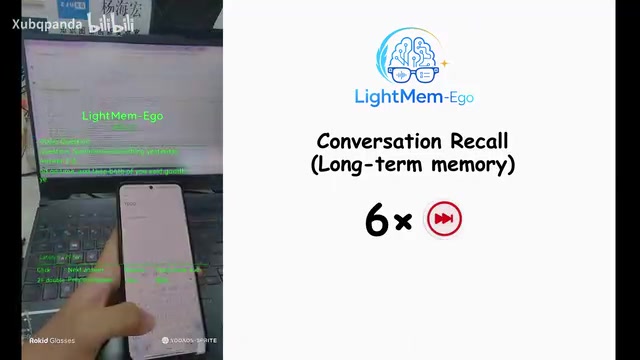
Going further, when the user asks, "Do you know what I'm preparing for right now?", the system not only answers "You're preparing for a project presentation," but also adds, "The retrieved slides show this is a demo for an AI-based legal contract review and revision system." This shows it doesn't just log conversation content — it can combine visual information (PPT content) for comprehensive understanding — and that's precisely the key value of multimodal memory fusion.
This capability relies on Multimodal LLM technology — models like GPT-4V and Gemini that can simultaneously understand images and text. In a memory system context, a single video frame (the user browsing a slide deck) must be converted into structured semantic memory units with timestamps and confidence weights. This complete pipeline of "perceive → understand → encode → retrieve" is orders of magnitude more complex than simple text-based Q&A. Especially in real-time processing scenarios, how to use lightweight models to perform preliminary understanding on edge devices and then upload refined information to cloud storage is an engineering problem that must be solved before deployment.
Causal Connections Across Time
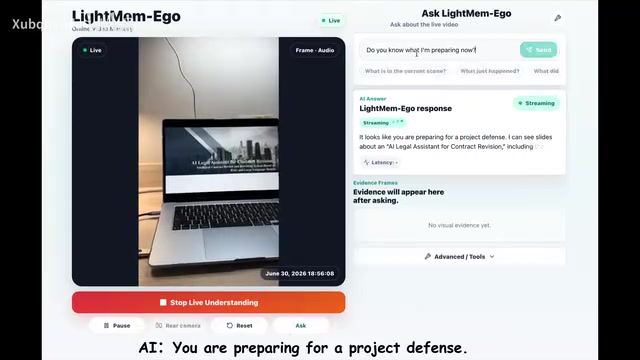
When the user follows up with "Do you remember why I was preparing this PPT?", the system replies, "Yes, yesterday you said this PPT was for today's project presentation." This demonstrates the system's ability to remember timelines and causal relationships — it doesn't simply store isolated facts, but can organically link "what was said yesterday" to "today's behavior."
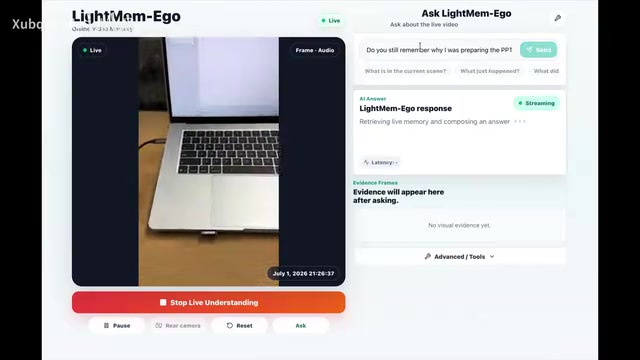
This kind of cross-temporal memory retrieval is one of the most glaring gaps in today's mainstream large language model assistants. Current LLM "memory" is largely constrained by the context window — the maximum text length a model can process in a single session — making it impossible to genuinely retain information across multiple independent conversations. To overcome this bottleneck, the engineering community widely uses the RAG (Retrieval-Augmented Generation) architecture: storing historical information in a vector database, then dynamically retrieving relevant fragments to inject into the prompt when the user asks a question, thereby "simulating" long-term memory. Tools like ChatGPT have introduced memory features, but they primarily store static records of user preferences and struggle to handle dynamic, timestamped life events like "yesterday–today" scenarios. The "Light" in LightMem hints at its pursuit of efficiency — traditional RAG systems see significantly increased retrieval latency and noise as memory size grows, and recent frameworks like MemGPT and A-MEM are specifically dedicated to addressing this problem.
USB Drive Localization: A Complete Closed Loop of Memory Chains
The demo reaches its climax at the end. The user discovers the PPT is blank and asks, "Do you remember where I put my USB drive?" The system delivers a precisely layered answer: "You put it inside a notebook, and then placed the notebook next to the light-gray laptop."
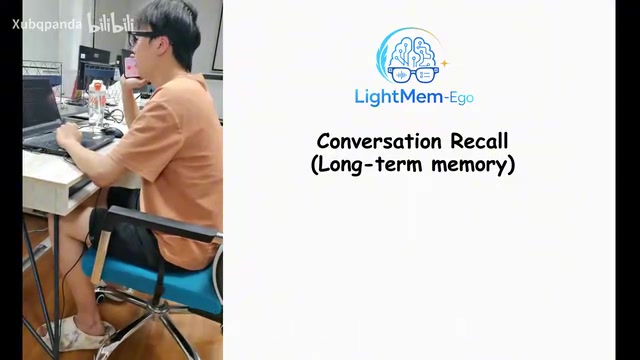
The user immediately finds the drive and thanks the system. What makes this scenario convincing is that it demonstrates a complete memory chain:
- The user had mentioned "already backed up to the USB drive"
- The system recorded the USB drive being placed inside a notebook
- The system recorded the notebook being placed next to the laptop
- When a crisis occurs (blank PPT), the system can trace this chain to help the user recover the critical item
This is precisely the core value of everyday AI memory — at the critical moment when you need it most, accurately restoring details that even you had forgotten.
Technical Architecture and Real-World Challenges
From "Q&A" to "Companion-Style Perception"
LightMem-Ego represents a shift in technical paradigm: AI moving from a passive question-answering tool toward an active, continuously perceiving life companion. To achieve this, the system requires at least three layers of coordinated capabilities:
- Continuous egocentric perception — capturing the user's perspective through wearable devices or smart glasses
- Lightweight, efficient memory storage — the naming "LightMem" hints at a focus on storage and retrieval efficiency, avoiding response latency caused by memory bloat
- Multimodal fusion and reasoning — uniformly encoding visual, audio, and timestamp information while supporting efficient retrieval
The Real Barriers of Privacy and Deployment
Continuously recording a user's first-person visuals and conversations means highly sensitive private data will be stored long-term. This risk is not hypothetical: after Meta launched its Ray-Ban smart glasses in 2023, their covert recording capabilities sparked widespread controversy; an MIT student project called "I-XRAY" further demonstrated the feasibility of identifying strangers in real-time using only glasses-mounted cameras, shocking the industry.
Two main approaches dominate privacy protection in this space: the first is "federated learning + local inference," where sensitive data never leaves the user's device and only highly abstracted semantic features are uploaded to the cloud — Apple has widely adopted this on-device processing strategy in the design of Apple Intelligence; the second is a "selective memory" mechanism, where users can actively mark scenes or time periods they don't want recorded. How to handle memory processing locally, and how to give users control over deleting and accessing their memories, will directly determine whether this type of product can gain mainstream acceptance.
Furthermore, demo environments tend to be idealized. In real life, lighting is complex, objects are numerous, and scenes change frequently — both memory accuracy and retrieval speed will face serious challenges. The hedged language in the demo (such as the item being "seemingly" placed somewhere) also hints at the system's cautious attitude toward confidence levels.
Conclusion
LightMem-Ego showcases a direction full of promise: AI no longer just answers questions, but truly becomes a personal assistant that remembers your life. From recovering a plastic bottle to locating a critical USB drive in a pinch, these small, everyday scenarios are often more moving than grand capability demonstrations. When memory becomes the fundamental infrastructure of AI, human-computer interaction may be on the verge of a deep transformation — from "tool" to "companion" — and the technical foundation of that transformation is being laid right now through egocentric visual perception, lightweight memory retrieval, and multimodal fusion reasoning.
Related articles

Felix Rieseberg Personal Homepage
Felix Rieseberg's personal homepage sparks attention on Hacker News. This article covers the Slack engineer's technical background, the rise and fall of nativefier, and the value of a developer homepage as a tech calling card.

@ai-sdk/vue 3.0.306 Patch Release Syncs with [email protected] Update
@ai-sdk/vue 3.0.306 released, synced with [email protected]. A routine patch release for the Vercel AI SDK ecosystem with no public API changes; the Vue adapter layer stays version-aligned with the core package.

Gemini 4 Argon API Launches: The Era of Million-Token Output Begins
Google launches Gemini 4 Argon with sparse MoE architecture, up to 1M output tokens, and a 68.90% Vals Index score, available across API, AI Studio, and the Gemini app.