Lightspeed Venture Partners Targets $250M for New India Fund with Early-Stage AI Focus

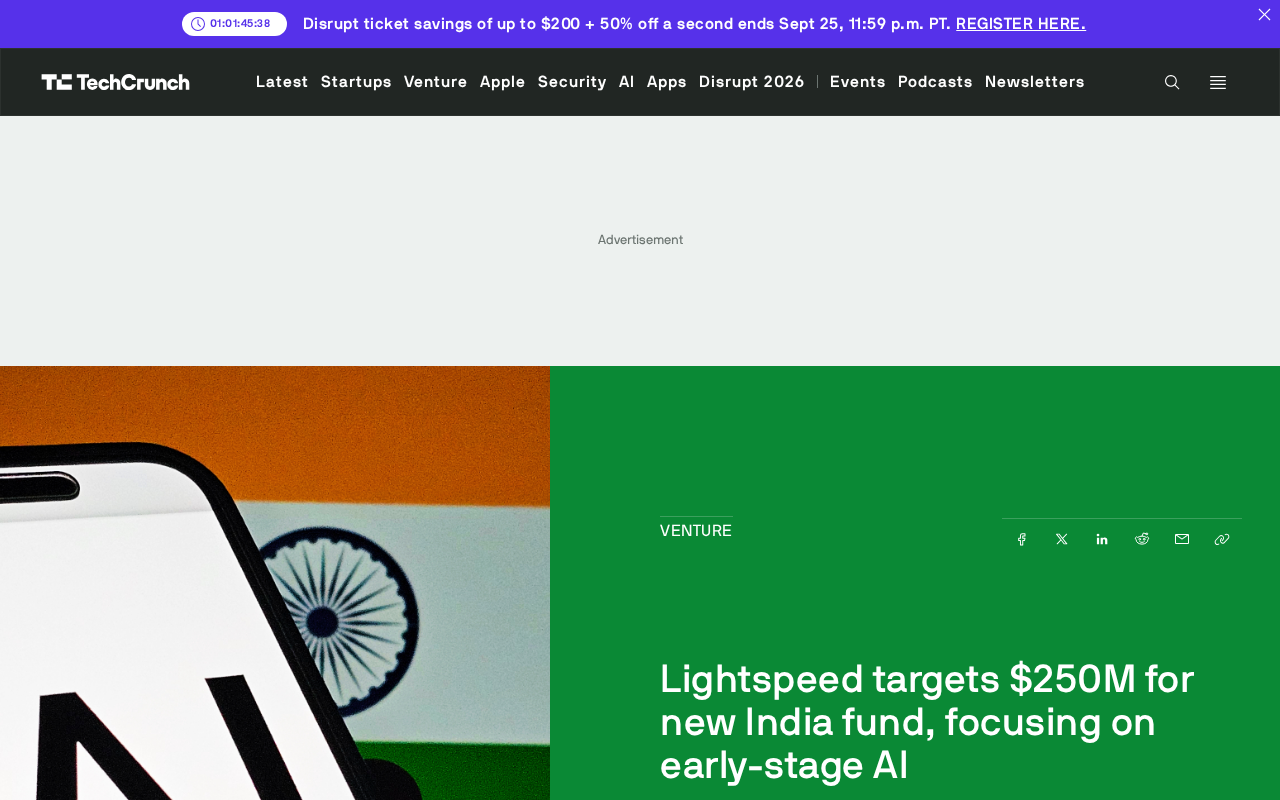
Lightspeed is raising $250M for a new India fund, targeting early-stage AI startups with a synchronized global cadence.
Lightspeed Venture Partners is raising approximately $250 million for a new India-focused fund targeting early-stage AI startups. Two key changes stand out: it marks the first time Lightspeed has aligned its India fundraising cycle with its global fund cadence, enabling stronger cross-team coordination on deals and capital allocation; and the firm is shifting to shorter investment periods to keep pace with rapid AI iteration and narrowing windows for high-growth companies. India's deep engineering talent pool and surging digital demand continue to attract top global capital. Specific deployment targets and initial portfolio companies have not yet been disclosed, but the strategic intent is clear: bring Lightspeed's global AI investment expertise to bear on India's earliest-stage market.
Lightspeed Doubles Down on Early-Stage AI in India
Lightspeed Venture Partners is raising approximately $250 million for a new India-focused fund, with a sharp focus on early-stage AI startups. The move reflects continued confidence from top-tier global investors in India's tech ecosystem — and in AI as the next frontier for cross-border capital.
For India, a market where startup activity has been climbing steadily, sustained commitment from leading dollar funds signals more abundant early-stage capital and confirms that AI is becoming the new battleground for international investors.
Founded in 2000 and headquartered in Menlo Park, California, Lightspeed Venture Partners is one of the world's most influential multi-stage venture firms, managing over $25 billion in assets. Its portfolio spans the US, India, Israel, China, and Southeast Asia, with early bets on companies like Snapchat, Epic Games, and Affirm. Lightspeed has been active in India for over a decade, with previous India funds focused on consumer internet, SaaS, and fintech — backing names like OYO, Udaan, and Sharechat. This new fund marks a systematic shift in its India thesis toward AI.
Aligning India's Fundraising Cadence with Global Funds — A First
One notable change this time around: Lightspeed is aligning its India fundraising cycle with its global fund cadence for the first time. Historically, regional funds have operated on relatively independent timelines, so this shift signals a move toward a more unified and coordinated capital deployment framework across the firm.
This alignment carries a few implications. On one hand, it enables stronger collaboration between global and regional teams on deal sourcing, portfolio support, and exit strategy. On the other, synchronized cycles give the firm more flexibility to allocate capital across markets and capture emerging opportunities wherever they appear. For portfolio companies, this could translate into easier access to Lightspeed's global network of resources and relationships.
The Logic Behind Shorter Investment Periods
Beyond the fundraising cadence, Lightspeed is also moving toward shorter investment periods — a broader trend across the venture industry, driven by several factors.
In an environment where AI is advancing rapidly, the growth trajectories of early-stage companies have compressed significantly. The time it takes for a promising startup to go from seed stage to scale has shortened considerably. A tighter deployment window allows funds to move faster, stay aligned with the pace of technological change, and avoid missing high-velocity growth windows.
At the same time, shorter investment periods demand sharper judgment and greater execution efficiency. Investors must identify truly compelling early-stage AI teams and move quickly. This is both a test of Lightspeed's India team's local market insight and a real-world application of its global AI investment playbook.
A fund's "investment period" typically refers to the window between final close and the deployment of most initial capital — traditionally three to five years, within an overall fund life of around ten years. Compressing this period has become increasingly common during the AI boom: firms like Sequoia and a16z have launched dedicated AI vehicles designed to move faster and more decisively. The inherent risk, however, lies in the tradeoff between speed and diligence — rapid deployment can lead to shortcuts in due diligence, a particularly serious concern given the elevated valuations commonly seen in early-stage AI deals today.
What This Signals for India's AI Startup Ecosystem
Lightspeed's renewed focus on early-stage AI in India reflects a broader reassessment of the market by global capital. India offers a massive engineering talent base, rapidly growing digital demand, and an increasingly dynamic startup culture — fertile conditions for homegrown AI companies to emerge and scale.
At $250 million, this fund is a substantial size for an early-stage vehicle, capable of backing a meaningful portfolio of seed-to-Series A AI companies. For Indian founders, this represents both a capital opportunity and an international endorsement — backing from a Silicon Valley firm like Lightspeed can accelerate access to global customers, partnerships, and follow-on investors.
It's worth noting that publicly available details remain limited. The fund's final close date, specific thematic focus areas within AI, and initial portfolio companies have not yet been disclosed. How Lightspeed ultimately deploys this capital will be the clearest indicator of its strategic intent in India's AI market.
Related articles

Workbuddy for Absolute Beginners: How a Desktop AI Agent Fits Into Real Workflows
A beginner's guide to the Workbuddy desktop AI agent: installation, claiming credits, file management, and building automated workflows—compared with CodeX for fit and cost, helping professionals shift from AI question-askers to AI managers.

OpenAI's New Agent Stack: Computer Use, Decisions API, and Ultra-Fast Workflows
OpenAI Dev Day unveiled a new agent stack: Computer Use outperforms humans, Decisions API delivers ultra-low-latency classification via Luna, Agents API opens the same Computer Use capabilities, and GPT-6.1 Sol costs only one-seventh of Astra. Core updates, benchmark data, and developer insights.

Liang Wenfeng Open-Sources DeepInfo Inference Framework, Takes On U.S. Ban
DeepSeek open-sources its DeepInfo inference framework after its models, featuring GPU/CPU cross-pipelining, small-model prediction with large-model verification, and full Huawei Ascend and NVIDIA chip support—facing the U.S. federal ban head-on. This article analyzes its significance for AI deployment and open-source strategy.