LightX2V 4-Step Accelerated LoRA Real-World Testing: A Complete Analysis of Efficiency Gains vs. Quality Trade-offs

Community tests LightX2V's 4-step LoRA: efficiency gains are real, but quality depends on configuration.
LightX2V's new 4-step accelerated LoRA promises 80% faster video generation, but community testing reveals polarized results. Success hinges on specific sampler, workflow, and model combinations rather than step count alone. A practical compromise of reduced LoRA weight (0.6–0.8) with 6–8 steps emerges as the recommended approach, balancing efficiency and quality while addressing audio convergence issues.
Introduction: The Efficiency Temptation and Quality Controversy of Accelerated LoRA
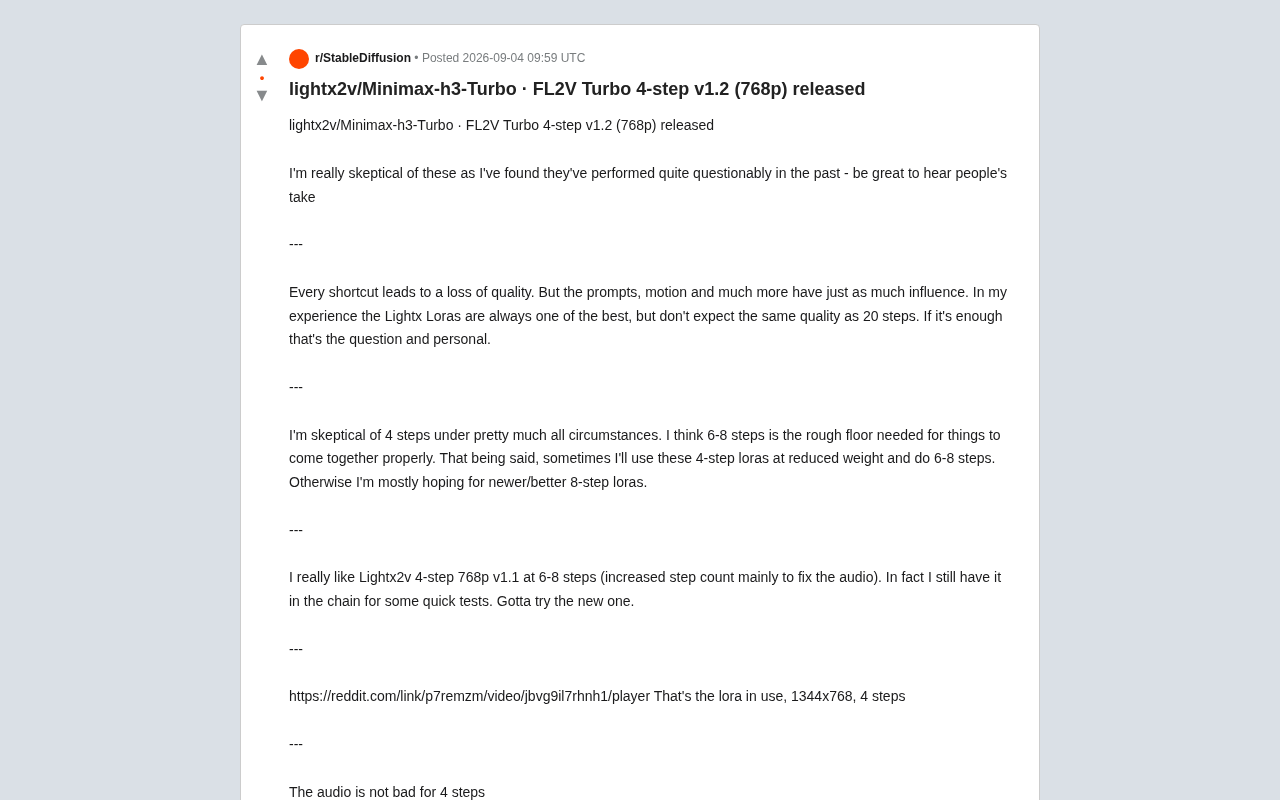
Recently, the LightX2V team released a new version on Hugging Face — Minimax-h3-Turbo, specifically FL2V Turbo 4-step v1.2 (768p). This accelerated LoRA designed for video generation models claims to complete generation in just 4 inference steps, dramatically reducing generation time compared to the traditional 20-step approach.
LoRA (Low-Rank Adaptation) was originally proposed by Microsoft Research in 2021 as a parameter-efficient fine-tuning technique. Its core idea is to freeze the pretrained model's original weights and inject low-rank decomposition matrices into specific layers for training, drastically reducing the number of trainable parameters. In the video generation domain, accelerated LoRAs work through distillation techniques, teaching the model to approximate multi-step inference output quality in fewer denoising steps. Traditional diffusion models typically require 20–50 iterative denoising steps to produce high-quality results, while accelerated LoRAs attempt to compress this process down to 4–8 steps. The core challenge lies in achieving sufficient noise removal and detail reconstruction within such a limited number of steps.
However, acceleration always comes with a fundamental question: How much quality is actually lost? Community users on Reddit have been blunt: "I'm always skeptical of these, they have been pretty questionable in the past." This reflects the genuine sentiment of many practitioners.
This article combines multi-source community testing feedback to objectively analyze the real-world performance of this 4-step accelerated LoRA and how to use such tools effectively in production environments.
The Acceleration Principle: Fewer Inference Steps Inevitably Affect Generation Quality
Regarding the core controversy of accelerated LoRAs, an experienced user offered a balanced assessment:
"Every shortcut causes quality loss. But prompts, motion, etc. have a huge impact as well. In my experience LightX's LoRAs have been among the best, but don't expect 20-step quality. Whether it's good enough depends on your needs."
This statement highlights two key insights:
Step Count Isn't the Only Variable Affecting Quality
Generation quality isn't determined solely by the number of inference steps. Prompt precision, motion amplitude settings, and base model quality all significantly impact the final output. A well-designed 4-step pipeline, combined with restrained motion amplitude, can absolutely produce clean, usable results.
To understand why, you need to know how diffusion model denoising works. Diffusion model generation is essentially a step-by-step denoising Markov chain — the model starts from pure Gaussian noise and at each step predicts and removes a portion of noise, gradually recovering a clear image or video frame. More steps mean smaller, more refined denoising increments per step, typically resulting in better detail and consistency. When steps drop to just 4, the denoising stride per step increases dramatically — the model must make bolder predictions in each single step, which can easily lead to high-frequency detail loss and incoherent motion trajectories. This is precisely why techniques like Consistency Distillation have emerged — they specifically train models to maintain output quality during large-stride denoising.
In practice, however, low-motion scenarios (such as close-up portraits or subtle expressions against static backgrounds) demand far less per-step denoising precision than high-dynamic scenes. This is why "restrained motion amplitude" can yield decent results at low step counts.
Does 4 Steps Hit the Quality Floor?
On the question of step count lower bounds, the community is divided. One user stated clearly:
"I'm skeptical of 4 steps in almost all cases. I think 6 to 8 steps is roughly the floor for things to come together properly."
This caution isn't unfounded. When step counts are too low, the denoising process may fail to converge sufficiently, resulting in motion distortion or detail loss. From a mathematical perspective, 4 steps means the model needs to complete roughly 25% of the total denoising per step — any single-step prediction error gets amplified by subsequent steps, with insufficient room for correction. At 6–8 steps, the per-step burden drops to 12–17%, giving the model more space for progressive refinement.
Practical Tips: The Compromise Strategy of Reducing Weight + Increasing Steps
Here's an important detail: the community has already developed a practical set of compromise strategies. Multiple users independently mentioned similar approaches:
Option 1: Lower LoRA Weight with 6–8 Step Inference
"Sometimes I use these 4-step LoRAs at a reduced weight and then run 6 to 8 steps."
This approach retains the efficiency gains from the accelerated LoRA while compensating for quality shortfalls by adding steps — a classic engineering balance.
The technical principle behind this: reducing the LoRA weight (typically from the default 1.0 down to 0.6–0.8) is essentially performing linear interpolation between the original model behavior and the LoRA-modified behavior. At weight 1.0, the LoRA's acceleration effect is strongest, but the deviation from the original model's generation path is also greatest. With reduced weight, the model partially reverts to its original multi-step denoising behavior — while the single-step acceleration effect weakens, combined with moderately increased steps (e.g., 6–8), you can find a better Pareto frontier between efficiency and quality. This strategy is highly flexible in practice — users can dynamically adjust the weight-step combination based on specific scenarios. For example, use weight 0.9 with 5 steps for quick tests where visual fidelity isn't critical, and weight 0.7 with 8 steps for important final outputs.
Option 2: Increase Steps for Specific Issues
One user shared their experience with the previous v1.1 version:
"I quite liked LightX2V's 4-step 768p v1.1, running 6 to 8 steps — mostly to fix audio issues. In fact, I still keep it in my workflow for quick testing."
This reveals an important detail: In video generation, audio convergence often requires more steps than visual output. When the visuals are already acceptable at 4 steps, audio may still need additional iterations to stabilize.
This phenomenon has technical roots. Minimax series models support synchronized audio-video generation, meaning the model processes visual frames and audio waveforms simultaneously within the same diffusion process. Audio signals have far higher temporal resolution than video frame rates — audio is typically sampled at 16kHz–48kHz, while video runs at only 24–30fps — so audio contains much denser temporal information. During the denoising process, audio's high-frequency details and temporal consistency are considerably harder to converge in fewer steps than visual content. More critically, pops, breaks, or unnatural transitions in audio are far more noticeable to human ears than visual artifacts — the human auditory system is extremely sensitive to temporal discontinuities. This explains why even when visuals look acceptable at 4 steps, users still need to add inference steps specifically for audio quality.
Community Testing: Polarized Real-World Feedback
After the new version's release, community test results showed a clear polarization — this is the most noteworthy part of this article.
Positive Case: Strong Performance Under Specific Configurations
One user generating at 1344×768 resolution with 4 steps reported quite positively:
"Works perfectly for me, I use the pixaroma workflow and the original pruned model with the er sde sampler at 4 steps."
Another user commented on the audio performance: "Audio is decent for 4 steps." However, some observers noted that the clean-looking output might be related to "limited motion" — low-motion scenes are inherently more stable at low step counts.
Notably, the user specifically mentioned the "er sde sampler." In diffusion model inference, sampler choice has a crucial impact on final quality. Common samplers include Euler, DPM++, DDIM, SDE variants, and others — they are essentially different numerical solving strategies for stochastic differential equations (SDEs) or ordinary differential equations (ODEs). SDE-type samplers introduce additional random noise at each step, increasing generation diversity but also instability. ODE-type samplers are more deterministic, producing more predictable outputs. In low-step scenarios, sampler selection becomes especially critical — some samplers see numerical errors explode rapidly at few steps, causing generated results to collapse, while others are more robust at low step counts. This is the fundamental reason why the same LoRA can perform drastically differently across different samplers.
Negative Case: Configuration Mismatch Leading to Failure
In stark contrast, one user experienced complete failure:
"This version completely doesn't work for me, the motion is total gibberish, and the sound is even worse. This is so strange, the only turbo LoRA that works for me is
minimax_h3_turbo_v4_step600_ema.safetensors. How can a month-old LoRA be better than a brand new one?"
This feedback reveals a common but easily overlooked issue: newer versions aren't necessarily compatible with all workflows. The same LoRA can perform drastically differently across different sampler, workflow, and base model combinations. The successful case specifically emphasized the "pixaroma workflow + original pruned model + er sde sampler" combination, hinting at the importance of configuration matching.
From a technical perspective: accelerated LoRAs are optimized during training for specific sampler scheduling strategies and model weights. When the actual sampler step allocation, noise scheduling, or model quantization method differs from training conditions, the "shortcut paths" the LoRA learned may completely fail — or even produce worse results than not using the LoRA at all. This is why "works for me" and "total gibberish" feedback can coexist in the community — the difference may simply come down to configuration combinations.
In-Depth Analysis and Usage Recommendations
Synthesizing feedback from multiple community sources, we can draw several reasonably objective conclusions:
First, 4-step acceleration is a clear trade-off between efficiency and quality. It's suitable for quick testing, batch previewing, and other scenarios where quality demands aren't stringent — but it should be carefully evaluated for final deliverables. From a time-cost perspective, 4 steps theoretically saves about 80% of inference time compared to 20 steps. When GPU resources are limited or you need to iterate through many creative directions, this efficiency advantage is very real.
Second, configuration matching matters more than version recency. "Newer version must be better" is a misconception. The combination of sampler, workflow, and base model often determines success or failure more than the LoRA iteration itself. When encountering "gibberish" results, check your configuration combination first rather than dismissing the LoRA entirely. When switching LoRA versions, start by testing with the exact configuration mentioned in successful cases as a baseline, confirm basic functionality, and then gradually swap in your preferred settings.
Third, compromise strategies are worth trying first. Rather than agonizing over whether pure 4-step can meet the bar, adopt the proven strategy of "reduced weight + 6–8 steps" to achieve more stable quality within an acceptable time budget. At 6–8 steps, you still save 60–70% of inference time compared to 20 steps, while the quality improvement over pure 4-step is often significant — making it an extremely cost-effective sweet spot.
Fourth, audio is the weak link in low-step generation. If your application involves audio-video synchronization, allocate more steps for audio convergence. In workflow design, you might also consider decoupling visual and audio generation — quickly iterate on the visual approach with low step counts, and once satisfied, generate the final version with audio at higher step counts.
Conclusion
LightX2V's 4-step accelerated LoRA reflects the video generation field's ongoing pursuit of inference efficiency. It's not a silver bullet, but under the right configuration, it can indeed deliver "good enough" results. For creators, the key isn't blindly chasing the latest release — it's understanding the cost behind every shortcut and finding the balance point that best suits your needs. As the community puts it — "Whether it's good enough ultimately depends on your needs."
Related articles
OpenAI Declares the AGI Era Has Arrived: Conceptual Controversies and Technical Realities
OpenAI launches GPT-6 Astra claiming the AGI era has arrived, sparking controversy. Deep analysis of AGI definition ambiguity, technical progress realities, industry standards battle, and practical impacts on users and developers.
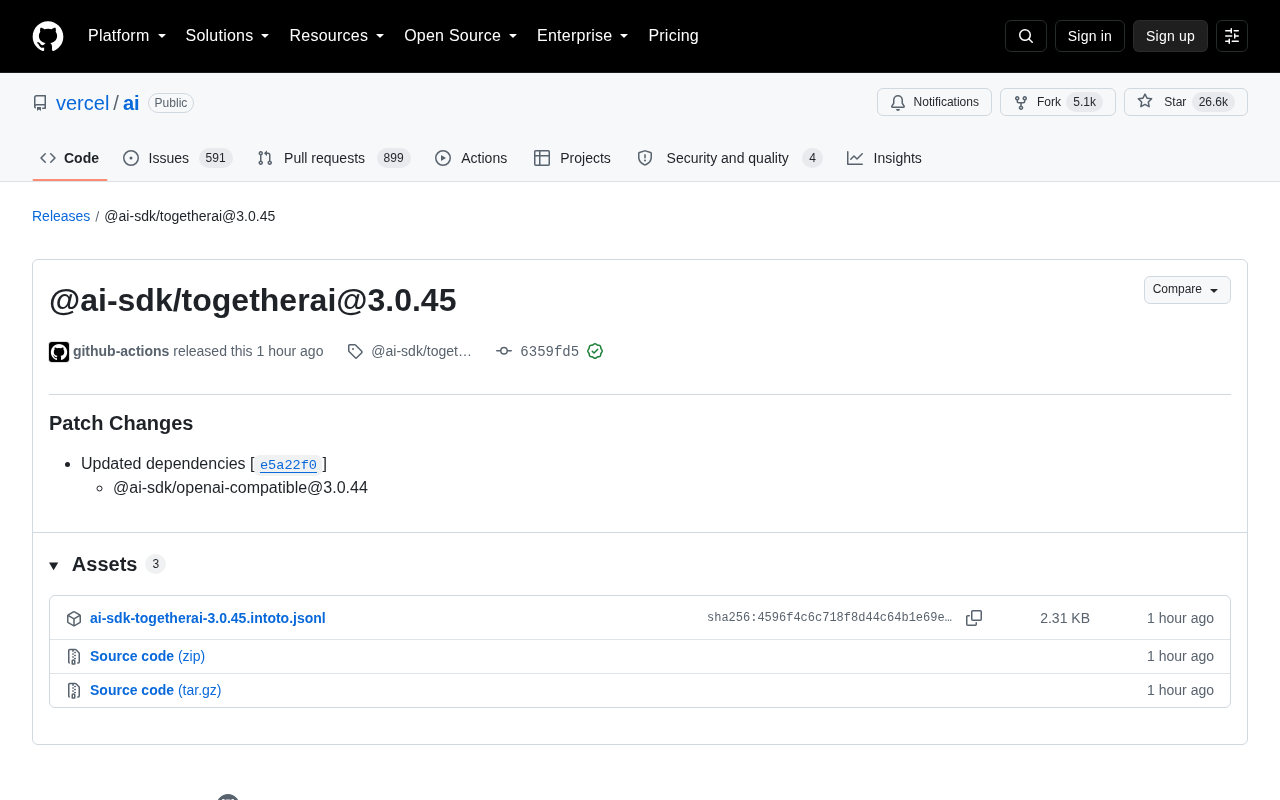
Vercel AI SDK TogetherAI Adapter 3.0.45 Update Analysis
Analysis of @ai-sdk/togetherai 3.0.45 patch update covering dependency sync, OpenAI compatibility layer architecture, and semantic versioning strategy in Vercel AI SDK.
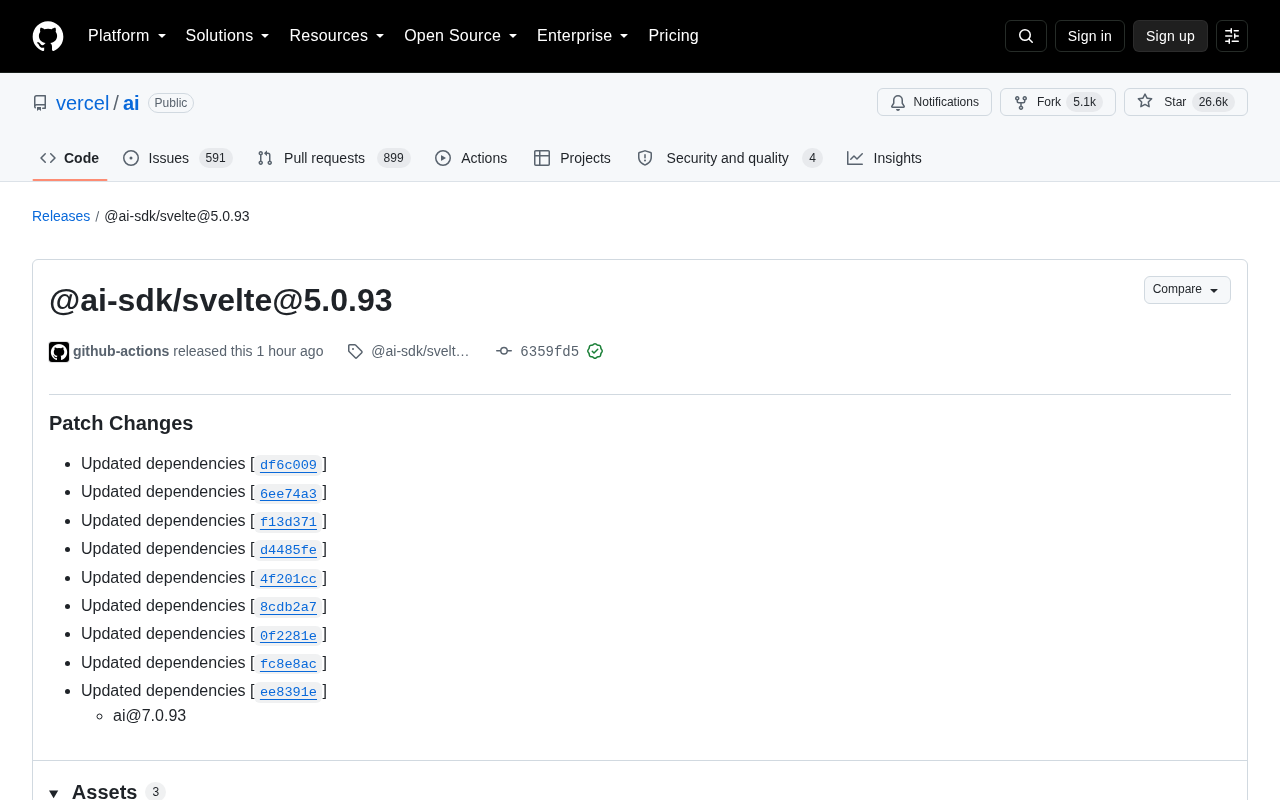
Deep Dive into Vercel AI SDK Svelte 5.0.93 Release Update
In-depth analysis of Vercel AI SDK Svelte 5.0.93 patch update, covering multi-framework adaptation, dependency sync, and automated release pipelines for Svelte AI app development.