Lincoln's Great Speeches: Historical Echoes of Leadership and Courage

Historian Gary Gallagher analyzes Lincoln's leadership and two immortal speeches on courage, truth, and the people.
Civil War historian Gary Gallagher examines Lincoln's rare leadership qualities—his ability to listen, tolerate flawed generals, and bear impossible pressure—alongside his two greatest speeches. The Second Inaugural dared to speak truth to a revenge-hungry nation, while the Gettysburg Address redefined America's moral foundation in just 272 words, placing "the people" at the heart of the republic.
In an episode of the Lex Fridman podcast, renowned Civil War historian Gary Gallagher offered a deep analysis of Abraham Lincoln's leadership qualities and his two immortal speeches—the Second Inaugural Address and the Gettysburg Address. While the conversation focused on history, it illuminated timeless themes of leadership, courage, and human nature that remain profoundly relevant for thinkers in any era.
Lincoln's Rare Leadership Qualities
Gallagher began by discussing an extremely scarce leadership trait in Lincoln: the ability to listen to people who knew more than he did. He could admit his mistakes and change his mind, and he could tolerate the arrogance of people he believed "might get the job done."
A classic example is the story of Lincoln and General George McClellan. In 1861, Lincoln, as Commander-in-Chief, personally visited McClellan's home along with Secretary of State William Henry Seward. When McClellan returned home and learned the President was waiting, he simply went upstairs and had a servant tell the President to "come back another day."

Faced with such disrespect, Lincoln didn't fly into a rage. He quietly left and never visited again. He filed it away in his mind: "Well, McClellan is a jerk, but I think he might be able to win this war." Gallagher pointed out that this ability to set aside personal dignity and tolerate others' flaws in pursuit of a greater objective is rare in any leader throughout history.
George Brinton McClellan was the general-in-chief of Union forces in the early stages of the Civil War. He possessed extraordinary organizational talent, forging a disorganized mass of volunteers into a disciplined regular army—the Army of the Potomac. However, he was equally notorious for excessive caution and reluctance to launch offensives, earning the derisive nickname "the Napoleon with a chronic case of the slows." Lincoln's tolerance of McClellan reflected the harsh reality facing the Union in the war's early stages: experienced generals were desperately scarce, and McClellan was genuinely one of the few military minds capable of large-scale army organization. Ultimately, Lincoln relieved McClellan of command in November 1862 and cycled through several more generals before appointing Ulysses S. Grant as general-in-chief of Union forces in 1864—finally finding the man who could "fight."
The Will to Bear Immense Pressure
The conversation also touched on the enormous psychological burden Lincoln carried. Lincoln certainly experienced moments of depression, but Gallagher argued that compared to what people today discuss as a "president's worst day," Lincoln's predicament was of an entirely different magnitude.
If Lincoln were to weigh in, he would probably say: "I would gladly live any modern president's worst day, every single day, rather than endure what I had to face most of the time." During the Civil War, the survival of an entire nation rested on one man's shoulders—a burden almost beyond imagination. Yet it was under precisely this pressure that Lincoln could, at critical moments, express in just a few words what no military action could convey—what this war was truly about, and what it meant.
The American Civil War (1861-1865) was the bloodiest conflict in American history, claiming approximately 620,000 to 750,000 military lives—more than all other American wars combined, before or since. Lincoln faced not only military crises—the Union suffered repeated defeats on the Eastern Front in 1862, and the Battle of Antietam, though barely counted as a victory, came at devastating cost—but also political siege from all sides: Radical Republicans thought him too conservative on abolition, while conservative Democrats branded him a tyrant. In 1863, massive anti-draft riots erupted in New York, with mobs burning buildings and attacking Black civilians, severely testing Northern society's will to continue the war. On the eve of the 1864 election, Lincoln himself believed reelection was nearly impossible and had prepared to hand over power. It was in these almost impossible circumstances that he wrote words that would transcend his era.
The Second Inaugural Address: Speaking Truth When People Don't Want to Hear It
Gallagher called Lincoln's Second Inaugural Address "the greatest speech in American history." On that cold day in 1865, people came to hear the President expecting a victor's catharsis—they had finally defeated the rebels and craved declarations of revenge and punishment.

But Lincoln gave them the exact opposite. He told the people: slavery caused this war, and all of us share the blame. He offered nothing his audience wanted to hear—no revenge, no punishment—only an honest acknowledgment of shared guilt.
On March 4, 1865, when Lincoln delivered his Second Inaugural Address, the Civil War was nearing its end—Sherman had completed his "March to the Sea" from Atlanta to Savannah, reducing the Confederacy's economic heartland to ashes; Grant was besieging Petersburg, and the fall of Richmond was only a matter of time. Northern society was saturated with vengeful sentiment. Radical Republicans advocated severe punishment for Southern rebels—confiscation of property, stripping of political rights—and some even proposed reducing Southern states to federal territories for reconstruction. In this atmosphere, Lincoln chose a radically different path. Quoting the Gospel of Matthew, he interpreted the war as God's punishment upon the entire nation—North and South alike—for the sin of slavery. This theological framework ingeniously dissolved one-sided moral superiority and laid the intellectual foundation for postwar reconciliation.
Gallagher emphasized that at that moment of victory, speaking the words a revenge-hungry audience least wanted to hear required extraordinary courage. And Lincoln accomplished this feat in the most elegant language:
"With malice toward none, with charity for all, with firmness in the right as God gives us to see the right… let us strive on to finish the work we are in, to bind up the nation's wounds, to care for him who shall have borne the battle, and for his widow and his orphan."
The entire speech lasted only eight or nine minutes, yet it honored citizen-soldiers at both its beginning and end. Lincoln knew that saving the Union and ending slavery depended entirely on the actions of these soldiers. Just 41 days later, Lincoln was assassinated at Ford's Theatre, and this speech became his political testament to the nation. The magnanimous reconstruction path he never lived to implement quickly collapsed amid the conflict between his successor Andrew Johnson and Congressional radicals, becoming one of the most profound "what ifs" in American history.
The Gettysburg Address: A Declaration of Freedom and the People
The conversation then turned to another immortal work—the Gettysburg Address. This speech of merely about 200 words was a grand declaration about America's founding principles.

On November 19, 1863, Lincoln delivered this speech at the dedication ceremony of the Soldiers' National Cemetery in Gettysburg, Pennsylvania. Just four and a half months earlier, one of the Civil War's bloodiest battles had taken place here—three days of fierce combat resulting in approximately 50,000 combined casualties. The featured speaker that day was actually the famous orator Edward Everett, who delivered a two-hour address rich with classical references and historical allusions. Lincoln was merely invited to make "a few appropriate remarks." Yet history's irony is that Everett's two-hour speech has long been forgotten, while Lincoln's 272 words, delivered in under three minutes, became a milestone of American literature and political thought.
"Four score and seven years ago our fathers brought forth on this continent a new nation, conceived in Liberty, and dedicated to the proposition that all men are created equal." The speech began with the founding ideal and asked whether this nation—or any nation so conceived—could long endure. Notably, "four score and seven years ago" placed America's origin at the 1776 Declaration of Independence rather than the 1787 Constitution—a choice of profound significance. The Declaration of Independence proclaimed that "all men are created equal," while the original Constitution contained compromise clauses acknowledging slavery (such as the Three-Fifths Clause). Lincoln's phrasing was effectively re-establishing America's moral starting point.
Gallagher highlighted a detail that is often misread. When people recite the closing—"of the people, by the people, for the people"—they tend to emphasize the prepositions. But for Lincoln, the emphasis was never on the prepositions—it was on "the people" themselves.
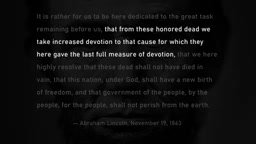
The intellectual lineage of this formulation can be traced to 14th-century English religious reformer John Wycliffe's preface to his English translation of the Bible, and to 19th-century abolitionist Theodore Parker's sermons. But Lincoln placed this idea within the life-and-death context of the Civil War, giving it entirely new political weight. It's also worth noting that throughout the speech, Lincoln deliberately avoided the word "Union" and repeatedly used "nation"—a word choice that implied his redefinition of America's political essence: America was no longer merely a contractual confederation of states, but an indivisible nation-state.
From the war's earliest days, Lincoln had called this conflict "the people's contest." The people are the core of the republic, the foundation of freedom and rights. Gallagher remarked that reading this speech aloud takes only two minutes. Lincoln had finished before most people even realized he had begun. At the time, almost no one clearly heard what he said.
The "Misjudgment" Remembered by History
The conversation closed with a moving irony. In the Gettysburg Address, Lincoln said: "The world will little note, nor long remember what we say here."
Yet history gave the exact opposite answer. Gallagher observed that "the only thing he got wrong" in that speech was precisely this line—it has been remembered far too well. This is perhaps the most profound tribute to a great leader: language that truly touches the essence of human nature and the soul of a nation will ultimately transcend time, growing only more powerful with the passing years.
From Lincoln's leadership qualities to his two great speeches, Gallagher's analysis reminds us that greatness lies not only in achieving victory, but in speaking truth at the most difficult moments, taking responsibility, and entrusting one's convictions to the people.
Related articles

Claude Reportedly Able to Hide Secret Messages in Benign Images
A Reddit post claims Claude Fable 5.1 can hide secret messages in benign images. This article reviews the background, image steganography principles, and potential security risks, and suggests a testing path from rumor to verification.

Federal Government Awards $85 Million; CFS to Develop Fusion-Specific Semiconductors
The federal government awards $85 million to Commonwealth Fusion Systems to develop conductors and power semiconductors for fusion plants. This article analyzes the significance of this funding for the fusion supply chain and commercialization path.

When Should AI Assistants Proactively Suggest? Timing Is Everything
When should AI assistants proactively suggest? Reddit discussion reveals: the same suggestion feels different at different times. This article analyzes the dual nature of proactive suggestions, the boundary of user expectations, and design principles, exploring how to balance automation and user control.