Ling-3.1-flash Open-Sourced: 1673 on GDPval-AA, a New Choice for Office Agents

Ling-3.1-flash opens weights under MIT, benchmarking office Agents with three scenario evaluations.
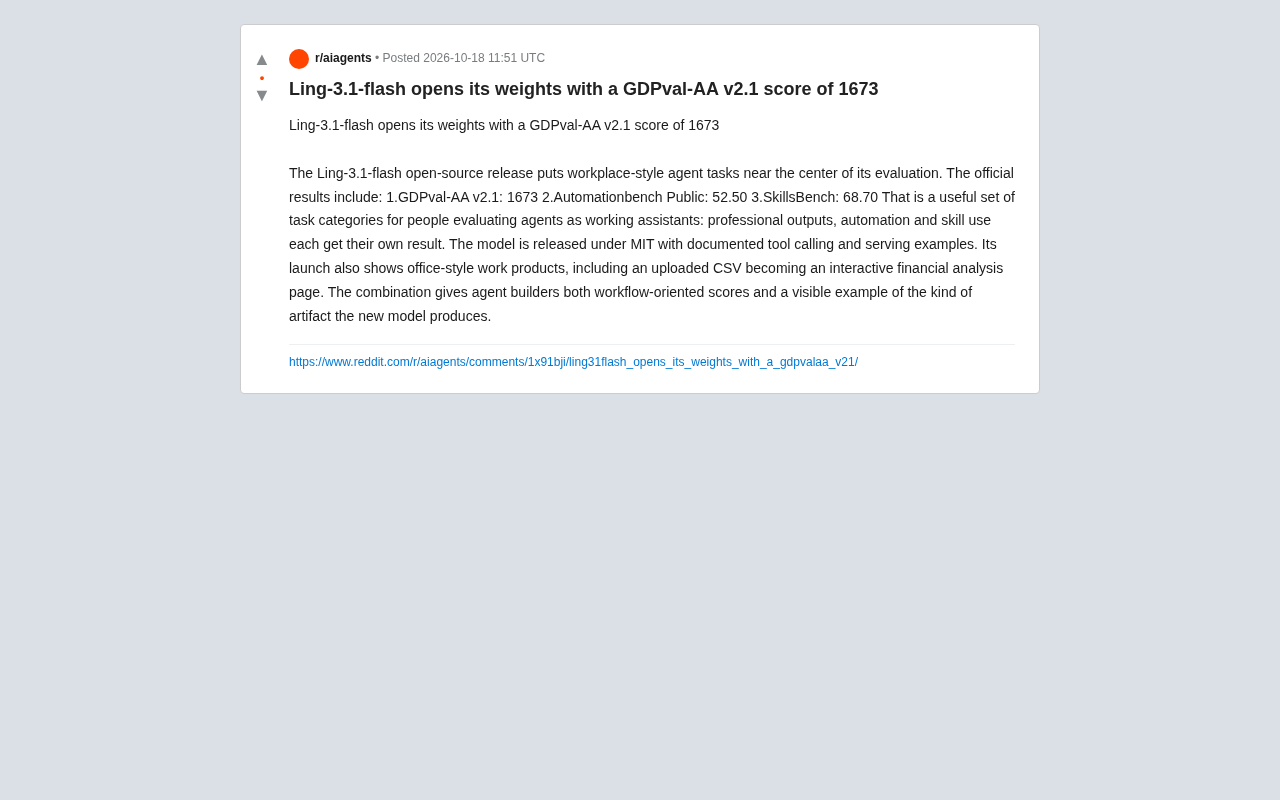
Ling-3.1-flash releases open weights under the MIT license, with scores of 1673 on GDPval-AA v2.1, 52.50 on Automationbench Public, and 68.70 on SkillsBench, covering professional output quality, automated workflow execution, and tool skill invocation. It also demonstrates an artifact-level case: generating an interactive financial analysis page from a CSV. The article notes that Agent evaluation is shifting toward scenario-specific segmentation, but without horizontal comparisons, the standing of 1673 is unclear—teams should validate against their own toolchains and task types.
Competition in the open-source model office automation race is accelerating. Ling-3.1-flash releases its weights under the MIT license and posts concrete scores across several evaluations aimed at "work scenarios," including a score of 1673 on GDPval-AA v2.1, directly targeting professional-grade Agent tasks.
Three Evaluation Scores, Mapped to Three Types of Work Scenarios
The three sets of results officially released are not an arbitrary pile-up—each points to a different capability dimension:
- GDPval-AA v2.1: 1673 — This evaluation focuses on professional output quality, measuring the model's performance on tasks that require industry knowledge and structured expression.
- Automationbench Public: 52.50 — Assesses the execution capability of automated workflows, such as multi-step task orchestration and tool-calling chains.
- SkillsBench: 68.70 — Evaluates skill usage level, i.e., whether the model can correctly invoke external tools or APIs to complete specific operations.
According to the Reddit original post, the significance of this combination is: to judge whether a model can serve as a "work assistant," general benchmarks alone are not enough—professional output, automated execution, and skill invocation must be viewed separately. Ling-3.1-flash at least provides comparable numbers across all three dimensions rather than reporting only a single total score.
GDPval-AA is an evaluation framework aimed at "economically valuable work output," where AA typically stands for Agentic Assessment and v2.1 is its iterated version. It does not test general knowledge Q&A but instead presents tasks close to real professions (such as writing industry reports or organizing compliance documents), scored by a grader across dimensions like factual accuracy, structural completeness, and professional expression—so the score better reflects whether the model can directly deliver usable work products.
Automationbench emphasizes end-to-end workflow automation: given a multi-step goal and several available tools, it examines whether the model can correctly plan steps, invoke tools in order, and adjust based on intermediate results. SkillsBench slices at a finer granularity, focusing on the correctness of a single tool or API call, including parameter construction, return value parsing, and error handling. Together, the three form a layered relationship of "output quality—workflow orchestration—atomic skills," and viewing them separately offers more diagnostic value than a single total score.
Office Artifact Example: CSV to Interactive Financial Analysis Page
More noteworthy than the scores is an hands-on case demonstrated by the publisher: upload a CSV file, and the model transforms it into an interactive financial analysis page.
The value of this example is that it steps outside the "conversational Q&A" framework. Traditional model evaluations often stay at the text generation level, whereas an interactive page means the model needs to understand the data structure, choose an appropriate visualization form, and generate runnable front-end code. For developers building office-oriented Agents, this "artifact-level" output is closer to the endpoint of real workflows than a plain text answer.
The specific implementation details of this case are not elaborated in the source material, but the publisher presents it as an intuitive demonstration of the model's capabilities, indicating that Ling-3.1-flash has a certain ability to connect data processing and code generation pipelines.
Artifact-level output (artifact) refers to the model delivering not just a piece of text but a file that can be directly run or opened—such as a webpage, chart, spreadsheet, or small application. Compared with conversational answers, an artifact requires the model to simultaneously complete data understanding, structural design, and code generation while ensuring the result is executable, thus coming closer to the true delivery endpoint of office automation.
Such tasks typically require the model to first generate front-end code (HTML/JavaScript plus a charting library), then bind the parsed CSV results to visualization components. Whether it can reliably produce a runnable page actually tests the model's ability to connect the three-stage pipeline of "data—code—interface," which is also an intuitive angle for assessing the practicality of an office Agent.
MIT License and Tool-Calling Documentation
Ling-3.1-flash releases its weights under the MIT license—a choice friendly to commercial use, permitting modification and redistribution. At the same time, the official team provides tool-calling documentation and serving examples, lowering the integration barrier.
For Agent developers, the combination of open weights plus tool-calling examples means they can deploy locally or in private environments and connect to their own toolchains without relying on a closed API. This is also why open-source models are gaining attention in office automation scenarios—data sensitivity and customization needs often require controllable deployment.
The MIT License is one of the most permissive open-source licenses, requiring only that copyright and license notices be retained; it allows commercial use, modification, and redistribution, and does not require derivative works to be released under the same license. For teams hoping to embed the model into internal systems or commercial products, this avoids the viral constraints of GPL-type licenses and is freer than most "research-only" open-weight licenses.
Tool calling (tool calling / function calling) refers to the model outputting a structured call request according to an agreed schema, which an external program executes and returns results to, after which the model continues reasoning. It is the fundamental mechanism for an Agent to interact with the outside world; the official provision of calling documentation and serving examples means developers need not figure out protocol formats and service deployment from scratch, and can connect the model to their own toolchains more quickly.
Evaluation Divergence in the Office Agent Race
The release of Ling-3.1-flash reflects a trend: Agent evaluation is evolving from general capabilities toward scenario-specific segmentation. Benchmarks like GDPval-AA, Automationbench, and SkillsBench each target different work dimensions, and developers need to choose the corresponding scores as reference based on their own scenarios rather than blindly comparing a single metric.
It should be noted that the source material does not provide horizontal comparison targets for these scores, so it is impossible to judge where 1673 stands among similar models. For teams considering adoption, a more pragmatic approach is to conduct small-scale validation based on their own toolchains and task types rather than making decisions solely on public scores.
Frequently Asked Questions
What is the license for Ling-3.1-flash? MIT License, open weights, supporting commercial use and modification.
What does a score of 1673 on GDPval-AA v2.1 mean? This evaluation focuses on the quality of professional work output. Since the material does not provide horizontal comparison data, it is recommended to validate against your own task scenarios.
What application scenarios is the model suitable for? Judging from the evaluation dimensions, it is suitable for office automation, multi-step task orchestration, tool-calling Agents, and scenarios that require transforming data into visual artifacts.
One-line Summary
Ling-3.1-flash releases open weights under the MIT license, benchmarking office Agents with three scenario-specific evaluations.
Paragraph Summary
Ling-3.1-flash releases its weights under the MIT license and announces three sets of work-scenario evaluation scores: 1673 on GDPval-AA v2.1, 52.50 on Automationbench Public, and 68.70 on SkillsBench, corresponding to professional output quality, automated workflow execution, and tool skill invocation respectively. The publisher also demonstrates a hands-on case: uploading a CSV and generating an interactive financial analysis page, showcasing artifact-level output capability. The article notes that Agent evaluation is evolving from general benchmarks toward scenario-specific segmentation, but the material provides no horizontal comparison targets, so the standing of 1673 among similar models cannot be determined. Teams are advised to conduct small-scale validation based on their own toolchains and task types rather than making decisions solely on public scores.
Related articles

Workbuddy for Absolute Beginners: How a Desktop AI Agent Fits Into Real Workflows
A beginner's guide to the Workbuddy desktop AI agent: installation, claiming credits, file management, and building automated workflows—compared with CodeX for fit and cost, helping professionals shift from AI question-askers to AI managers.

OpenAI's New Agent Stack: Computer Use, Decisions API, and Ultra-Fast Workflows
OpenAI Dev Day unveiled a new agent stack: Computer Use outperforms humans, Decisions API delivers ultra-low-latency classification via Luna, Agents API opens the same Computer Use capabilities, and GPT-6.1 Sol costs only one-seventh of Astra. Core updates, benchmark data, and developer insights.

Liang Wenfeng Open-Sources DeepInfo Inference Framework, Takes On U.S. Ban
DeepSeek open-sources its DeepInfo inference framework after its models, featuring GPU/CPU cross-pipelining, small-model prediction with large-model verification, and full Huawei Ascend and NVIDIA chip support—facing the U.S. federal ban head-on. This article analyzes its significance for AI deployment and open-source strategy.