Ling-3.2-flash Demo: From Paper Formulas to CPU-Runnable Grad-CAM

Ling-3.2-flash launch demo translates Grad-CAM paper formulas into executable CPU code and verifies accuracy via heatmap visualization.
At the launch of Ling-3.2-flash, the Ant Group Ling team presented a hardcore demo: the model reads the Grad-CAM paper PDF, identifies core mathematical operations, and generates executable code. The demo fully presents the two core operations — extracting channel weights from gradients and weighted combining feature maps with ReLU — then runs on CPU, generating corresponding heatmaps by switching target classes (boxer and tabby cat), forming a closed-loop verification of formula → code → visual result. This demo style places the model's ability to translate mathematical semantics under an executable, inspectable standard, making it more convincing than benchmark scores. However, a single demo cannot yet prove the model's ability to generalize to complex papers, and use in actual projects still requires independent verification and adaptation.
Title
Ling-3.2-flash Demo: From Paper Formulas to CPU-Runnable Grad-CAM
Meta Description
In a launch demo for Ling-3.2-flash, Grad-CAM paper formulas are translated into executable code and run on CPU, with heatmaps for boxer and tabby cat categories demonstrating the model's accurate translation of mathematical semantics.
Article Content
At model launches, teams often like to showcase benchmark scores and parameters, but the Ant Group Ling team took a more hardcore route for the Ling-3.2-flash launch demo: translating a classic computer vision paper — Grad-CAM — directly from formulas in a PDF into executable CPU code.
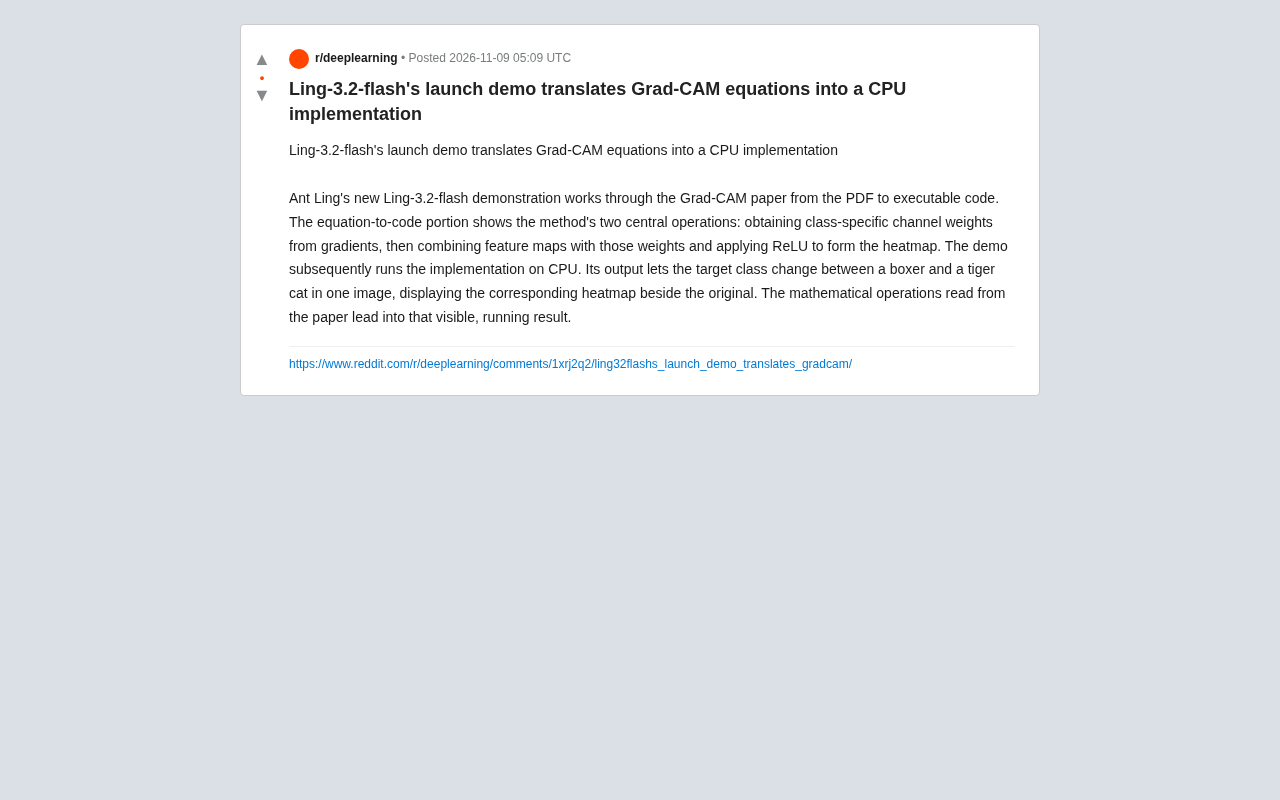
The value of this demo lies not in how strong the model itself is, but in the rare kind of "verifiability" it demonstrates: whether the formulas are understood correctly can be seen by simply running the code and glancing at the heatmap.
What the Demo Did: From Formulas to a Runnable Implementation
According to information shared in the Reddit community, the Ling-3.2-flash launch demo fully walked through the implementation path of the Grad-CAM paper: the model read the paper PDF content, identified the core mathematical operations of the method, and output the corresponding executable implementation.
The demo highlighted two key steps of Grad-CAM:
- Extracting class-relevant channel weights from gradients: compute the gradient of the target class score with respect to the feature maps, then perform global averaging over the spatial dimensions to obtain an importance weight for each channel;
- Weighted combination of feature maps and applying ReLU: use the weights from the previous step to perform a weighted sum of the feature maps, then apply ReLU to retain regions that positively contribute to the target class, forming the final heatmap.
These two steps are the core of what distinguishes Grad-CAM from ordinary CAM — no model architecture modification is needed; class activation maps can be generated using only gradients and feature maps. The demo accurately mapped these two mathematical descriptions to the code implementation.
The Mathematics Behind Grad-CAM: The core of Grad-CAM (Gradient-weighted Class Activation Mapping) is to compute the gradient of the target class score with respect to the feature maps of the last convolutional layer, then perform global averaging over the spatial dimensions for each channel's gradient to obtain channel weights (\alpha_k^c = \frac{1}{Z}\sum_{i}\sum_{j}\frac{\partial y^c}{\partial A_{ij}^k}), where (y^c) is the score for class (c), (A^k) is the (k)-th feature map, and (Z) is the total number of spatial locations. These weights are then used to perform a weighted sum of the feature maps and apply ReLU: (L^c = \text{ReLU}(\sum_k \alpha_k^c A^k)). The role of ReLU is to retain only regions that positively contribute to the target class, since negative values indicate that the region is negatively correlated with the class. This method requires no modification to the model architecture and needs only one forward and one backward pass to generate a heatmap, making it applicable to any CNN architecture.
Runs on CPU, Results Visually Verifiable
More noteworthy is that this implementation was then actually run on CPU. The demo output switched the target class on the same image: selecting "boxer" generated one set of heatmaps, and switching to "tabby cat" changed the heatmaps accordingly, displayed side by side with the original image.
This closed loop of "formula → code → visual result" constitutes a natural verification mechanism. If the formula translation were wrong — for example, if the dimensions for the weighted sum were mistaken or ReLU were applied in the wrong place — the heatmap would be clearly misaligned or fail. According to the Reddit post, the demo ultimately presented "the mathematical operations read from the paper leading to a visible, running result."
Running on CPU rather than GPU also sends a signal: this implementation does not depend on special hardware, and ordinary developers can directly reproduce and modify it.
Global Average Pooling and Broadcasting: In Grad-CAM, performing global average pooling (GAP) on gradients means averaging each channel's gradient over the spatial dimensions (height and width) to obtain a scalar weight. This operation reduces the gradient tensor from (C \times H \times W) to (C), where (C) is the number of channels. These weights then need to be multiplied with the feature maps. Since the weights are a vector of length (C) while the feature maps are a tensor of shape (C \times H \times W), broadcasting must be used to expand the weights to (C \times 1 \times 1) before channel-wise multiplication. Broadcasting is a common mechanism in libraries such as NumPy that allows arithmetic operations on arrays of different shapes, but it requires compatible dimensions. If the broadcasting dimensions are wrong in the implementation, the weights will be misaligned with the channels, and the heatmap will fail to correctly reflect the class's regions of focus.
Why This Demo Is Worth Noting
Large model demos usually focus on the fluency of generating text, writing code, or answering questions, but Ling-3.2-flash chose to showcase the complete chain of "read paper → write implementation → run and get results," touching on a harder dimension of code generation capability: accurate translation of mathematical semantics.
The Grad-CAM formulas are not complex, but they involve a combination of multiple operations such as gradients, global average pooling, broadcast weighting, and ReLU. Any semantic deviation in any step will be exposed in the final heatmap. This style of demo effectively places the model's comprehension ability under an executable, inspectable standard, which is more convincing than benchmark scores alone.
For developers, if this capability is stable, it means the first-draft stage of paper reproduction can be handed to the model, leaving developers to focus on debugging and optimization. However, a single demo is not enough to prove generalization ability — it showcases a selected classic method, and how it performs with more complex papers or longer formula chains remains to be further verified.
Mathematical Semantic Translation in Model Code Generation: Converting mathematical formulas into executable code requires the model not only to recognize symbols but also to understand their operational semantics (such as summation axes, broadcasting rules, and activation function placement). This involves accurately inferring the dimensional conventions and operation order implicit in the formulas. For example, the summation symbol in the Grad-CAM formula may omit the summation dimension, and the model needs to determine from context whether to sum over the spatial dimension or the channel dimension. Such tasks are more challenging than ordinary code generation because errors often surface only at runtime and domain knowledge (such as deep learning framework APIs) is needed for correct implementation. The demo shows that the model has some potential for such tasks, but complex formula chains or non-standard notation may still pose obstacles.
FAQ
What is Grad-CAM?
Grad-CAM is a method for generating class activation heatmaps. It uses gradient information to assign weights to feature map channels, allowing visualization of the model's regions of focus without modifying the model architecture.
Can this demo be used directly in my own project?
The demo runs on CPU, indicating a low barrier to implementation, but the demo itself is for launch presentation purposes; using it in an actual project still requires your own verification and adaptation.
What is Ling-3.2-flash?
Ling-3.2-flash is a version in Ant Group's Ling series of models, and this demo was one of the showcased items at its launch.
One-line Summary
In the Ling-3.2-flash launch demo, Grad-CAM paper formulas are translated into executable CPU code, with accuracy verified through heatmap visualization.
Paragraph Summary
At the launch of Ling-3.2-flash, the Ant Group Ling team presented a hardcore demo: the model reads the Grad-CAM paper PDF, identifies the core mathematical operations, and generates executable code. The demo fully presents the two core operations — extracting channel weights from gradients and weighted combining feature maps with ReLU — then runs on CPU, generating corresponding heatmaps by switching target classes (boxer and tabby cat), forming a closed-loop verification of "formula → code → visual result." This demo style places the model's ability to translate mathematical semantics under an executable, inspectable standard, making it more convincing than benchmark scores. However, a single demo cannot yet prove the model's ability to generalize to complex papers, and use in actual projects still requires independent verification and adaptation.
Related articles

MLSys 2027 Reviewers Haven't Received Paper Assignments Yet? Community Discussion Draws Attention
Reddit community discusses whether MLSys 2027 reviewers have received paper assignments. Reciprocal reviewers report no assignments yet, with attention on timelines and impact.

RTX 5060 Ti 16GB Flying Off Shelves: The New Darling of the AI Boom
Reddit buzzes as AI users snap up the RTX 5060 Ti 16GB. We analyze its VRAM edge, cost-performance, market impact, and the new trends in AI hardware demand.

Collapse AI-Generated PR Descriptions with details/summary
Simon Willison shares a practical trick: use the HTML details/summary tag to collapse verbose AI-generated PR descriptions, keeping only a short human-written intro. This article breaks down the operational details, the human-AI collaboration thinking behind it, and a mnemonic for the tag order.