Ling Medical Model Hands-On Test: General LLMs vs. Specialized Medical AI — Who Wins?

Side-by-side test shows specialized medical models beat general flagships on evidence integration and uncertainty expression.
A Bilibili creator used the same simulated checkup report and identical prompts to compare general flagship models (Claude Fable 5.2, GPT-6 Astra, Gemini 4 Neon) against Ant Group's Ling medical health model series. The evaluation covered metric interpretation, medical interpretation, and risk notification with weighted rankings; Lynx Santa 3.1 Flash VL scored 94.3 overall, 0.3 points above Claude Fable 5.2 — a small gap, but with an edge in data recognition and medical interpretation sub-items. The article further analyzes Air VL's multimodal and local deployment advantages, Flash's million-token context and complex reasoning, and the practical forms in the Ant Afu app (checkup report interpretation and video call follow-ups), concluding that the core value of specialized medical models is articulating what is known, what is unknown, and what to confirm next — not delivering seemingly definitive diagnoses.
As general-purpose large models iterate at breakneck speed, a more practical question surfaces: are they truly professional and reliable enough when dropped directly into medical and health scenarios? Bilibili creator Xiao Liu ran a side-by-side evaluation using the same simulated health checkup report and identical prompts, comparing general flagship models like Claude Fable 5.2, GPT-6 Astra, and Gemini 4 Neon against Ant Group's newly released Ling medical health model series (Lynx Santa 3.1 Air VL and Lynx Santa 3.1 Flash). The takeaway isn't simply "who scored higher" — it's about the differentiated value of specialized medical models in evidence integration, uncertainty expression, and interaction formats.
How the Test Was Done: One Checkup Report, Four Models, Same Questions
The starting point was an AI-generated simulated health checkup report containing examination data and imaging reports. The creator fed the same material and the same set of prompts to four models, asking each to produce a Markdown-formatted interpretation report, then aggregated the results and used DeepSeekAd for visual comparison.
Evaluation dimensions covered key areas such as metric interpretation, medical interpretation, and risk notification, with eight weighted items calculated to produce an overall ranking. For access, the creator used OpenCode as an example, created an API Key on Ant Group's Suke large model platform, connected each model, and completed the comparison by switching between them.
This "same questions, same material" design makes differences easier to expose: when facing the same abnormal metric, simply telling you it's "high" or "low" is only a preliminary interpretation; the real help for ordinary users shows up when the model can explain possible causes by combining other metrics, while also clarifying which aspects remain uncertain.
Small Model, Big Capability: Air VL's Multimodal and Local Deployment Advantages
The first model featured was Lynx Santa 3.1 Air VL. According to the creator, it has roughly 124B total parameters with about 5.5B activated per token — a small-scale parameter model — yet with outstanding multimodal capability, supporting understanding of text, images, and video, and deployable on laptops and local devices.

In medical scenarios, multimodal understanding matters because checkup reports are often images or scans: the model must not only read the text but also understand the report layout and medical imaging information. Air VL's positioning here is precisely to solve the entry problem of "handing the report image directly to the model."
In the overall ranking, 3.0 Flash VL scored 94.3, 0.3 points higher than Claude Fable 5.2. The creator admitted this gap isn't large — after all, the competitor is also a top-tier model — but on sub-items like data recognition and medical interpretation, the Ling model performed slightly better, and its scoring precision was corroborated on public test sets, with self-test results differing little.
MoE Architecture and Activated Parameters: The phrase "roughly 124B total parameters with about 5.5B activated per token" describes a Mixture of Experts (MoE) architecture. MoE splits a model into multiple "expert" subnetworks, and during each inference a gating network activates only a small subset of parameters for computation. Total parameter count determines the model's knowledge capacity, while activated parameter count determines the compute cost of a single inference. 124B total parameters paired with 5.5B activated means the model has a knowledge base at the tens-of-billions scale, but only consumes the computation of about 5.5B parameters at runtime, making deployment on laptops and local devices feasible. This design is especially valuable in medical scenarios: institutions can keep the full model weights locally to process sensitive health data while maintaining acceptable response speed.
The Significance of Multimodal Understanding in Medical Reports: Medical multimodal models must do more than OCR text recognition — they also need to understand the report's spatial layout (such as the correspondence between metrics and reference ranges, and table structure) as well as the visual features of medical imaging. The traditional pipeline converts images to text first and then hands them to a language model, during which layout and imaging information is largely lost; an end-to-end multimodal model encodes the image directly, preserving cues like metric positions, arrow directions, and imaging grayscale. This is the technical prerequisite that makes "handing the report image directly to the model" viable.
The Flagship Enters: Flash's Complex Medical Reasoning and Million-Token Context
In the difficulty-escalation segment, the creator focused on the Ling flagship model Lynx Santa 3.1 Flash, with total parameters reaching 562B. Its context reaches one trillion — meaning it can ingest up to 1 million context tokens — so beyond the checkup report PDF, additional medical history information can be supplemented.

The challenge in this round: many symptoms look unremarkable on their own, but when analyzed together with other results, the direction may change. So what the creator watched for was whether the model grasped key clues, whether it could distinguish supporting evidence from uncertain information, and whether the medical references cited were reliable and authentic.
In the creator's view, for complex medical questions this matters more than directly giving what looks like a definitive diagnosis — what's valuable isn't immediately telling you the answer, but helping you clarify what is currently known, what remains unknown, and what needs confirmation next. This is precisely the most noteworthy aspect of specialized medical reasoning models, and Ling still ranked among the top across different scoring rounds.
The Technical Meaning of Million-Token Context: The context window refers to the total number of tokens a model can read simultaneously in a single inference. One million tokens is roughly equivalent to hundreds of thousands of Chinese characters or hundreds of pages of PDF — enough to hold a complete checkup report, past medical history, medication records, and multiple lab sheets. The key challenge of long context isn't just "fitting it all in" but whether the model can stably retrieve and associate distant information within long text — for example, linking a metric from three months ago to the current abnormality. This depends on the effectiveness of the attention mechanism and the quality of long-text data during training, and it's an ability easily overlooked when evaluating medical reasoning models.
Evidence Grading and Uncertainty Expression: Evidence-based medicine emphasizes levels of evidence: randomized controlled trials, cohort studies, and expert consensus decrease in credibility in that order. A specialized medical model should, during reasoning, distinguish conclusions "supported by clear guidelines" from those "backed only by scattered case reports," and flag uncertainty for the latter. The emphasis in the article on "distinguishing supporting evidence from uncertain information and citing reliable medical references" essentially requires the model to implicitly perform evidence grading in its output, rather than presenting all inferences with the same tone of certainty.
From Testing to Daily Use: Health Features in Ant Afu
Model capabilities ultimately need to reach ordinary users. In the Ant Afu app, tapping "Check Health" and uploading a checkup report lets the AI help interpret metrics and continue answering questions about anything unclear, so once-hard-to-understand checkup issues can be viewed and discussed intuitively.
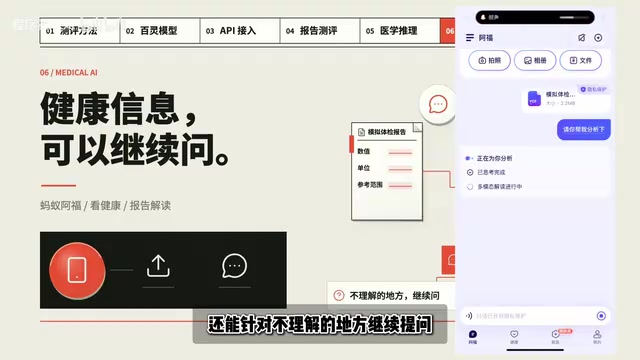
The creator's favorite feature — video calling — reflects a different interaction philosophy: when symptoms are unclear or hard to describe, open a video call and let Afu analyze based on the visuals, and if information is insufficient the AI can ask further questions rather than stopping at a single frame or answer. This is the kind of experience multimodal models like Lynx Santa Live aim to deliver — moving from text Q&A toward more natural, continuous interaction. Of course, what it provides remains auxiliary health information and advice, and cannot replace a doctor's diagnosis.
Where the Value of Specialized Medical Models Lies
After several rounds of testing, the creator's biggest takeaway: although general flagship models are already very strong, the medical and health field demands higher professional standards — not only understanding medicine but also integrating evidence for accurate analysis and being aware of its own limitations. Ling's product division confirms this: Air VL strengthens multimodal medical understanding, Flash strengthens complex medical reasoning, and combined with open-source and local deployment capabilities, it offers more possibilities for doctors and medical institutions.
From checkup report analysis to complex case reasoning, and on to Afu's health features, specialized medical AI is moving toward real-world application. What must be clearly understood is that AI cannot replace doctors; its value lies in clearly articulating "what is known, what is unknown, and what to confirm next," making health information genuinely understandable and open to follow-up questions.
Related articles

MIT PhD Takes You from Scratch to Build DeepSeek: A 25-Hour Hardcore Course
MIT PhD Raj Dandekar launches a 25+ hour Bilibili course building DeepSeek from scratch—MoE, MLA, GRPO, hand-written code plus math derivations, aiming to reproduce mini R1.

DeepSeek Harness in Practice: From Installation to Plugin Ecosystem, Building a Fully Automated AI Workflow
Based on a hardcore Bilibili tutorial, this guide systematically covers DeepSeek Harness installation, three plugin installation methods, and real-world use cases to help developers quickly build customizable AI Agent workflows.

DeepSeek Harness in Practice: From Installation to Automated Workflows
Hands-on DeepSeek Harness tutorial covering Mac/Windows installation, login, workspace binding, model & permission setup, and minimal closed-loop verification for AI automation workflows.