Ling Tiny 3.0: How an 8B Small Model Brings AI to a 2017 Laptop

Ling 3.0 Tiny's MoE architecture lets a 2017 laptop run AI at 10 tokens/sec with no GPU.
A Reddit user ran Alibaba's Ling 3.0 Tiny on a 2017 laptop (7th-gen i5, 8GB RAM, no GPU) using llama.cpp, achieving ~10 tokens/sec and completing a multi-turn coding task. The key: its MoE architecture activates only 1B of 8B total parameters per inference, dramatically cutting compute needs. Combined with Q6 quantization fitting the model into 8GB RAM, this experiment reveals an AI democratization path that requires zero new hardware — existing devices worldwide could quietly gain the ability to handle lightweight intelligent tasks.
A Old Laptop That Redefines Edge Intelligence
A Reddit user experimenting with Alibaba's Ling 3.0 Tiny model arrived at a thought-provoking conclusion: true AI democratization may not come from more powerful GPUs, but from smaller, smarter models.
Ling 3.0 Tiny is a Mixture of Experts (MoE) model with 8 billion total parameters but only 1 billion active parameters per inference. Rather than using an expensive GPU cluster, this user ran it on a 2017 laptop — equipped with a 7th-gen Core i5, 8GB of RAM, no discrete GPU, and no VRAM. By today's standards, that configuration barely handles modern everyday tasks smoothly.
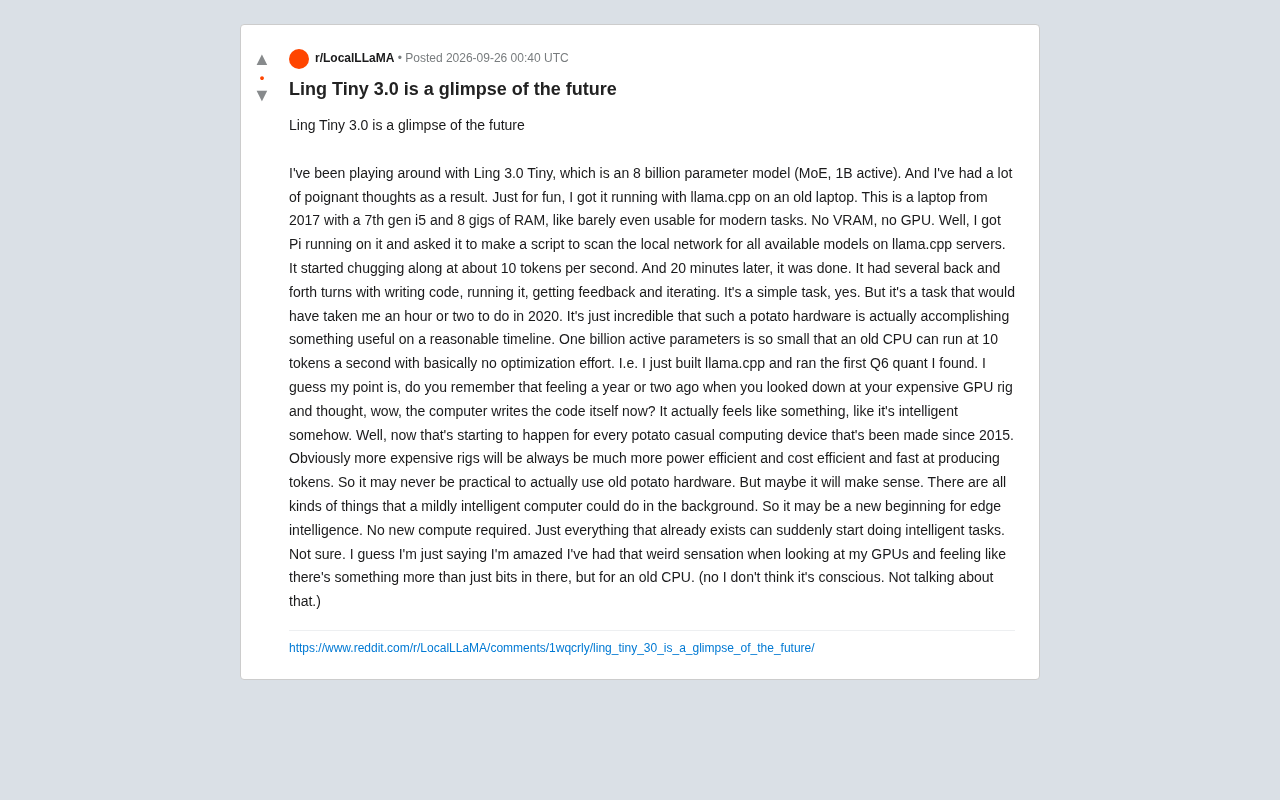
The result was surprising. Using a Q6-quantized version found casually online and running it via llama.cpp with zero special optimization, the model ran steadily at roughly 10 tokens/second.
Getting a Real Programming Task Done on an Old CPU
The user assigned the model a practical task: write a script to scan the local network for all available models running on llama.cpp servers.
The entire session lasted about 20 minutes. The model went through multiple rounds of interaction — writing code, running it, receiving feedback, and iterating on fixes. It wasn't a trivial task; it required a closed-loop reasoning and self-correction workflow, not just a simple one-shot Q&A.
In the user's own words: "This is a task that might have taken me an hour or two back in 2020." Today, a machine that struggles to run a modern browser managed to complete it independently using pure CPU in a reasonable timeframe.
The key is that only 1 billion parameters are active at any given time. The MoE architecture allows the total parameter count to reach 8B to preserve capability headroom, while only activating a small fraction during each inference — dramatically reducing real-time memory and compute requirements. This is the technical reason an old CPU can sustain 10 tokens/second.
The MoE (Mixture of Experts) architecture is key to understanding this performance. Traditional dense models activate all parameters on every inference pass, while MoE models split the network into multiple "expert" sub-networks. A lightweight "router" dynamically selects a few experts to handle each input during the forward pass. In Ling 3.0 Tiny's case, 8B total parameters are distributed across multiple expert modules, but only ~1B are activated per inference — meaning the actual compute load is equivalent to a 1B dense model, while the model's overall knowledge capacity and task ceiling approach the 8B level. This design offers two direct benefits: memory bandwidth pressure drops significantly, so the cache and memory bus of an aging CPU don't become major bottlenecks; and floating-point operations (FLOPs) are substantially reduced, allowing ordinary processors without vector acceleration units to maintain usable inference speeds.
From "Intelligence Lives in the GPU" to "Every Old Device Has Intelligence"
What resonated most in the original post was the feeling it described.
The author recalled the near-awe he felt a year or two ago, watching his expensive GPU rig and realizing "the computer is writing code by itself" — as if some form of intelligence truly resided within those bits (he was careful to note he wasn't talking about consciousness).
Now, that same experience is trickling down to every "potato-tier" device manufactured since 2015. No new hardware investment required. The vast sea of already-existing old computers and laptops could suddenly become capable of executing intelligent tasks.
Q6 quantization (6-bit quantization) is the other key technology that made it possible to fit the model into 8GB of RAM. The core idea is to compress model weights from the 32-bit or 16-bit floating-point values used during training into lower-precision integer or fixed-point representations. Q6 means each weight is stored in 6 bits — saving roughly 62% of memory compared to FP16 — with typically acceptable precision loss. For a MoE model with only 1B active parameters, the Q6-quantized file size can be kept to a few gigabytes, small enough to fit in 8GB of system memory with room to spare. llama.cpp, as an open-source inference framework optimized specifically for CPU execution, natively supports multiple quantization formats and includes low-level optimizations targeting AVX/AVX2 extensions on x86 — making it one of the most widely used tools for running local large models on consumer hardware.
A New Starting Point for Edge Intelligence — Or Just a Theoretical Possibility?
The author kept a realistic perspective on practicality. He acknowledged that more expensive hardware will always hold an advantage in energy efficiency, cost-per-token, and raw generation speed — so in practice, most people won't actually bother running inference on aging hardware.
But viewed from another angle, many tasks don't demand peak performance. A computer with "just a little intelligence" can quietly handle mundane work in the background — local network management, file organization, simple automation scripting, and so on. For these low-frequency, non-real-time tasks, being able to run at all is enough; speed is a secondary concern.
This may mark a new starting point for edge intelligence: no new compute needed — letting every device that already exists naturally acquire the ability to handle intelligent tasks.
What the Small-Model Trend Signals
Beyond the romantic story of this old laptop, Ling 3.0 Tiny reflects an important technical trend: small-parameter MoE models are rapidly approaching the threshold of practical utility.
Over the past two years, the industry's attention has been focused on flagship models with hundreds of billions of parameters. But what will actually determine whether AI can penetrate everyday devices are efficient models like this one — with minimal active parameters, yet still capable of multi-turn reasoning and code generation. When 1B active parameters are enough to complete a meaningful closed-loop programming task, the hardware barrier for AI deployment is fundamentally rewritten.
It's worth noting that this article is based on a single Reddit user's hands-on report — a personal observation — and specific performance results will vary depending on the quantization version, task type, and hardware. But the directional signal it sends is worth paying attention to: the democratization of intelligence may not come from stacking more hardware, but from making models smaller and smarter.
Related articles

Chain of Thought Isn't Just for AI: How Humans Can Use CoT to Improve Thinking Quality
Chain of Thought isn't just a prompt trick for large models. Starting from a Hacker News discussion, this article analyzes why CoT works for human thinking too, breaks down actionable ways to transfer it, and highlights the key differences between human CoT and machine CoT.
Cloudflare Teams Up with OpenAI: Closi…
Cloudflare Teams Up with OpenAI: Closing the Loop from Vulnerability Discovery to Defense with AI
Cloudflare uses OpenAI Daybreak to investigate security vulnerabilities and generate reviewable remediation plans, while developers use Codex to boost coding efficiency and quality.

Orca Multi-Agent Orchestration in Practice: A Guide to Parallel Collaboration with Claude and Codex
Orca is Stable AI's free open-source agent workbench supporting 34 agents like Claude Code and Codex in parallel. Learn its Git worktree isolation, multi-model orchestration, and mobile management.