Link.bio: Paste a Link, AI Builds Your Personal Page in Seconds and Runs It Automatically

Link.bio uses AI to generate and continuously host link in bio pages from social links, challenging Linktree.
Link.bio launched on Product Hunt with a "paste your link, AI builds and runs your page" pitch. Paste an Instagram, TikTok, YouTube, or website link, and AI generates your bio, button copy, and theme colors in seconds—no blank canvas or templates needed. Unlike Linktree, it emphasizes automation over fine control, and pages can be conversationally edited via ChatGPT or Claude. But the product is early-stage, and questions remain about AI output quality and control boundaries.
From Link to Homepage, AI Handles It All
Link.bio launched on Product Hunt with the tagline "Paste your link, we build your page. Your AI runs it." It targets a long-standing pain point: social media creators need a personal homepage that aggregates all their entry points, but building the site, writing copy, and tweaking styles often takes time and effort. Link.bio's approach is to let AI start from your existing public links and generate a complete link in bio page in one step.
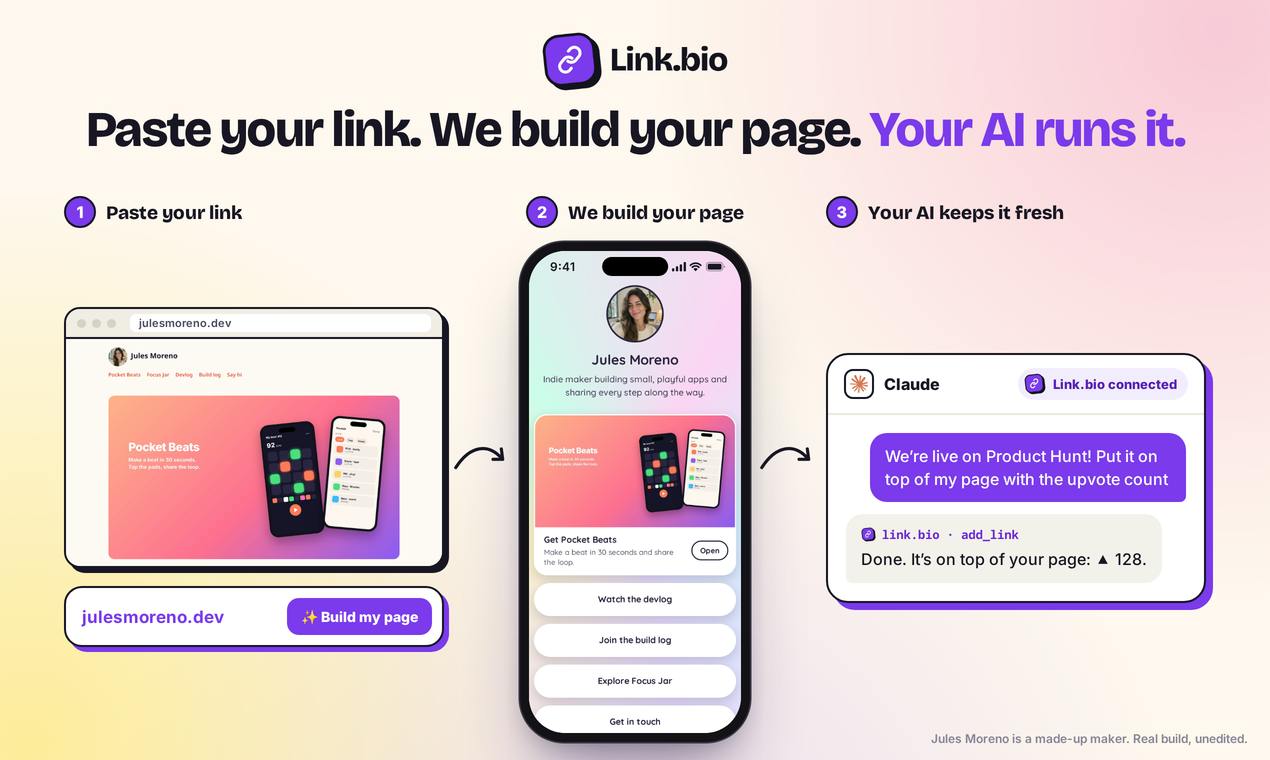
The workflow is minimal: paste your Instagram, TikTok, YouTube, or personal website link, and AI writes your bio, button copy, and theme colors within seconds, generating a shareable link.bio page. Users don't need to start from a blank canvas or apply cookie-cutter templates. According to the Product Hunt page description, the entire generation process is automated, and after receiving the result, users can make fine adjustments or directly ask ChatGPT or Claude to continue modifying it.
A link in bio page refers to the aggregated homepage that the single clickable link in a social media profile points to. Since platforms like Instagram and TikTok typically limit users to one clickable link, creators consolidate multiple entry points (other social accounts, portfolios, product pages, subscription channels) onto a single page—this page is the link in bio. It's essentially a lightweight personal navigation site, with the core goal of letting fans find the creator's other content or commercial entry points with minimal clicks.
Key Differentiator: After the Page Is Built, AI Keeps Running It
Most link in bio tools stop at "generating a good-looking page." Link.bio's selling point is "Your AI runs it"—the page is continuously operated by an AI agent rather than being a one-time product. This means routine maintenance like editing bios, adjusting buttons, and changing themes can all be handled by AI, so creators don't need to log into a backend to edit manually.
This design philosophy upgrades AI from a "site-building assistant" to a "page manager." For creators who run multiple platforms and frequently update content, reducing backend operations is itself an efficiency gain. Link.bio supports conversational page adjustments through ChatGPT or Claude, bringing the natural language interaction capabilities of AI coding assistants into website editing and lowering the barrier for non-technical users.
The difference between an AI agent and ordinary conversational AI is that an agent can autonomously plan and execute multi-step operations given a goal, rather than merely answering single-turn questions passively. In Link.bio's context, "AI runs it" means the agent can receive instructions like "update the bio" or "change the theme" and complete the page modifications on its own, without the user clicking through backend forms item by item. This model turns AI from a one-time generation tool into a continuously running service provider, but it also requires the product to clearly define the boundaries of the agent's operational permissions—otherwise users may lose precise control over their pages.
Comparison with Existing Solutions: Who Should Use Link.bio
Established link in bio tools like Linktree have built mature template ecosystems and data analytics capabilities, giving users a high degree of freedom for manual configuration. Link.bio chooses to compress the configuration process with AI: paste the link, and the page structure and copy are generated automatically.
The trade-offs differ. Users who need precise control over brand visuals and deep integration with e-commerce or analytics tools are still better served by traditional tools; while creators who just want to quickly launch a decent homepage and don't want to repeatedly debug in a backend will find Link.bio's automated path more hassle-free. One detail: Link.bio is still in its early stages, with 65 upvotes, 4 comments, and a ranking of 17th on Product Hunt. Community discussion is limited, and the product's maturity and long-term stability remain to be seen.
Linktree is the most representative product in the link in bio category. Founded in 2016, it has built a relatively complete ecosystem through templates, analytics dashboards, and e-commerce/payment integrations, with users primarily relying on manual drag-and-drop and configuration. Its strength lies in controllability and data insights, making it suitable for brands and creators who treat their personal homepage as a formal traffic entry point. The difference between Link.bio and Linktree isn't about feature count but about interaction paradigm: the former compresses configuration costs with natural language and automatic generation, while the latter preserves fine-grained control through visual editing. Understanding this divide helps determine which type of tool suits which audience.
Potential and Open Questions
AI-generated bios and button copy sound convenient, but the results depend on how well the AI understands your personal brand. If the output is too templated, users will still need extensive manual adjustments, and the "instant build" experience will be diluted. Link.bio lets users continue modifying pages with ChatGPT or Claude, which essentially outsources the refinement step to general-purpose AI assistants—this may bring issues like inconsistent style or misinterpreted instructions.
Another unverified point is the boundary of "AI operations." After the page is built, what content can AI automatically update, what triggers updates, and how much control users retain—these details aren't elaborated in the Product Hunt introduction. For creators who treat their personal homepage as an important traffic entry point, the balance between control and automation is crucial.
Link.bio represents an emerging category of tools: AI doesn't just generate content but continuously hosts a digital asset. Whether it can gain a foothold in territory dominated by mature products like Linktree depends on whether AI generation quality can consistently reach the level of "almost no edits needed."
One-line Summary
Link.bio uses AI to generate and continuously host link in bio pages from social links with one click, challenging Linktree.
Paragraph Summary
Link.bio launched on Product Hunt, featuring "paste your link, AI generates the page, and AI keeps running it." Users simply paste an Instagram, TikTok, YouTube, or personal website link, and AI generates a bio, button copy, and theme colors within seconds, eliminating the hassle of building from scratch or applying templates. Compared with traditional tools like Linktree, Link.bio emphasizes automation over fine-grained control, and after the page is generated, it can be conversationally modified through ChatGPT or Claude, reducing backend operations. However, the product is still early-stage with limited community discussion, and key questions remain: whether AI generation quality can reach "almost no edits needed" and how to define the control boundaries of AI operations.
Related articles

Prompt Engineering for Beginners: From Writing Prompts to Engineering Thinking
Starting from the essence and four functions of prompts, this article systematically explains the six-step process, four success criteria, learning value, and practical limitations of prompt engineering to help you build a complete understanding.

Anthropic Launches Nasdaq IPO: AI Giant's Listing and Risk Disclosures
Anthropic officially launches its Nasdaq IPO under ticker ANT, with market valuation expected to potentially exceed SpaceX's record. The prospectus devotes nearly 100 pages to AI risks, while first-half revenue grew over 14x but net losses widened sharply, reigniting the AI bubble debate.

Rust cURL Clone Uses 4,832 unsafe Blocks—Is the Memory Safety Myth Broken?
A Rust cURL clone uses 4,832 unsafe keywords, challenging Rust's memory safety narrative. We analyze what unsafe really means, compare Fil-C, and examine rewrite motives.